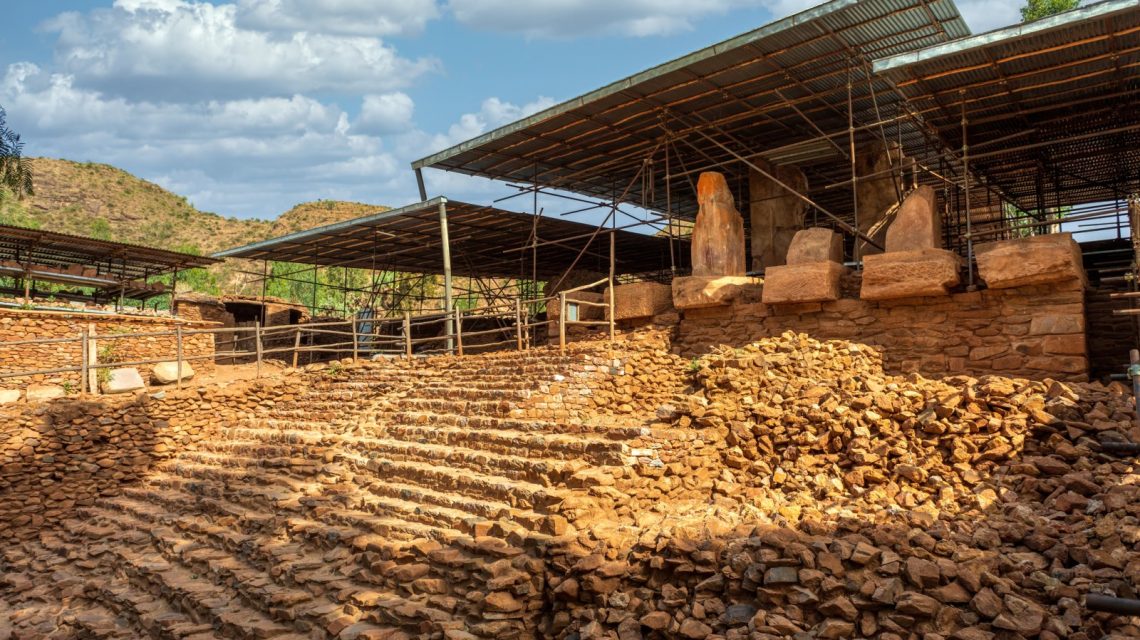
Recent research has unveiled remarkable insights into an ancient palace in Ethiopia that dates back roughly 2,800 years. This grand structure is thought to have reached significant heights, potentially comparable to today’s skyscrapers. The investigation was jointly conducted by the German Archaeological Institute and Brandenburg University of Technology Cottbus-Senftenberg, focusing on the Grat Be’al Gibri palace in the highlands of Ethiopia and Eritrea.
The palace, the largest known of its kind in the region during its era, originally spanned a floor area of about 60 by 60 meters (around 196 feet). Official statements from BTU suggest that destruction by fire occurred in antiquity, with only parts of the ground floor and podium visible today.
This ancient structure utilized rubble masonry set with clay mortar. Horizontal timber beams reinforced the construction, confirmed by Professor Davide Tanasi, a classical archaeologist at the University of South Florida. The recent study leveraged advanced technology to create a virtual 3D model of the palace’s wall sections. The finite element method (FEM) was employed to analyze the load-bearing capabilities.
Historian Kwasi Konadu noted that these simulations demonstrate the significant load-bearing capacity of the palace’s construction techniques. This suggests that the architectural system was more advanced than the surviving ruins indicate.
This architectural system was more capable than what the surviving ground floor suggests.
Historically noted by Arab historians and depicted in South Arabian carvings and paintings, the structures of the time were believed to have multiple floors. The recent study provided substantial engineering evidence to support these claims. According to Tanasi, the findings quantitatively assess a sophisticated ancient construction system. The research indicates that the structure could support up to 19 floors in load-bearing capacity, challenging existing assumptions about ancient construction expertise.
A wall carrying 19 floors is not the same as a structure that stood 19 floors high.
Both Tanasi and Konadu urged caution in labeling the palace a skyscraper by modern definitions. The 19 floors refer to the structural load capacity theoretically supported rather than physical stories. This research questions older narratives that consider neighboring regions as the engineering source for such systems. It affirms that local traditions in architecture and engineering have long existed in the area.
Konadu emphasized that African builders adeptly calculated height, materials, and load capacities 3,000 years ago. Tanasi views the findings as an expansion of understanding, diverging from the traditional focus on civilizations like Egypt, Mesopotamia, Greece, and Rome.
Martin Drieschner, chair of structural analysis and dynamics at BTU, highlighted that modern engineering methods, such as FEM, have proven effective when applied to historical structures, illustrating the power of numerical simulation beyond traditional uses.
 Ancient Roman Artifacts Discovered Off Sardinia’s Coast
  Roman Empire’s Road Network Study Challenges ‘All Roads Lead to Rome’
  Reflections on September 11: A New Yorker’s Perspective
  Ancient Ring Sparks Debate Over Connection to Pontius Pilate
  Confederate Statues and Historical Context
  Significant Historical Events in Chicago on September 3