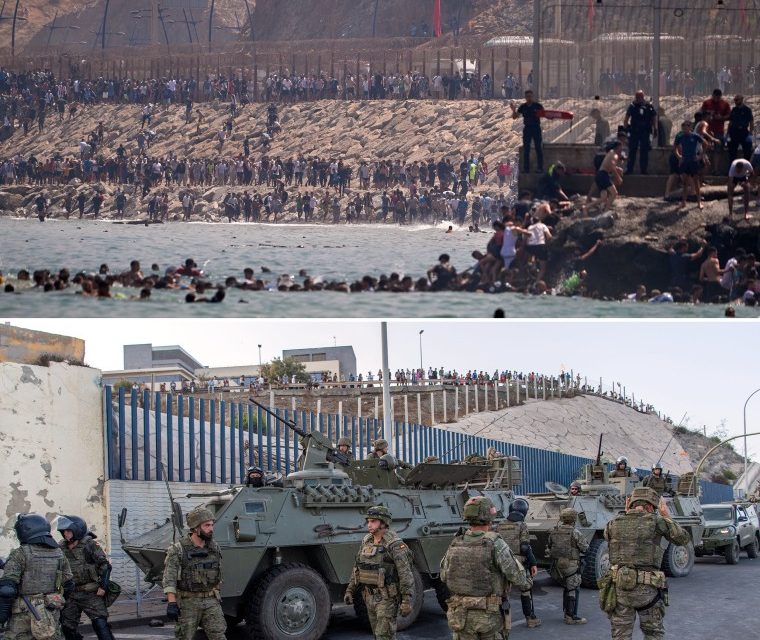
At least 18 migrants lost their lives during an attempt to reach the Spanish territory of Ceuta. Thousands breached the border with Morocco, leading to chaos in the area.
The crisis unfolded on Thursday and persisted overnight. Spain’s state broadcaster, RTVE, aired images showing burned vehicles on the Moroccan side, following clashes.
Rachid Sbihi, who heads a local workers association representing Civil Guard officers, described the situation as a ‘serious humanitarian crisis.’ Thousands of migrants, including unaccompanied minors, slept in public spaces, while others wandered the streets.
More people continue to enter, with army reinforcements assisting in humanitarian efforts.
Spain deployed army soldiers to Ceuta in response. Spanish Prime Minister Pedro Sánchez plans to join Interior Minister Fernando Grande-Marlaska for a Ceuta visit on Friday morning.
According to the Interior Ministry, an estimated 49,000 migrants crossed into Ceuta in the last 24 hours. Many of the deceased drowned, while others were trampled during a rush to cross the breakwater fence at Tarajal beach.
Video footage depicted large groups, mostly Moroccans, moving near the breakwaters onto local roads. Although mainly young men, families with women and children were also present. Some shouted ‘Viva España!’ to photographers working for The Associated Press.
During the transition from late Thursday into Friday, people gathered on the Moroccan side attempted entry into Ceuta. Some also tried returning to Morocco from Ceuta.
Moroccan authorities have remained silent on the crossings, with no response from the Interior Ministry to inquiries.
The reasons for this mass crossing remain unclear. Spain serves as a principal entry point into Europe for migrants seeking economic opportunities or fleeing violence. Many attempt the swim from the Moroccan town of Fnideq to Ceuta, a journey of about three miles. Others take a shorter route from Belyounech.
As chaos ensues at the Spain-Morocco frontier, Italy faces effects too. Premier Giorgia Meloni threatened to suspend Italy’s open-border Schengen agreement to protect its borders and ensure safety.
Ceuta authorities attribute the increase in crossings to a Spanish Supreme Court decision that bars the immediate return of sea-arriving migrants without due process. This ruling does not apply to land entries.
However, some Moroccan activists doubt that this ruling influenced the surge, believing most migrants were likely unaware of such legal decisions.
Juan Jesús Vivas, the head of Ceuta’s regional government, called for emergency status on national security grounds. He requested more police and army presence to maintain border security and citizen safety.
Reception centers in Ceuta have struggled to cope since Wednesday, with hundreds sleeping on the streets.
Though the Interior Ministry has not confirmed the number of migrants reaching Ceuta recently, it plans to publish a migration report on Aug. 3.
Spain’s legislation on national emergencies does not classify migration as a national security threat. However, government bodies are cooperating to address Ceuta’s situation effectively.
Ceuta, a Spanish possession since 1580, locates on a historic isthmus. Its diverse population, consisting of Christians, Muslims, Spanish, and Moroccan residents, usually live peacefully. Nonetheless, many migrants from Africa attempt to cross its border in pursuit of a better life in Europe.
 U.N. General Assembly Set to Host Key Diplomatic Moment
  Suspects in Haitian President’s Assassination Await Extradition to U.S.
  Ambassador Avoids Timeline on Prolonged Iran Conflict
  Controversy Surrounds Children’s YouTube Star and Journalist’s Revelations
  German Chancellor Friedrich Merz Faces Challenges After Election Losses
  Trump’s Approach to Iran at the United Nations