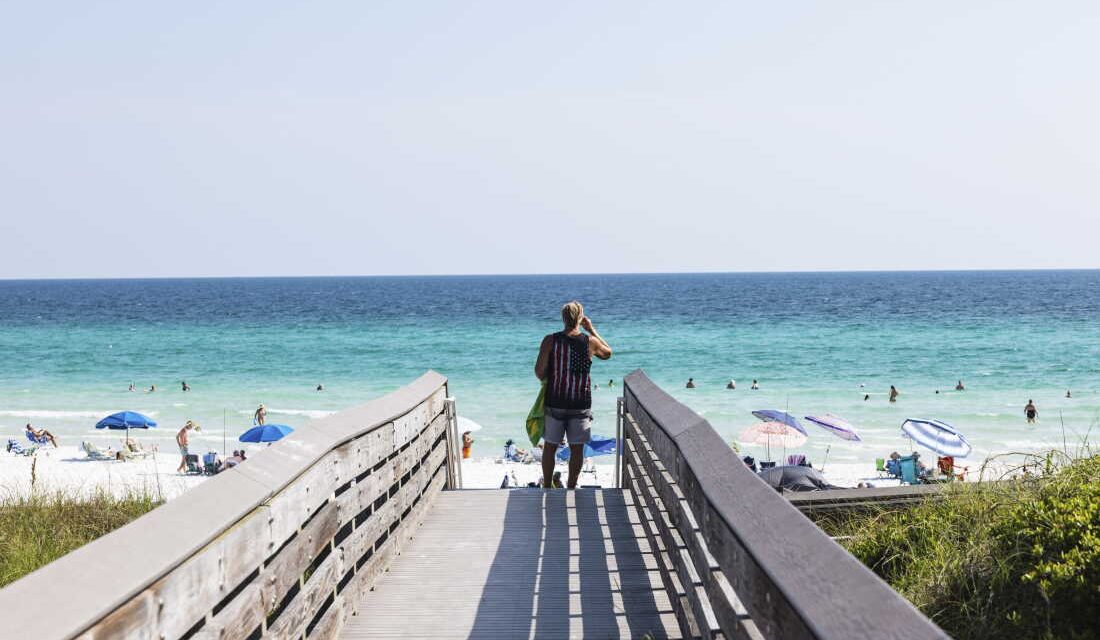
A beachgoer walks along the boardwalk at Ed Walline Regional Beach Access in Santa Rosa Beach, Florida. This area of the Gulf Coast has become a central point in a dispute between private property rights and public beach access.
Walton County, known for its 26 miles of shoreline and luxurious beach towns like Seaside, WaterColor, and Alys Beach, along state Scenic Highway 30A, is famous for its emerald waters and fine white sand. This location has become the focal point for a long-standing battle over property lines and public access to beaches. Efforts by the county to maintain public access have failed, and conflicting state laws and lawsuits from landowners have created a confusing situation for beachgoers.
Florida residents are considering a constitutional amendment to resolve the issue and alert other areas that may experience the same situation. Dave Rauschkolb, founder of the nonprofit Florida Beaches for All, advocates for shared beaches. As he walks the boardwalk leading to public beach areas between expensive Gulf-front homes, he points out signs restricting access.
Security guards, employed by adjacent property owners, are stationed to prevent beachgoers from entering private areas. Rauschkolb, who owns Bud & Alley’s restaurant in Seaside, insists on open beaches. He argues for the right of people to access public areas and stroll across any beach with chairs and umbrellas.
Homeowners like Eric Wilhelm from Georgia argue that open access violates their constitutionally protected rights. Wilhelm, who enjoys his property’s seclusion and development, views unrestricted access as chaos. With private security and surveillance cameras, he has reported trespassers to authorities.
The conflict escalated when Walton County attempted to apply a customary-use ordinance, granting public access to traditionally used recreational beaches. Politically connected homeowners objected, leading to a 2018 Florida law requiring legal action for public access claims. Attorney Kent Safriet, representing landowners, contends that customary use clashes with the Fifth Amendment.
Under public pressure, the Florida Legislature repealed the 2018 law, but Walton County had already reached a settlement with landowners. Ambiguity remains, placing Walton County Sheriff Michael Adkinson Jr. in a challenging position.
Adkinson notes the difficulty in defining property boundaries and emphasizes negotiation to resolve beach disputes. He cites attempts to lower tensions without making arrests.
Eric Wilhelm, along with other property owners, views public use of private lands as resembling communism. He has engaged in legal battles, including countersuits against beach visitors on his property. High-profile cases, like those involving Backstreet Boys member Brian Littrell, accentuate the conflict.
Sara Day, a beach activist, focuses on identifying public beach boundaries with the app Shoreline Defender, designed to locate the mean high-tide line. After being stopped by security guards herself, Day emphasizes staying informed to prevent trespassing. She notes mounting conflicts in other Florida regions, prompting grassroots efforts for constitutional changes to ensure beach accessibility.
Local real estate agent Linda Miller outlines the impact on property sales, as access concerns deter potential buyers. She acknowledges both owners’ desire for privacy and public needs, suggesting developments including beach sharing and sand relocation projects.
Advocates like Rauschkolb seek statewide resolutions through constitutional amendments to secure public beaches, citing similar protections in other states like Oregon and Texas.
 Python Hunter Helps Capture Record-Breaking Snake in Puerto Rico
  Environmental Concerns Halt Tree Removal at East Potomac Golf Links
  West Virginia’s Nuclear Proposal Faces Local Opposition
  Texas Data Centers Face Criticism Over Water Use Reporting
  First Offshore Mining Lease Sale by U.S. Government
  Unseasonal Warmth Delays Fall Foliage and Brings Impacts