
Sen. Bernie Sanders, I-Vt., did not express regret during a Sunday appearance on CBS’ “Face the Nation” over his initial endorsement of former Maine Democratic Senate hopeful Graham Platner. Platner withdrew from the race after a sexual assault accusation from a former girlfriend, which he denied. Sanders had urged Platner to exit the race, joining calls from many of his supporters.
Host Margaret Brennan questioned Sanders on whether earlier intervention might have benefited Platner’s replacement, former Maine Senate President Troy Jackson. Sanders replied, “No, I don’t think so,” emphasizing his quick action once becoming aware of allegations against Platner. “When we heard the serious allegations made against him, I wanted to get on the phone. I wanted to talk to him. I did. I asked, along with virtually all his supporters, that he should get out of the race, and he did,” Sanders stated.
Brennan further asked Sanders about the vetting process for candidates he backs. Sanders acknowledged the large number of candidates involved, stating, “Well, look, I think, you know, there are hundreds of candidates. I don’t know who has been, quote unquote, fully vetted.” He affirmed that he supports candidates advocating for the working class.
Throughout Platner’s campaign, Sanders maintained his endorsement despite controversies surrounding Platner. These included offensive social media activity, a Nazi-linked tattoo, abusive conduct allegations, and exchanges of explicit messages with women during his marriage. Platner apologized for some posts but denied engaging in serious misconduct.
In June, when questioned about reconsidering his endorsement after reports of explicit messages, Sanders firmly responded, “Certainly not.” Platner withdrew from the U.S. Senate race following pressure from Sanders and other supporters after a sexual assault allegation, which Platner denied.
With Platner’s exit, Maine Democrats nominated Jackson by a 566-5 delegate vote on Saturday, allowing him roughly 100 days to challenge Republican Sen. Susan Collins, who seeks a sixth term. Prior to Jackson’s nomination, concerns arose regarding his rushed vetting, including questions about his abortion stance, temper, workplace behavior, and mortgage records.
A Democratic strategist noted the brevity of Jackson’s vetting process, describing it as “a bit of a rocket vetting process.” Additionally, a Republican lawmaker questioned the legitimacy of Jackson’s nomination within state election law.
The situation in Maine reflects larger tensions between progressive factions and establishment-backed candidates within the Democratic Party. Former Chicago Mayor Rahm Emanuel cautioned in a Wall Street Journal opinion article that “Bernie Bros” might harm Democrats by supporting candidates with unpopular views.
Sanders addressed Emanuel’s critique, highlighting ideological and financial divides within the party. “There is a strong division within the Democratic Party,” Sanders stated, contrasting establishment figures like Emanuel who rely on wealthy donors, with progressives gaining traction nationwide.
For more insights on media and culture, visit our website.
 German Chancellor Friedrich Merz Vows to Continue Amid Election Losses
  Nikole Hannah-Jones Reflects on School Choice and Its Impact
  Republican Senator Criticizes Trump’s $5,000 Check Proposal
  Trump’s Approach to Iran at the United Nations
  Trump’s Triumphal Arch Controversy
 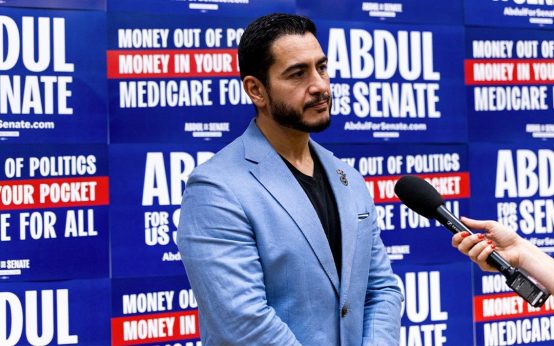 Concerns Over Abdul El-Sayed’s Potential Senate Role and National Security