A decade ago, on the first day of biology class at Trinity Christian College, Andrew Kowitz met Casey when she asked to sit beside him. They became lab partners, which marked the beginning of a significant relationship. About a year and a half later, Andrew orchestrated a scavenger hunt across their campus in Palos Heights, complete with handwritten notes. This adventure led Casey to pivotal locations, including the site of their first kiss in Alumni Hall’s basement. It concluded at their biology class spot, where Andrew proposed marriage. Casey immediately accepted, and their journey continued with two children and a recent celebration of their sixth wedding anniversary. Unfortunately, the college that served as the backdrop to their story is closing its doors.
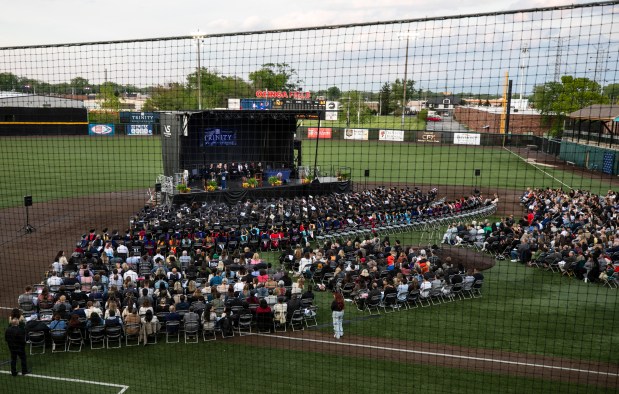
Trinity Christian College announced in November that it would shut down due to financial challenges and declining student enrollment. The school’s board of trustees, as stated by acting president Jeanine Mozie, exhausted all alternatives but couldn’t find a viable path forward. The final commencement ceremony took place on May 8, marking a bittersweet farewell to alumni and students who considered the college home.
For Casey and Andrew Kowitz, the college was more than just an institution; it was a foundation for their lives together. Casey lamented, “Trinity was vital to who we are.” The closure affected not only local institutions; in recent years, several Christian colleges have closed or merged due to financial pressures and declining enrollment. Lincoln Christian University ceased operations in 2024, while Trinity International University sold its Illinois campus.
“Decades of students, faculty, and staff built something meaningful on that campus,” noted Chris Donato, a spokesperson for Trinity International University. “We’re holding onto the mission, not just the property.”
This trend reflects broader challenges in American higher education, where small, private colleges face fierce competition for a reduced student pool. Perry Glanzer of Baylor University highlighted how this mirrors nationwide challenges across institutions. Recent demographic shifts have compounded financial struggles exacerbated by the pandemic.
Despite closures, some religious institutions are thriving. From fall 2023 to 2024, enrollment at Protestant colleges increased, partly due to robust online programs. Professor Glanzer noted that demographic shifts in regions also influence enrollment patterns.
Emotional ties to faith-based education make closures more impactful. A notable tradition at Trinity was its student-led worship service, which alumni from different generations attended one last time. Casey Kowitz expressed gratitude for the college’s role in shaping their spirituality and personal growth.
Students faced abrupt transitions after closure announcements. Julia Leidecker, a student, was shocked and saddened by the news. The once lively campus quickly turned somber, forcing students like Leidecker to seek alternative colleges.
Not all institutions face gloom. Some, like the Catholic and Protestant colleges experiencing enrollment growth, show resilience by leveraging unique offerings and adjusting to an online education framework. Rick Ostrander, executive director of the Michigan Christian Study Center, remarked how religious affiliations might attract more students.
The broader educational environment faces an uncertain future, burdened by a decline in public perception and the looming enrollment cliff. Pew Research and Gallup surveys indicate waning confidence in the value of a college education.
For former Trinity students, the closure was personal and reflective. Kylla Hutcherson, a graduate, cherished the intimate community and spiritual life at Trinity. Although saddened by the closure, alumni are left with memories of a time and place that significantly shaped their identities.
Olivia Stevens contributed to this report.
 Impact of Removing Tax-Exempt Status from Private Schools
  AFL Investigates Fairfax County Schools’ 9/11 Teaching Guidance
  Challenging the ‘Trust the Experts’ Narrative in School Libraries
  Implications of AI in College Admissions
  Preparing Students for an AI-Shaped Workforce
  Concerns Over Racism and School Funding Inequality Discussed by ‘The View’ Co-Host