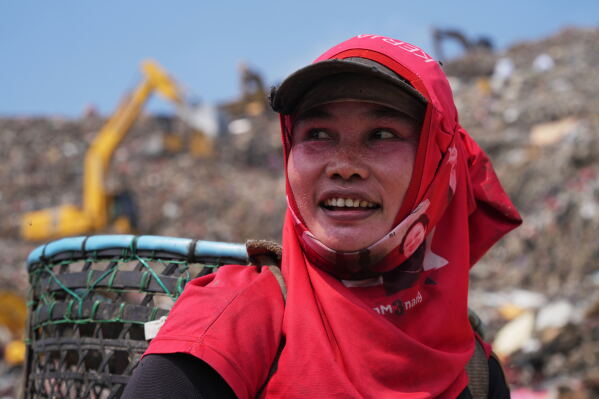
The Bantargebang landfill in Indonesia, located on the outskirts of Jakarta, is home to many who make a living by collecting and selling discarded items. Among them is Nur Wencih, a 35-year-old widow who has been working there for 20 years. Despite her challenging job of searching through garbage for sellable items, including toys, cardboard, and bottles, she manages to earn around 200,000 rupiah ($12) on good days. Occasionally, she finds items of greater value, such as gold jewelry.
Wencih supports her two teenage daughters living in a rural village. She hopes they will not have to take the same path she has. Living near the landfill, she shares her fear about diminishing opportunities. Starting August 1, Indonesia plans to transition from open dumping to a more controlled system, aligning with a national waste management plan. This change could impact the livelihoods of many like Wencih, as open-dumping operations are set to close across hundreds of sites.
The shift is intended to improve environmental health and reduce pollution. This includes setting aside organic waste and recyclables for separate processing. Dudi Gardesi Asikin from Jakarta’s Environment Agency emphasizes the importance of this plan to curb methane emissions, a significant contributor to global warming.
Bantargebang, one of the world’s largest methane emitters, is a focal point of Indonesia’s reform. Originally intended as a sanitary landfill, it devolved into open dumping after a contract ended in 2016. Efforts to cover areas with tarps are underway, but the entire site requires significant investment.
While the government aims to protect waste pickers’ livelihoods, potentially creating jobs in recycling, the new policy also brings uncertainty. Over 4,000 registered waste pickers work at Bantargebang. The unintended economy around the landfill supports businesses like rental houses and food stalls.
Bantargebang spans 110 hectares and receives about 7,500 tons of waste daily. In March, a collapse due to heavy rain killed seven, highlighting the site’s risks. Satellite data ranked it as the second-largest landfill methane emitter globally in 2025.
Jakarta residents are expected to separate organic from recyclable waste under the new plan. While this reflects a shift in behavior, many, like Central Jakarta resident Rukasih Wanti, find it confusing. Public awareness and infrastructure are essential for success.
Organizations such as YPBB note that approximately 80% of Jakarta’s waste could be kept out of landfills with effective sorting and processing. Community efforts, like Monica T. Anggriani’s waste bank, demonstrate progress, but broader education is crucial.
Continued collaboration across government sectors is necessary to achieve the intended waste management reforms. Although challenging, these efforts are critical to overcoming decades of inadequate waste handling practices in Jakarta.
 Far-Left Groups Allegedly Organize Protests in Austin
  Austin Police Release Footage of Arrest After ICE-Involved Shooting
  Himalayan Pilgrimage: A Couple’s Narrow Escape and Lingering Questions
  Religious Trends: Decline in Affiliation with LDS Church
  UC Berkeley Student’s Harrowing Encounter Raises Questions About Safety and Legal Protections
  Tinley Park Updates Downtown Parking Rules Amid Increased Congestion