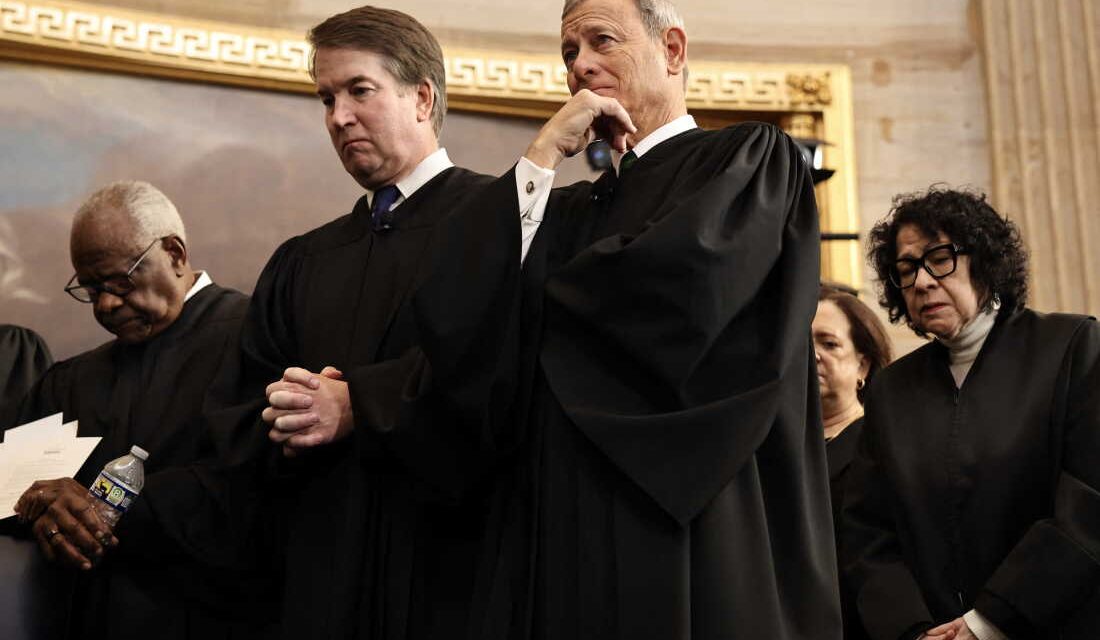
The Supreme Court has seen a noticeable increase in the duration of its oral arguments. Sessions once capped to an hour are stretching far longer, with some justice’s patience being tested. Chief Justice John Roberts is contemplating adjustments for the new term starting in October, though finding a solution may not be straightforward.
Changes in Oral Argument Practices
Traditionally, oral arguments at the Supreme Court adhered strictly to a 60-minute time limit. Under late Chief Justice William Rehnquist, time limits were rigidly enforced. Lawyers would often recount tales of Rehnquist ending arguments when the allotted time expired, often highlighted by the advocate’s light turning red.
Adam Feldman, who studies the Supreme Court, noted, “The arguments are definitely longer than they used to be.” Many cases now extend beyond the 90-minute mark, diverging from the traditional schedule.
Impact of COVID-19 on Argument Structure
The COVID-19 pandemic reshaped how oral arguments unfold. Advocates were initially granted uninterrupted time to present their cases, followed by a structured question period for each justice. This adaptation was crucial as justices were unable to see each other during virtual sessions. Feldman explained, “The purpose during COVID was you couldn’t see each other telephonically, and so there had to be some ordering or it would have been really messy.”
Importance of Oral Arguments
Oral arguments hold significant importance as they represent the transparent aspect of the Supreme Court’s decision-making process. Tonja Jacobi, a law professor at Emory University, emphasized the need for public access to these arguments, despite limited public engagement. “Oral argument is the one open part, the one transparent part of the Supreme Court’s decision-making process,” Jacobi said.
Shift Following Pandemic Changes
The new format, stemming from pandemic adjustments, is largely welcomed. Justice Clarence Thomas, previously known for his silence during arguments, now leads with the first question due to his seniority. This change also addresses issues of gender-related interruptions, allowing equal speaking opportunities for all justices.
Challenges and Considerations
Some challenges persist with the extended argument times. Chief Justice Roberts has voiced concerns over their expanding duration and is evaluating ways to curb them. Former Solicitor General Jeff Wall acknowledged the difficulty in addressing the issue, likening it to conference call situations without easy solutions for reducing conversations.
Roberts aims to balance time management and the dynamics among justices. Feldman noted, “The chief has to be very thoughtful about where he asserts himself because he wants to manage the court, but he also doesn’t want to alienate any of the justices.”
Justice Ketanji Brown Jackson and Justice Sonia Sotomayor, both liberals on the court, speak extensively during arguments. As Jacobi explained, “Essentially, when you’re expecting to be on the losing side of an argument, you do more talking to try and persuade people to your side.”
Global Perspective
Jacobi provided a comparative perspective, stating, “In other jurisdictions such as Australia, my home country, we measure oral arguments in days, not minutes, so it could be worse.” This highlights the relative brevity of arguments compared to other courts around the world.
Changes in the Supreme Court’s approach to managing oral arguments will become evident when the new term commences on October 5.
 President Trump’s New Hair Color Sparks Online Buzz
  JD Vance’s Remarks and Their Impact During Trump’s Campaign
  Violence Erupts at Canfield Fair as Ohio Gubernatorial Candidate Targeted
  Violent Incident at Amy Acton’s Campaign Stop in Ohio
  President Trump’s Ideal Venue Near the White House
  U.S. Lawmakers Propose AI Development Ban Amid China Competition Concerns