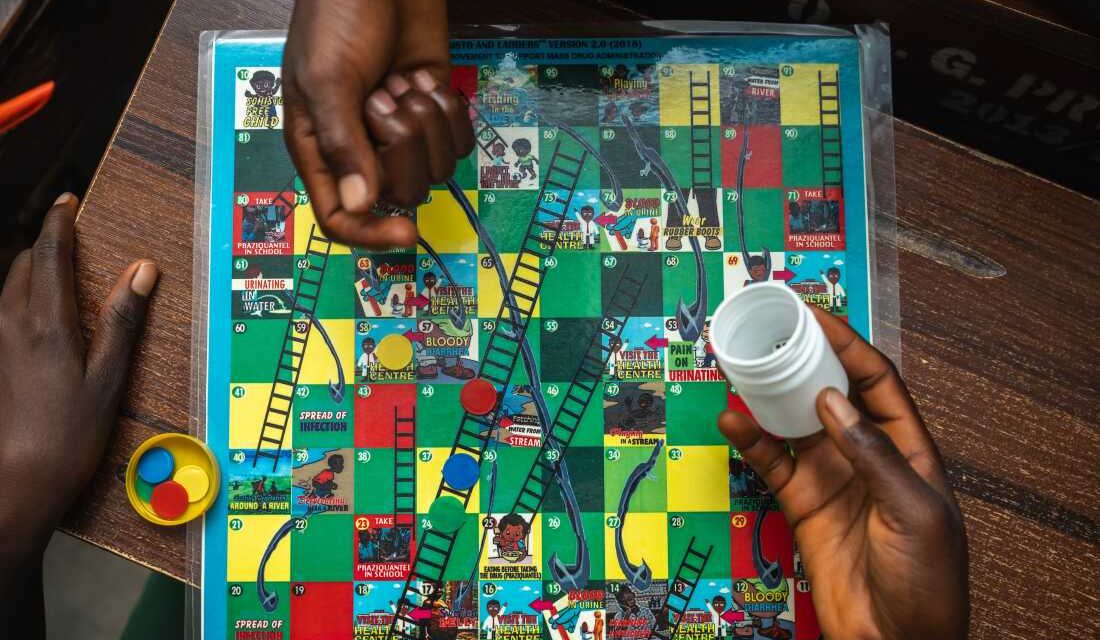
In an elementary school in Nigeria, a version of the classic board game ‘Chutes & Ladders’ is educating children on the prevention of schistosomiasis. Named ‘Schisto & Ladders,’ the game addresses a parasitic disease prevalent in the community. Developed by researcher Cynthia Umunnakwe and colleagues, this educational tool is part of broader efforts to tackle this neglected tropical disease.
Schistosomiasis is caused by parasitic worms and spreads through skin contact with infested water. The disease, locally known as ‘Atosi Aja’ or ‘Bloody Urine,’ manifests with symptoms like blood in the urine, fever, and rash. If untreated, it may lead to severe health issues, including organ and neurological damage, infertility, and bladder cancer, especially among young people in Nigeria.
Game Mechanics and Goals
‘Schisto & Ladders’ mirrors the traditional board game’s mechanics. Players roll a dice to navigate a winding path, with improved behaviors propelling them up ladders and risky behaviors sending them down worms instead of chutes. The game incorporates messages such as ‘eat before taking medicine,’ which educates players on proper disease management, and ‘visit the health center,’ encouraging health-seeking behavior.
By including elements like ‘Fetching water from a stream’ and ‘Defecating near a river,’ the game highlights critical transmission points of the parasite. It educates children on avoiding contact with infested water and reducing human waste contamination, thereby interrupting the parasite’s life cycle.
Community Engagement and Awareness
During a visit to a village school in Apojola, Cynthia Umunnakwe taught students how to play the game as part of a Ministry of Health program. This initiative includes urine testing and treatment for affected individuals. In the area, schistosomiasis is common due to reliance on local rivers for daily activities such as washing and fishing. Children often play in these waters, further increasing infection risks.
The game session also involved educating children about intermediate snail hosts, which contribute to the parasite’s spread. Live snails, collected by researcher Dr. Olubukola Adelakun, were shown to the children to help them recognize these hosts.
Impact of Schisto & Ladders
Research demonstrated the game’s effectiveness in raising awareness and promoting health behaviors. Over six months, 275 students participated, and subsequent studies showed increased knowledge about the disease and the safety of the treatment drug praziquantel. Previously, misinformation about the drug had hindered its acceptance.
Cynthia Umunnakwe hopes that the game will drive lasting behavioral changes in children, motivating them to apply acquired knowledge to real-life situations. The game is enjoyable, reinforcing positive learning experiences. During a session, a student’s cheerful exclamation, ‘Hey look, I’m on top!’ upon reaching the ‘Schisto-free child’ square, spoke to the game’s success.
William McCarthy, a medical student and child health researcher, emphasizes innovative community-led approaches for tackling global health issues. His work includes schistosomiasis research with the Prakash Lab at Stanford Bioengineering. As CEO of Health In Your Hands Diagnostics, he advances community-focused solutions to infectious disease challenges.
 Family Files Lawsuit Following Tierra Walker’s Death Due to Preeclampsia
  Concussions Increase Alzheimer’s Risk in Older Adults
  Porsha Williams Opens Up About Her Health Journey
  Communicating with Children about Weight Loss Medications
  Successful Separation of Ethiopian Conjoined Twins
  AI Integration in Healthcare: Navigating Challenges and Opportunities