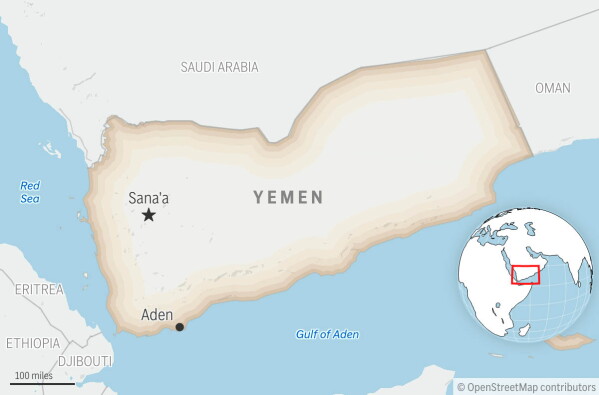
The Iran-backed Houthi rebels in Yemen announced on Monday that they launched missiles and drones targeting Saudi Arabia’s Abha International Airport. This action was reported as a response to airstrikes attributed to Saudi Arabia that had earlier targeted Sanaa International Airport.
No reports of casualties have emerged, but these incidents reflect an escalation reminiscent of moments when a Saudi-led coalition struck Houthi-controlled regions several years prior. Saudi officials have not yet commented on these airstrikes in Yemen. Houthi military spokesman Brig. Gen. Yahya Saree addressed airlines on Telegram, urging them to avoid Saudi airspace until the blockade on Sanaa International Airport is lifted.
The recognized Yemeni government stated that recent strikes on Sanaa Airport aimed to prevent an Iranian aircraft from landing. The Houthis promised retaliation, marking a significant escalation following a recent period of relative peace. The U.N. Security Council convened an emergency meeting on the matter, where officials expressed concerns about potential broader conflicts.
“Yemen and the wider region cannot afford another cycle of escalation,” said U.N. Assistant Secretary-General for political affairs Khaled Khiari during the council session. “We call on all actors to constructively engage in negotiations under UN auspices.”
For several years, a Saudi-led coalition, based in southern Yemen, has been engaged in conflict with the Houthis who control the north. Saree commented on Telegram, critiquing the Saudi airstrikes and labeling them as the end to a period of “de-escalation.” He warned that this aggression would not go unanswered.
He noted that these strikes at Sanaa were aimed at disrupting humanitarian flights for individuals in need of medical evacuation. Yemen’s civil war, which commenced in 2014 with the Houthi seizure of the capital Sanaa and much of northern Yemen, prompted the Saudi-led coalition’s intervention the following year to restore governmental control.
Tensions between U.S. allies Saudi Arabia and the UAE have heightened, resulting in the UAE withdrawing from Yemen. The spokesperson for the Saudi-led Coalition to Restore Legitimacy in Yemen, Maj. Gen. Turki al-Malki, mentioned that their air defenses handled Houthi ballistic missiles heading towards the south without providing further information.
This latest airport attack coincides with renewed tensions, as the Houthis accused Saudi planes of infringing on their airspace to obstruct an Iranian plane carrying a Houthi delegation intended for Tehran. Yemen’s defense minister, Gen. Taher al-Aqili, stated that the airport’s runway was struck to prevent an Iranian aircraft from returning from Tehran.
Video footage broadcasted by the Houthi-controlled al-Masirah channel appeared to capture a missile hitting a Sanaa airport runway, followed by an explosion. Subsequently, the government in the south declared the closure of all airports in Yemen indefinitely. The Yemeni defense ministry also called for evacuations of the airport area.
Yemen’s ruling Presidential Leadership Council, headed by Rashad al-Alimi, noted Iran’s request for an Iranian Mahan Air flight from Tehran to Sanaa to aid the Houthi delegation. The council denied such a request, arguing the Houthis demanded the flight outside established aviation protocols.
The U.N.’s special envoy for Yemen, Hans Grundberg, stated his office is closely watching developments in Yemeni airspace, urging for dialogue in light of the relative calm since 2022. Previous coalition attacks on Houthi-controlled areas had ceased following a U.N.-mediated truce established last year.
 Venezuelan Leadership at the United Nations
  Ontario Synagogue Shooting During Yom Kippur Leaves One Officer and Shooter Injured
  Pope Leo XIV’s Upcoming Visit to Latin America: An Overview
  Ukraine Deploys Ground Robots in ‘Operation Vivaldi’
  Understanding AI’s Impact Compared to Historical Threats
  State Department Alerts on Middle East Travel Amid Rising Tensions