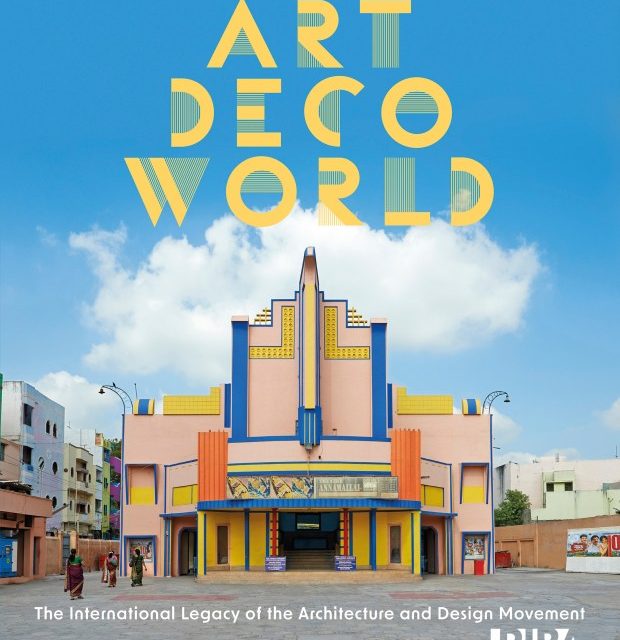
Mid-century modern remains popular in home decor and furnishings, largely due to IKEA’s influence. However, a century ago, Art Deco emerged as a vibrant style that encompassed architecture, interior design, artwork, and type fonts. This style is explored in depth by Chicago architectural historian Max Chavez in his new coffee table book, Art Deco World.
The term ‘Art Deco’ originates from the French phrase ‘arts décoratifs’, first showcased at a 1925 exhibition of modern decorative and industrial arts. With a desire to leave behind the dark, heavy Victorian aesthetics, tastemakers of the early 20th century explored what modernity could look like, driven by fascination with technology, industry, and machinery.
“In the first two decades of the 20th century, people were trying to figure out, what is the aesthetic of this century?” said Chavez.
Art Deco’s early phase was marked by gilded, geometric designs with a vertical emphasis. Skyscrapers became engineering marvels intertwined with the Art Deco style, exemplified by buildings like Chicago’s Carbide & Carbon Building and New York’s Empire State Building.
Chicago boasts several Art Deco landmarks including the Civic Opera House, Chicago Board of Trade building, and One North LaSalle building. Art Deco symbolized excessive design born from the prosperous 1920s. With links to Hollywood, the style represented optimism post-World War I and featured shiny metals, lacquer, rich stones, and technological materials like steel and glass.
Chavez’s Art Deco World emphasizes Chicago’s Art Deco examples outside downtown areas, particularly in churches and storefronts. The First Church of Deliverance in Bronzeville, originally a 1923 hat factory converted into a church, highlights Art Deco in unconventional settings.
“We don’t really associate churches with Art Deco,” said Chavez. “But that church is so distinct and singular, so I really wanted to highlight it.”
The church features large glass block windows, a defining Art Deco element used for diffused industrial lighting. Chavez humorously identifies as the ‘glass block guy’, appreciating how this core material spread from factories to Art Deco designs.
Chicago’s 1933 World’s Fair, the Century of Progress, marked the city’s ‘big Art Deco moment’, celebrating technology and modern life. The event epitomized Art Deco ethos with structures like Lee Lawrie’s stone-like water gate entrance at the Electric Building, showcasing ancient inspirations blended for modernity.
Art Deco’s influence persisted beyond the early 20th century, resurging in the 1970s when it was formally named by art historian Bevis Hillier. Previously labeled ‘modernistic’, Hillier characterized Art Deco through exhibitions and literature, elevating its artistic value. Pop culture, such as the 1974 film adaptation of The Great Gatsby, ignited interest, and the style flourished during the opulent ’80s, influencing works like Miami Vice.
Chicago’s NBC Tower, completed in 1989, exemplifies the ’80s Art Deco revival. TV series such as Miami Vice used exaggerated Art Deco to convey indulgence and entertainment during a period of excess.
However, the movement faded by the 1990s, influenced by IKEA’s accessible Scandinavian modern look—simpler to understand and manufacture. While modern Art Deco furniture exists, it’s often a simplified version with cheaper materials, risking the style’s legacy.
Despite current economic times, Chavez argues for embracing joyful design aesthetics. Art Deco’s identity is not solely limited to rich extravagance but extends to middle-class furniture and product design in the 1930s and 1940s.
“One thing I hope the book asks of folks is to think of Art Deco as a multi-faceted thing,” Chavez said.
Chavez invites readers to explore Art Deco World, encouraging them to find modest examples in their neighborhoods, appreciating the style’s complex and multifaceted nature that reflects futurism and optimism.
 Ancient Gold Pendant Discovered by Metal Detectorist in England
 Uncovering the Pirate Past of Thomas Jones
 Social Media’s Influence on Halloween Celebrations
 The Role of Green Plantain in Ecuador’s Renowned Breakfast Dish, Tigrillo
 Terry Bradshaw Shares His Battle with Depression
 Church Community Finds Renewal After Fire Damages Stained Glass