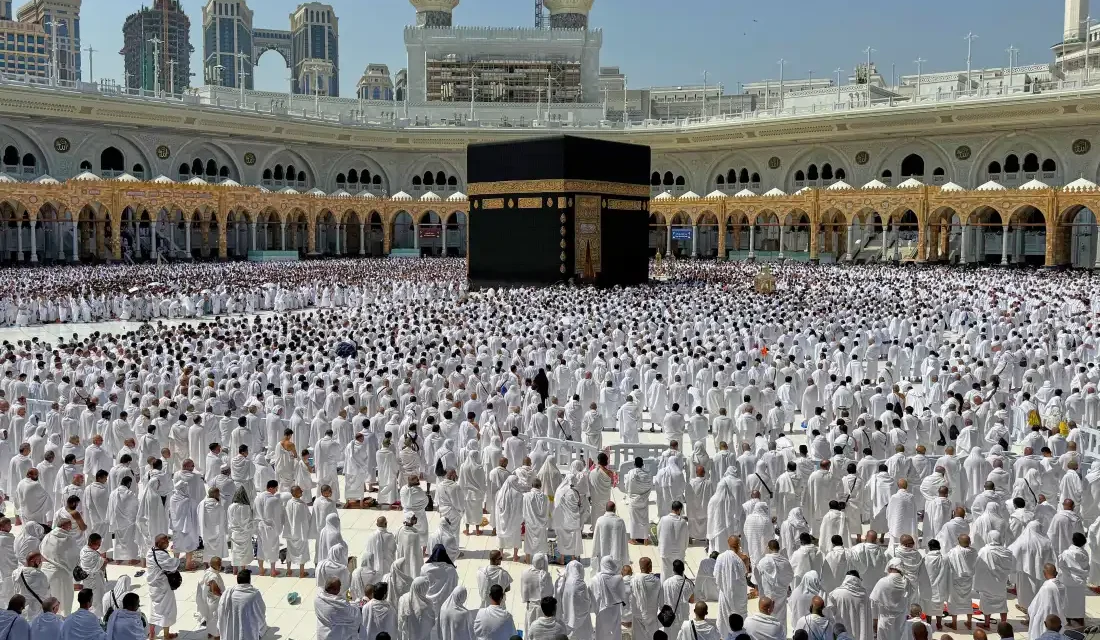
Pilgrims pray at the Grand Mosque in Mecca, Saudi Arabia, in front of the Kaaba, the holiest shrine in Islam. A new report reveals that Muslims will outnumber Christians by 2035. The Pew Research Center released this report, indicating that Muslims will soon be the largest religious group, with Christians following as the second-largest.
Both Muslim and Christian populations are expected to grow, but Muslims will increase at a faster rate. Given current demographic trends, Pew estimates that by 2070, the Muslim population will reach 3.6 billion, while Christians will be just under 3 billion. This projection relies on data from global censuses, fertility rates, and religious switching patterns, along with UN reports and migration estimates.
Hindus and Jews will grow in absolute numbers but decline as a global percentage. Buddhists are expected to decrease in both number and global proportion. Most population growth this century will occur in Africa. By 2070, over a quarter of the world’s population will reside in sub-Saharan Africa, predominantly Christians and Muslims. The high fertility and increased lifespans in the region predict significant growth for both faiths, with Muslims increasing at a quicker pace.
Pew’s projections indicate the Democratic Republic of the Congo will surpass the United States in the Christian population by 2070. Alan Cooperman from Pew notes a shift in the center of gravity for Christianity globally with this trend.
Birth rates drive religious shifts
Differential fertility rates greatly influence religious demographics. Globally, Muslims have more children compared to other faith groups. Currently, Muslims have an average of 3.1 children per woman, whereas non-Muslims have about 2.0 children per woman.
By 2070, several religious trends are anticipated: China, Japan, and South Korea will see population declines, halving their Buddhist populations. A larger percentage of the global Jewish population will reside in Israel, increasing from 46% in 2020 to 62% in 2070. Interestingly, while the percentage of people without religious affiliation may rise in many countries, the total “nones” population worldwide may drop, primarily due to population decreases in China caused by low birth rates.
U.S. trends align with global patterns, indicating religious changes domestically. By 2070, the U.S. will lack a Christian majority, with Christians dropping from 62% to under 48%. Concurrently, the religiously unaffiliated population is projected to rise to 41%. This shift results more from religious switching than birth rates, as Christians lose more members to the “nones” category rather than to other traditions.
The U.S. is expected to become more religiously diverse. Pew forecasts that Muslims and Hindus will outnumber Jews in the U.S. by 2070, based on current trends.
 Highlights from Recent News Stories
 Pentagon Releases Declassified UFO Files with Intriguing Plans and Reports
 Sinaloa Violence Erupts After Capture of Cartel Leader
 Trump, Xi, and Putin’s Shenzhen Meeting Echoes Historic Yalta Conference
 Trump Urges Nvidia to Reinstate Huang Amid Controversy
 Canada and China Strengthen Trade Relations Amid U.S. Tensions