In Singapore, U.S. Secretary of Defense Pete Hegseth stressed Washington’s commitment to its Pacific allies despite moderating his previous statements that labeled China as a threat. He spoke at the Shangri-La Defense Conference alongside dignitaries, diplomats, and senior security officials from various nations. Hegseth emphasized that the Pacific region holds significant implications for U.S. security and prosperity. Washington’s primary goal is to establish a lasting and favorable balance of power in the Pacific.
During his second address to the forum, organized by the International Institute for Strategic Studies, Hegseth recalled his last year’s remarks cautioning against China’s aggressive stance toward Taiwan. At that time, he warned of China’s military build-up aimed at taking Taiwan, asserting that China’s forces are actively training for this objective daily.
This year’s meeting followed a visit by President Donald Trump to Beijing, where he praised Chinese President Xi Jinping. Trump described Xi as a ‘great leader’ and expressed hopes for a ‘fantastic future together’. Hegseth, who accompanied Trump, revealed that both presidents agreed to maintain a stable strategic relationship marked by equality and reciprocity. While protecting their respective interests, both nations aim to reach practical, mutually beneficial agreements.
Still, Hegseth claimed that the U.S. priority remains ensuring China does not dominate the Indo-Pacific region. He acknowledged concerns over China’s historical military power surge and regional military expansions. He noted the shared understanding that any hegemonic control of the Pacific would undermine the sought-after regional stability.
Chinese Major General Meng Xiangqing lauded Hegseth’s comments about the Trump-Xi meeting. He emphasized strategic stability should focus on cooperation with managed differences and controlled competition, providing a peaceful outlook.
Senator Tammy Duckworth expressed concern over Trump’s closeness to China, fearing distractions from the U.S. commitment in the Indo-Pacific. Duckworth questioned Washington’s defense readiness for Taiwan, prompted by Trump’s references to the $14 billion arms deal as a negotiation tool with China. The U.S., legally bound to ensure Taiwan’s defense capabilities, maintains a policy of ‘strategic ambiguity’ regarding military intervention in case China attacks the island.
Hegseth assured that there are no changes to their stance regarding Taiwan but refrained from commenting on the arms deal.
Hegseth praised countries increasing defense spending, stressing the need for partners over protectorates. He highlighted Asian efforts while critiquing European allies distracted by globalist rhetoric about rule-based order.
Australia’s Defense Minister Richard Marles, acknowledged for increased military expenditure, supported renewing the rule-based order. He stressed that rules empower smaller states, while unchecked power would favor only the strong.
Outside the conference, Hegseth, Marles, and British Defense Secretary John Healey unveiled a new AUKUS initiative focused on developing advanced underwater drone capabilities. They outlined plans to produce cutting-edge sensors or weapons systems for submarines, enhancing threat detection, including risks to underwater cables and pipelines.
 Challenges Facing the Supreme Court’s Public Perception
  California Democratic Aide Arrested for Visa Overstay by Federal Authorities
 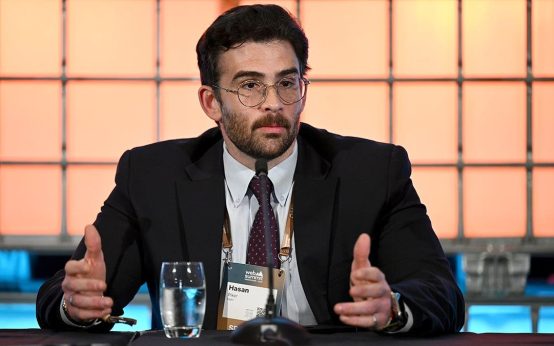 Twitch Streamer Hasan Piker Discusses Controversial Commentary
  Experts Doubt Export Ban Will Lower Fuel Prices
  A Shifting Political Landscape: The Decline of Autocratic Power
  Trump Delivers Warning to Iran, Cuba at UN General Assembly