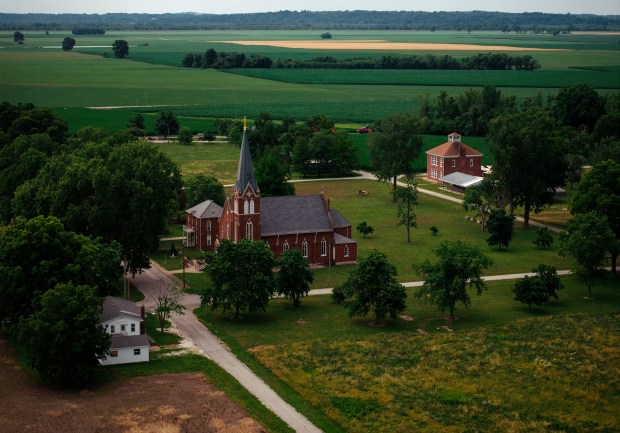
The congregation began arriving half an hour before the Mass on a Saturday afternoon, filling the old church with the descendants and caretakers of a place marked by serenity and loss. This church is located in Kaskaskia, a site reclaimed by nature and plagued by desolation.
Kaskaskia, once the first capital of Illinois, is now mostly empty. The island west of the Mississippi, a geographic oddity shaped by the river’s unpredictable nature, stands as a testament to the current’s power. It birthed life into the town and then took it away.
Aerial view of Kaskaskia shows Immaculate Conception Church, founded by Jacques Marquette in 1675.
The land is rich with history, boasting a Liberty Bell gifted by King Louis XV of France that predates Philadelphia’s famous bell. The church stands because of those dedicated to preserving it, becoming a symbol of resilience and community.
Once, over 7,000 people lived in Kaskaskia during its heyday as a hub of trade and expansion. The area was crucial during the American Revolution and held prominence through the early 1800s. It was nearly another St. Louis, if not for the Mississippi’s whims.
The population dwindled dramatically after floods in 1844 and 1881, leading to Kaskaskia’s isolation as an island. In 1993, the Mississippi’s cruelty left few inhabitants, including Stanley Hurst, a lifelong resident who chose to move away but returns regularly.
Weekly, Immaculate Conception hosts Mass, drawing the community back to life, if only for a couple of hours. The congregation reunites for memories and faith, despite the presence of nearby churches.
Mary Ellen Brown and Emily Lyons, regular attendees, feel responsible for maintaining the church. Brown was married there and Lyons taught in the local school until students disappeared.
As unofficial historians, they share generations worth of tales and history, viewing it as mission work. Brown recalls her wedding before the disastrous summer of 1993 and Lyons reminisces about teaching as schools closed.
Lyons noted the spirits remain “friendly” in a Kaskaskia booklet.
With only 22 inhabitants, according to the census, the island feels emptier than numbers suggest. Solitude is broken only by church gatherings.
Warren Gendron visits to lay flowers on ancestor graves, recalling tales of fur-trading relatives settling here. While time passed, floods often submerged this cemetery.
Family gatherings, like a holiday weekend cookout, offer moments of communal reset, as noted by Derick DeRousse. Despite hearsay, this land lures back those it once displaced.
Once bustling with homes, schools, and stores, Kaskaskia’s scarcity contrasts its historical importance. Visitors enter through Missouri, reminding of St. Louis and the Menard Correctional Center.
Fort Kaskaskia commemorates the original town, a pivotal site during the American Revolution. Locals rang the old bell on July 4, 1778, celebrating George Rogers Clark’s victory.
Kaskaskia’s “old town” vanished except for the bell and church. After floods forced relocations in 1894, the church was rebuilt, brick by brick. Despite adversity, locals like Hurst and others salvaged and resurrected the chapel after ’93.
The Rev. Vincent Obi leads Saturday Mass, drawing congregations who fill pews during holidays. Worship begins with Mary Ellen Brown’s hymns, her voice carrying through the chapel.
Since 1993, discussions pondered the church’s future while locals repaired and salvaged. Brown and Lyons actively advocated maintaining the church, securing support from the Diocese of Belleville. They lobbied officials expressing its historical significance.
Immaculate Conception remains due to faith and obligation for Kaskaskia’s citizens. Brown acknowledges challenges yet insists, “We’ve kept up our end of the bargain.”
For Hurst and others, church is pride, where land and faith intertwine. He visits because “it’s my church,” pledging not to “give it up.” Yet as history accounts, nature ultimately dictates.
The Mississippi burrowed beneath levees in 1993, and despite efforts, the River defines Kaskaskia’s fate. Only rich soil for farming and the church preserve its legacy.
Mary Ellen Brown candidly shares ongoing worries, noting, “There’s three centuries of history.” After Mass, quietness returns, and the island retains its peaceful noise.
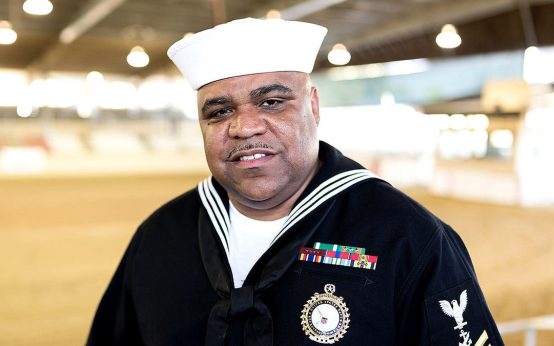 Navy Veteran Generald Wilson Reflects on Emotional National Anthem Performance
 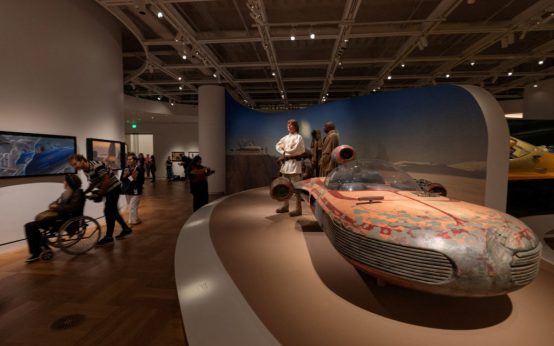 Lucas Museum of Narrative Art: A New Cultural Landmark
 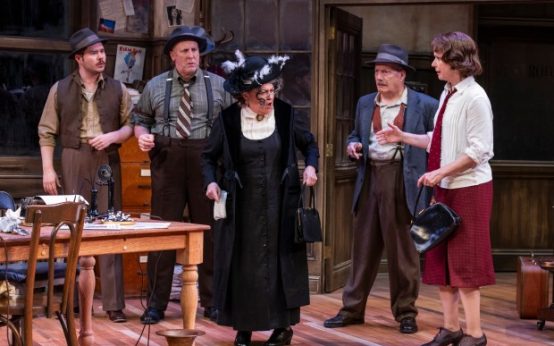 Northlight Theatre’s ‘The Front Page’: A Satirical Nod to Chicago’s Journalistic Past
  The Value of Unsupervised Play in Child Development
  Why the Creative Class and Global City Concepts Lost Momentum
  Aurora’s Moon Festival Showcases Cultural Diversity and Community Engagement