Residents across the Americas are in for a celestial treat as the moon prepares to undergo a significant partial eclipse. This event follows closely after the solar eclipse viewed in parts of Europe earlier this month. A staggering 96% of the lunar surface will be obscured, offering an impressive sight Thursday night into Friday.
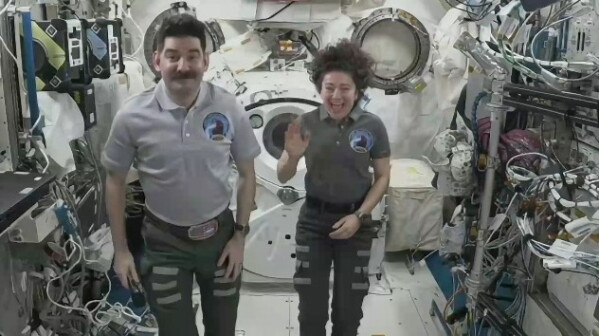
NASA has recently focused on lunar explorations. The Artemis II mission set new records with a lunar flyby in April, paving the way for future missions to establish bases on the moon. NASA astronaut Jack Hathaway highlighted the rapid advancements in space exploration, expressing enthusiasm over these developments from the International Space Station.
Lunar and solar eclipses occur due to the precise alignment of the Earth, moon, and sun. Remarkably, despite the moon being 400 times smaller than the sun, it appears the same size from Earth due to being 400 times closer. This cosmic arrangement allows for such celestial events.
This upcoming lunar eclipse promises to reach a wide audience. People in North and South America, Europe, Africa, and the Middle East will witness the event, weather permitting. Space station commander Jessica Meir notes the unique views from space that allow astronauts to experience phenomena like eclipses and auroras differently.
During this partial lunar eclipse, Earth’s shadow will turn the moon a reddish-orange hue. The partial phases will last over three hours, with the entire process taking around 5 ½ hours. Peak viewing time occurs shortly after midnight EDT.
In the U.S., Canada, and Central and South America, the entire eclipse will be visible. The event will also be partially observable for over 3 billion people, or 44% of the world’s population. In Europe, Africa, and the Middle East, the eclipsed moon will set early. Meanwhile, in Hawaii and parts of the Pacific as well as the northwestern U.S. and Canada, the event will begin later in the evening.
This is the second lunar eclipse of the year and part of a quartet of astronomical events. Earlier, a total lunar eclipse was visible across large parts of the world in March. The next full lunar eclipse will occur at the end of 2028, drawing attention mainly in Asia and Australia, while North and South America will have to wait until 2029 for a complete lunar eclipse.
The Associated Press Health and Science Department acknowledges support from the Howard Hughes Medical Institute’s Department of Science Education and the Robert Wood Johnson Foundation. The AP maintains authority over its content.
 China Delays Chang’e-7 Lunar Mission Plans
  Astronauts Experience Northern Lights and Culinary Delights in Space
  James Webb Space Telescope Uncovers Early Universe Surprises
  Total Solar Eclipse of 2026: Where and When to Watch
  Exploring the Mystery of the Solar Corona During the Eclipse
  The Venus Flyby Mission That Nearly Was and Future Possibilities