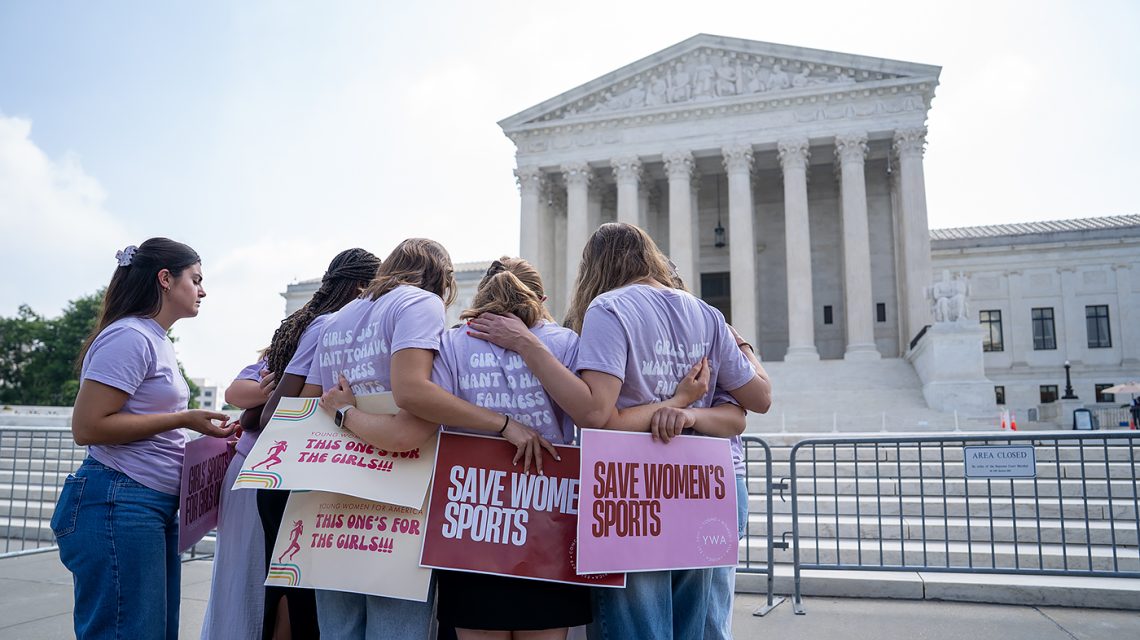
Members of Concerned Women for America gathered outside the Supreme Court in Washington, D.C., on June 29, 2026, awaiting a pivotal decision. On the following day, all nine Supreme Court justices acknowledged physical differences between men and women. This decision in State of West Virginia v. B.P.J. and Little v. Hecox marked a significant win for girls confronting injustice and affirmed that men cannot be considered women.
The court ruled unanimously, 9-0, that Title IX—a federal law ensuring women’s equal opportunities in education—permits states to safeguard female athletes with sex-specific sports. Additionally, in a 6-3 decision, they ruled that the Equal Protection Clause of the 14th Amendment supports such protections. A critical question arises from this: How did confusion over this issue become so prevalent?
Our organization assisted in defending state laws for women’s sports, collaborating with Idaho Attorney General Raul Labrador and West Virginia Attorney General JB McCuskey. These laws acknowledged a truth long considered self-evident: Biological differences impact strength, speed, muscle mass, and physiology. Although some advocates of gender ideology attempted to erase these biological protections, the result was widespread harm.
A case in point involves a young male, known as B.P.J., who blocked West Virginia’s law and outperformed over 470 girls in high school track events, reducing opportunities and scholarships for young women. B.P.J. also won a women’s state championship in shot put and allegedly harassed a girl, Adaleia Cross, leading her to abandon her sport due to inaction by her school. We represent Kallie Keeler, a high school sophomore, who sued Washington state officials following a sexual assault by a male opponent during a wrestling match. These examples illustrate the consequences of ignoring biological realities.
Despite these challenges, the Supreme Court’s decision supports the truth within Title IX, allowing states to protect women’s sports. If the court had ruled otherwise, protections for women would have been compromised in various settings, from sports to accommodations like restrooms.
The court’s decision reminds us that a functioning legal system must clearly define terms like ‘woman’ to effectively protect women’s rights. Trust in the justice system would erode if it upheld contradictions as laws. Such coercion would force society to participate in falsehoods, affecting coaches, parents, and society’s fundamental trust.
Contrary to media portrayal as a complex issue, the court resolved an obvious question. States without legislative protection for women’s sports should act swiftly to ensure fairness and equal opportunities for girls. The ruling stands as both a triumph and a warning. It affirms that truth underpins the law, and the debate should never have existed. The challenge now is not whether the law can protect, but whether it will.
Kristen Waggoner serves as CEO, president, and chief counsel of Alliance Defending Freedom.
 Economic Challenges in Senator Collins’ Reelection Bid
  Democratic Women’s Caucus Economic Agenda Unveiled
  Renowned Journalist Jodie T. Allen Passes Away at 88
  Partial Reopening of Lafayette Square Near White House
  Innovative Child Care Plans by Mayor-Elect Mamdani
  Challenges Facing President Trump: Nuclear Issues, Climate Crisis, and AI