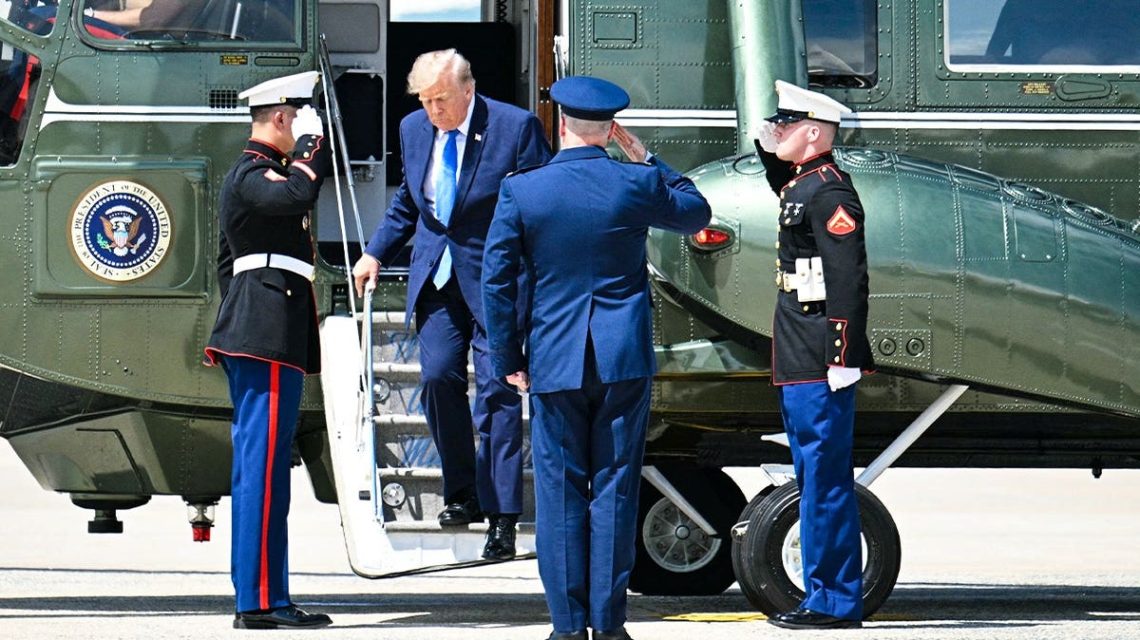
Recent findings from a National Transportation Safety Board (NTSB) report outline communication issues involving Marine One as it prepared for departure on August 4. These issues led to a near encounter between President Donald Trump’s helicopter and a commercial jet. The report details unsuccessful attempts by Marine One’s crew to notify Reagan National Airport.
The crew’s initial call on Reagan National’s helicopter-control frequency was not received. A follow-up transmission was unclear and unreadable. Unable to reach the tower directly, the crew tried relaying through the helicopter facility at Joint Base Anacostia-Bolling, which also failed.
Trump Eyes New White House Lawn Project That Could Reshape Presidential Travel
The lack of notification resulted in the departure clearance of Envoy Air Flight 3742, bound for Pensacola, Florida, from Runway 1, coinciding with Trump’s departure aboard Marine One. The NTSB report states that the passenger jet commenced its climb as Marine One left the Ellipse, around 2 miles north of the airport.
The Federal Aviation Administration (FAA) estimated the aircraft were separated by approximately 0.82 nautical miles laterally and 700 feet vertically. Despite this proximity, there were no injuries or damage, and both flights proceeded without further incident.
The Envoy flight crew reported that their traffic-collision system announced “Traffic, Traffic,” but did not issue a resolution advisory, which would prompt pilots to alter altitude to avoid a threat. Marine One eventually contacted the tower, with the controllers then giving traffic advisories as soon as the helicopter crew identified the jet.
Previous communication concerns between Marine Helicopter Squadron One (HMX-1) and Reagan National controllers had been addressed on July 30. Issues of spotty communications were noted, and agreements were made to use backup methods if direct contact failed.
The FAA later found an inadequate line-of-sight between the radio transmitter-receiver and the Ellipse. This prompted repositioning of the radios to the control tower at Reagan National, improving connection reliability.
Further investigation by the FAA and NTSB classified the incident as “momentary loss of separation,” meeting the FAA’s separation standards in Class B airspace.
Despite being less than 1.5 nautical miles apart horizontally, the vertical separation met the required standard. While ongoing surveillance data review seeks to confirm the closest point of approach, the safety of the president was never at risk, according to White House official Kush Desai.
The NTSB’s preliminary report provides factual data without analysis or conclusions of probable cause. Continued investigation and any safety advice will be shared publicly in subsequent reports.
 James Talarico’s Campaign Launches TV Ads Targeting Biden and Paxton
  President Trump Considers Firing Ambassador Kimberly Guilfoyle
  Georgia Gubernatorial Debate and Election Dynamics
  Katie Zacharia Begins Her Role as New White House Press Secretary
  Controversy Surrounds Government-Funded Ads Promoting President Trump
  Trump Considers Dismissing U.S. Ambassador to Greece Amid Conduct Allegations