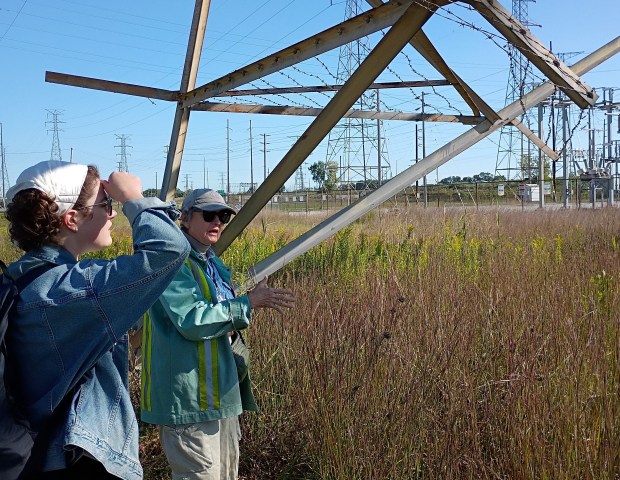
Tall transmission towers and high-voltage power lines mark the landscape over Eggers Grove Cook County Forest Preserve on Chicago’s Southeast Side, close to the Illinois/Indiana border. Beneath them, bikers and hikers enjoy a natural setting filled with native prairie plants and grasses. Monarch butterflies flutter around, landing on flowers as they migrate south. This area is part of 53 sites in northern Illinois where ComEd fosters habitats to aid monarchs.
Many butterflies have already begun their journey to central Mexico. However, ComEd’s efforts are part of a larger movement to convert right-of-way areas into habitats that support wildlife. Catherine O’Reilly, partner coordinator for Sustainable Landscapes at the Energy Resources Center, University of Illinois Chicago, underscores the importance of these habitats for species survival. Whether in a backyard or a right-of-way, supportive habitats are crucial.
“Whether you’re talking about a pocket garden in someone’s backyard or ROW, any space with a supportive pollinator habitat is important for species survival,” said Catherine O’Reilly.
In 2016, about 40 energy and transportation organizations collaborated to establish the Nationwide Candidate Conservation Agreement with Assurances for Monarch Butterfly on Energy and Transportation Lands, known as “Monarch CCAA.” This agreement, valid until 2045, encourages right-of-way landowners to implement conservation practices to support monarchs. O’Reilly notes the significant participation in this effort. Currently, the enrolled lands cover 9.3 million acres, with more than 1.3 million transformed into habitats.
In Illinois, the right-of-way commitments from energy utilities and transportation agencies have revived milkweed populations, the monarchs’ host plant. Between 2014 and 2024, milkweed stem counts increased by 108 million, according to a UIC Sustainable Landscapes report. Half of these gains occurred in right-of-way areas.
O’Reilly explains how utility and transportation rights-of-way naturally support pollinator and prairie habitats, which need management of tree growth. The Monarch CCAA enhances this advantage through practices like reducing mowing, planting native species, and using targeted herbicides. The conservation agreements also include controlled burning and grazing to maintain habitats.
“CCAAs are legally binding and suggest measures that go beyond compliance,” said Sara Race, ComEd’s senior manager of Environmental Management.
These agreements not only benefit pollinators but also aid utilities in continuing operations if a species becomes endangered. ComEd’s commitment fosters goodwill and community involvement. Eggers Grove volunteer site steward Marianne Kozłowski often leads teams to remove invasive plants and collect seeds for replanting throughout the preserve. With ComEd’s approval, volunteers cleared trash from right-of-way areas, supporting a local cleanup effort.
In LaSalle and DuPage counties, ComEd’s Mighty Acorns program encourages third and fourth graders to engage in planting native species and removing invasives. In 2020, the Illinois Department of Transportation pledged to support the monarch with 401,000 acres of rights-of-way throughout the state. IDOT implements practices such as reduced mowing and planting native species like milkweed.
South of Champaign, IDOT removed invasive shrubs and planted beneficial native plants along I-57. This not only helps monarchs but also improves the visual experience for motorists. IDOT prioritizes maintaining safe travel while encouraging native plant growth. The agency claims 5,300 acres of diverse prairie along Illinois roadways.
“Non-native plants can be very destructive,” said James Schackmann, IDOT’s roadside maintenance resource specialist.
IDOT efforts protect the environment and enhance roadway safety by reducing risks associated with frequent mowing. While challenges remain, coordinated actions by ComEd, IDOT, and conservation groups contribute to preserving modern prairies that sequester carbon and manage water runoff.
 El Niño Strengthens to Historic Levels: What to Expect This Season
  Endangered Species Act and America’s Future Development
  Bokashi Fertilizer Provides Relief for Zambian Farmers Amidst Fertilizer Price Hikes
  Architects Warn of Housing Challenges Amid Climate Change and AI Concerns
  How Little Brown Bat Genes Are Outsmarting a Fungal Killer
  Criminal Investigation Underway at Lineage Cold Storage Warehouse