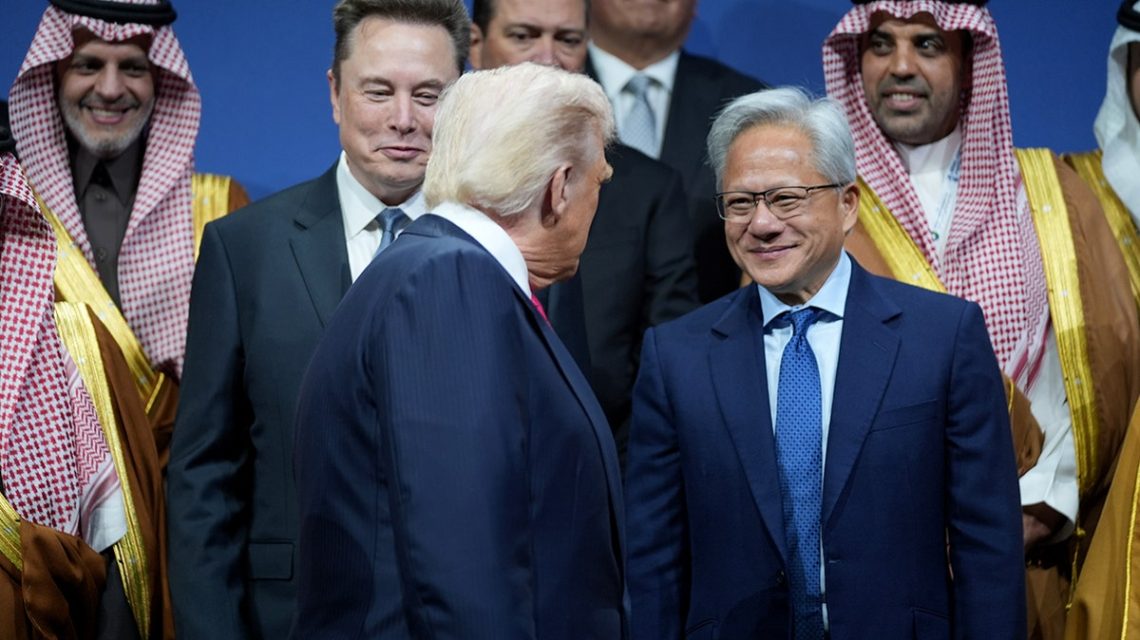
Nvidia CEO Jensen Huang suggests that artificial intelligence (AI) will fundamentally transform the workforce, comparable to the Industrial Revolution, by creating new job opportunities and changing the way Americans work. He expressed these views on “The Will Cain Show,” encouraging young people to embrace AI rather than fear it. According to Huang, AI will serve as a tool that enhances abilities across various fields.
The quick expansion of AI infrastructure is driving demand for skilled labor, including electricians, welders, and construction workers. Companies are building chip manufacturing facilities, computer plants, and data centers nationwide. Huang stated that around half a million jobs have already been created, with more expected as the industry grows.
“We’ve created about half a million of them. We’re probably going to create a lot more,” Huang commented.
Earlier this week, Huang gave Fox News host Will Cain a tour of a manufacturing facility in Sherman, Texas, where Nvidia collaborates with software company Coherent. Nvidia recently invested $2 billion in Coherent, which produces lasers and optics for advanced technologies. Coherent CEO Jim Anderson mentioned that production at the Sherman facility could quadruple within the next 12 to 18 months.
Huang argued that, historically, productivity leads to job creation. In contrast to previous technological advances, AI is accessible to people with limited technical expertise, enabling interaction with complex systems through natural language.
“If you’re not sure how to use AI, you tell the AI: I don’t know how to use AI,” he said.
Huang positions AI as a tool for skill enhancement rather than replacement. He urges students and young professionals to pursue their interests while learning to integrate AI into their disciplines.
He likened AI to calculators, emphasizing that technological tools alter work methods but do not negate the need for skilled workers. According to Huang, AI will enhance U.S. productivity, benefit the economy, and increase energy demand as AI infrastructure advances.
“We don’t have to do algebra anymore, we don’t do surface integrals, we don’t do calculus,” he said. “All of those things are now done by computers.”
Addressing concerns about job displacement, he maintained a positive outlook on AI’s future impact. However, there are notable concerns related to national security as the Trump administration recently banned certain AI models for foreign use. Huang stressed the need for the U.S. to lead in AI, acknowledging its long-term presence without a clear endpoint.
“AI is going to last a long time, and there’s no end,” he commented. “We should absolutely lead.”
 Concerns Over Chinese Influence in Automotive Technology
  U.S. and China to Discuss AI Transparency at Washington Summit
  Apple’s Latest Devices: iPhone 18 Pro, AirPods 5, and More
  Paramount’s Concessions in Warner Bros. Discovery Takeover
  FAA Embraces AI to Enhance Air Traffic Management with SMART System
  Tips for Maintaining VPN Connection While Traveling