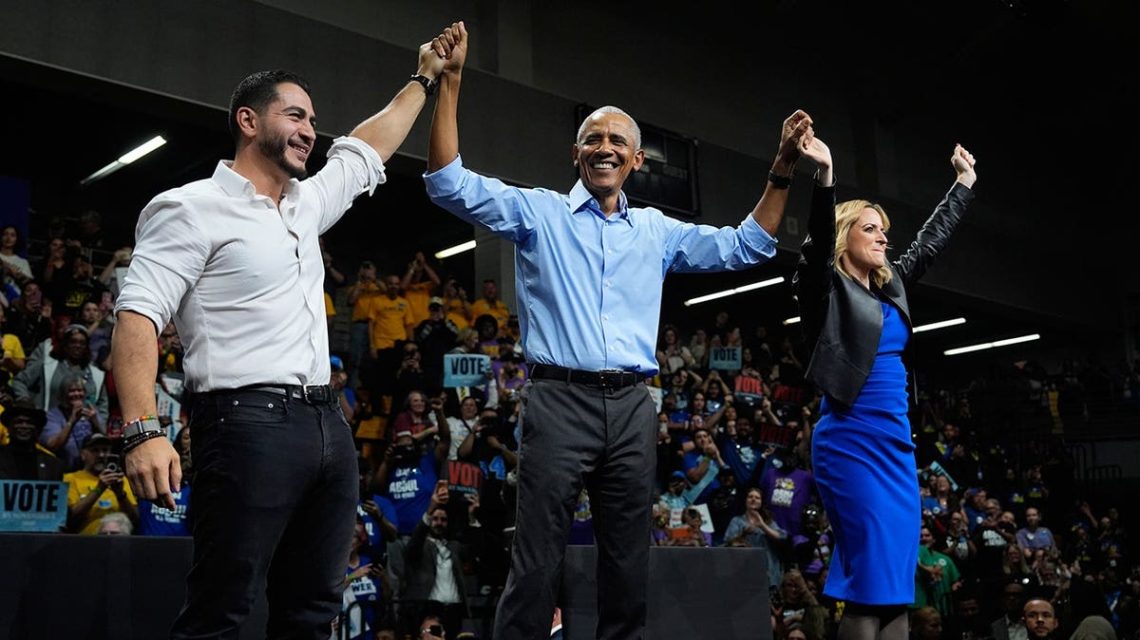
Former President Barack Obama is increasingly showing support for socialist and progressive Democrats as the party’s left wing gains influence ahead of the midterm elections. The Democratic Socialists of America-backed candidates have achieved several primary victories, indicating the left wing’s growing power in Democratic politics.
While Obama does not endorse every socialist candidate, his recent support and campaign involvement signify his willingness to integrate progressive figures into the Democratic coalition. Democratic strategist Kevin Walling notes that Obama remains a popular figure in Democratic politics. He is viewed as a kingmaker whose backing is sought by candidates.
Obama’s campaign efforts in Michigan recently highlighted his embrace of the party’s progressive wing. He appeared alongside Democratic Senate nominee Abdul El-Sayed and supported Florida Senate nominee Angie Nixon. El-Sayed, although not identifying as a democratic socialist, supports policies like Medicare for All, which are central to the party’s left wing.
During the Michigan rally, Obama defended Democrats against accusations of being too left-leaning by invoking healthcare accessibility. He questioned what was radical about wanting universal health care, promoting El-Sayed’s commitment to expanding affordable coverage. Critics revisited his Obamacare-era promises, questioning the affordability of health care.
Obama praised Nixon for her advocacy of a $15 minimum wage and her opposition to Republican-backed redistricting maps. Nixon, a DSA member, campaigns on Medicare for All and other progressive measures. Obama has also supported Texas Senate candidate James Talarico, who emphasizes economic populism and universal health care without identifying as a socialist.
This support from Obama occurs amid victories by democratic socialists and left-wing challengers. In Colorado, Melat Kiros defeated longtime Rep. Diana DeGette, and Donavan McKinney ousted Rep. Shri Thanedar in Michigan. Socialist-backed candidates won congressional primaries in New York, building on Zohran Mamdani’s earlier mayoral victory.
Obama’s endorsement of the party’s socialist left is not new. He previously endorsed Rep. Alexandria Ocasio-Cortez in her 2018 race and former Rep. Jamaal Bowman in 2020, with backing from the DSA. He has consistently celebrated figures tied to communist movements, such as Nelson Mandela and mentor Frank Marshall Davis.
Obama also reached out to Mamdani during his mayoral campaign in New York City, praising his campaign and offering support without a formal endorsement. Democratic strategist Mally Smith defends Obama’s campaign activities, describing them as efforts to build a broad coalition rather than endorsing every progressive policy.
Smith states Obama is the most popular politician in America, traveling nationwide to support diverse Democratic candidates. Obama’s broad appeal contrasts with Trump’s recent campaign efforts, which Smith describes as desperate tours in red states.
At a Kansas rally, President Trump criticized Obama’s planned appearance with El-Sayed, expressing disbelief in Michigan’s support for El-Sayed. Yet, Obama’s strength lies in supporting candidates with diverse political profiles while keeping them united under the Democratic banner.
Obama’s return to campaign activities raises questions about whether the party can leverage the energy of socialist and progressive movements into a national coalition. Democrats continue to debate the potential for candidates backed by the left to succeed beyond deeply Democratic areas.
 House Speaker Johnson Warns of Democratic Policies’ Impact on Midterm Elections
 Chicago’s Daylight Saving Time Debate
 Mystery Group Targets Republicans in Key House Races
 Trump Rallies in Texas as Senate Race Remains Tight
 US Intelligence Warns of Iran’s Increased Threat to Americans Abroad
 Unexpected Challenges in Senate Race for Sen. Roger Marshall