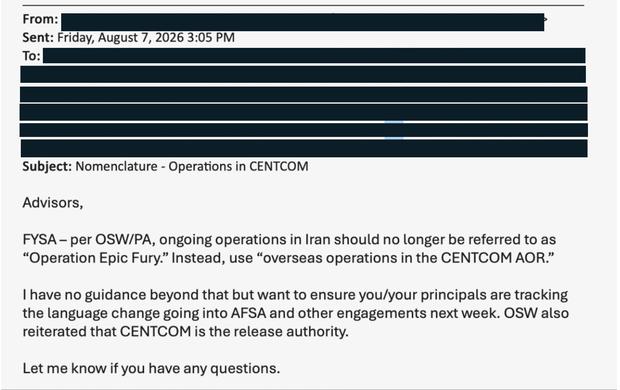
Newly obtained information from CBS News reveals the Pentagon instructed military personnel to cease referring to U.S. operations in Iran as ‘Operation Epic Fury’ months after it was declared over. An Air Force email from August highlights this directive following the Trump administration’s May announcement.
Operation Epic Fury officially concluded on May 5, the same day Secretary of State Marco Rubio informed the public. He stated, ‘The operation is over. Epic Fury is — the president notified Congress — we’re done with that stage of it. We’re now on to this Project Freedom.’ Days earlier, President Trump informed Congress that the ‘hostilities’ had ‘terminated.’
Despite these declarations, U.S. and Iranian forces have engaged sporadically, with pauses like the April ceasefire. The Pentagon’s guidance on renaming ongoing operations came months after the official end date.
Guidance and Communication Issues
On August 7, an Air Force email advised against using ‘Operation Epic Fury’ to describe actions in Iran, urging broader language like ‘overseas operations in the [U.S. Central Command Area of Responsibility].’ This directive came from Defense Secretary Pete Hegseth’s public affairs office, led by Sean Parnell, to ensure consistent communication.
Military officials across the Defense Department received this guidance to align terminologies. Yet, the inconsistency regarding the operation’s end date prompted questions about categorizing service members injured or killed after May 5.
Public Statements and Records
While Rubio publicly confirmed the operation’s end, he didn’t specify May 5 as the end date. On that day, Hegseth briefed reporters, distinguishing Epic Fury from Project Freedom, a mission to protect commercial shipping through the Strait of Hormuz. However, he didn’t explicitly state the operation’s end.
Historically, the U.S. military publishes dates for operations, crucial for maintaining records and assessing the duration of military involvement. These dates provide vital information for tracking missions and awarding service-related honors.
Continued Military Engagement
Even though Epic Fury was officially over, U.S. forces continued missions related to the Iran conflict, initiated six months prior. On July 7, President Trump notified Congress of resumed ‘military action,’ following the collapse of negotiations with Iran.
Subsequent exchanges between U.S. and Iranian forces persisted, with recent strikes resulting in counterattacks. Questions linger regarding the Pentagon’s August guidance to avoid using Epic Fury when the operation ended months earlier.
Casualty Reporting and Data Corrections
Another issue arose around casualty reporting. In July, the Defense Department misclassified four service members as casualties of Epic Fury, despite its conclusion in May. These members, initially listed under Epic Fury fatalities, were later reclassified under ‘overseas operations.’
This reclassification raised media inquiries, prompting Chief Pentagon spokesman Sean Parnell to attribute it to a ‘temporary data disruption.’ He noted that efforts were ongoing to resolve data anomalies.
As of now, the Defense Casualty Analysis System lists recent casualties under Operation Epic Fury, despite its May end. This discrepancy prompts further questions about the operation’s official closure date and related reporting inaccuracies.
 Trump’s Approval Rating Declines Among White Voters
  Trump’s Favorability Ratings Show Political Polarization Across Party Lines
  Elon Musk’s Super PAC Invests Big in Republican Candidates
  Jennifer Sey Discusses Controversy on Trans Athlete Wins in Girls’ Track
  Trump Plans Campaign Support for Key Republican Races
  Political Candidates and Primetime Readiness