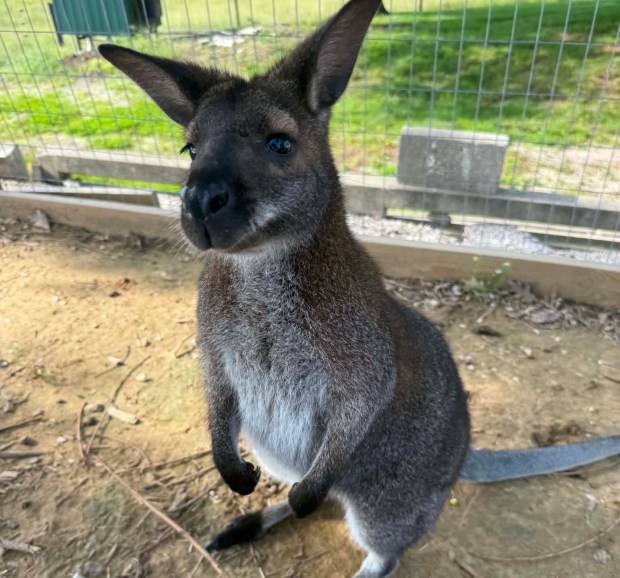
Phillips Park Zoo in Aurora has introduced two new young wallaby residents, Wally and Bindi. These wallabies, just over a year old, arrived at the zoo on August 5th, marking the zoo’s debut of marsupials, according to city officials.
The duo is expected to enjoy a lifelong stay at the zoo, with lifespans ranging from 10 to 15 years, as shared by Anna Borozenets, the zoo manager. Bindi, a female wallaby, is known for her inquisitiveness and curiosity. In contrast, Wally, a male wallaby, is more reserved and prefers watching from a distance.
Borozenets described them as a dedicated pair, emphasizing Wally’s devotion to Bindi. ‘They are very sweet, quite social with our zookeepers, and seem to enjoy interacting with the public,’ Borozenets mentioned. ‘Their adjustment has been exceptionally smooth.’
The wallabies were sourced from Santa’s Reindeer Ranch, a facility licensed by the U.S. Department of Agriculture, also on August 5th. Borozenets highlighted the decision-making process behind introducing wallabies to fill the empty exhibit space, stemming from a professional connection.
Her familiarity with wallabies throughout her career assured her of their enigmatic presence and appeal to visitors. ‘I believed they would be a positive addition to the community and engaging for guests,’ she expressed.
Despite slight increases in food and veterinary costs planned within the zoo’s budget, Borozenets noted that the animals’ low maintenance and existing exhibit led to manageable expenses.
Wally and Bindi are housed in the exhibit between Tito the Lynx and the zoo’s barnyard. Visitors can explore Phillips Park Zoo at 1000 Ray Moses Drive in Aurora, open Thursdays through Tuesdays from 9 a.m. to 5 p.m., as noted on the city’s website.
City officials stated that as Wally and Bindi acclimate to their environment, they have the flexibility to choose being on exhibit or retreating to their indoor space. Their visibility will increase as they gradually adapt.
Bennett’s wallabies, commonly known as red-necked wallabies, inhabit the forest and coastal shrublands of Australia and Tasmania. Adults weigh between 25 and 60 pounds, and they are herbivorous, consuming grasses, herbs, and roots within their natural habitats.
 Kyle Kennedy, Advocate for Education and Disability Rights, Dies at 42
  U.S. State Department Raises Travel Advisory for Kenya Due to Security Concerns
  Save on Crest 3D Whitestrips During Amazon Beauty Sale
  Finding Fulfillment in Retirement: Steps to Enjoy the Life You’ve Built
  Finding Fulfillment in Retirement
  Finding Fulfillment After Retirement