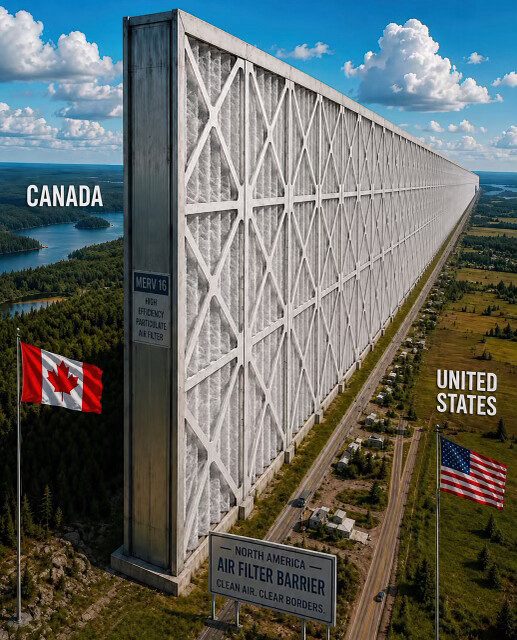
President Donald Trump on Saturday shared an image apparently generated by artificial intelligence. The image showed a giant air filter along the U.S.-Canada border. This act amplified his criticism of Ottawa as wildfire smoke continued to drift into the United States.
Despite a history of cooperation between the two countries during wildfire emergencies, Trump’s post followed his recent blame on Canada for worsening U.S. air quality. He suggested that the economic impact of the wildfire smoke should influence tariffs on Canadian goods. Meanwhile, Canadian officials highlighted long-standing cross-border firefighting collaborations, with personnel, aircraft, and resources being used reciprocally during intense fire seasons.
What the Post Shows
The image on Trump’s Truth Social account showed a massive filtration barrier labeled as a “MERV 16 High Efficiency Particulate Air Filter.” It featured a sign that read “North America Air Filter Barrier: Clean Air, Clean Borders.” The Canadian flag was displayed on the left side, and the American flag on the right.
Canada’s Prime Minister Responds
Trump has criticized Canada’s severe wildfire seasons, blaming poor forest management. His rhetoric escalated last week as smoke from Canadian forests spread into multiple states, leading to air quality alerts in areas like Michigan and New York.
On July 17, Trump accused Canada of “willful negligence” and described the smoke as “filthy, polluted, and unhealthy air.” He insisted that the costs imposed on the U.S. by this pollution should be added to existing tariffs on Canadian imports. Prime Minister Mark Carney responded by explaining Canada’s significant efforts to manage the wildfires, as reported by CBC News.
Carney emphasized the scale of Canada’s forests, which are eight times the size of Texas, and the widespread drought conditions, stretching from Texas to Minnesota.
What Causes Canadian Wildfires?
Wildfires are common in Canada’s vast boreal forests. However, fire seasons have worsened as warmer temperatures and drier conditions make forests more susceptible to ignition and rapid spread. Climate researchers note that rising temperatures result in longer fire seasons and more severe fire behavior.
Canadian wildfires arise from both natural and human factors. Experts state that lightning often sparks the largest fires in remote forests. Meanwhile, human activities, such as unattended campfires, discarded cigarettes, equipment sparks, and power-line failures, can also start fires.
Many current fires burn in remote areas of Ontario and other northern regions, challenging suppression efforts due to limited access.
Wildfire Smoke Impacts on the U.S.
Smoke from these fires became a major issue across the Great Lakes and Northeast. Cities like Chicago, Detroit, Cleveland, New York City, and Boston experienced thick smoke, prompting air quality alerts. Residents reported orange skies, reduced visibility, and a strong burning wood smell as pollution levels became unhealthy.
Although much smoke has dispersed, it may be noticeable again soon. Meteorologist Ben Noll, posting on X on Saturday, warned of increased smoke across the U.S. and Canada in the coming days. He noted that air quality in the East might not be severely impacted, but haze could be visible on Sunday and Monday.
What Happens Next
Canada’s wildfire season is most active from May through September. Fire activity usually decreases in the fall when cooler temperatures, more rain, and eventually snow reduce new fire risks and slow existing blaze spread. As a result, if dry conditions persist, air quality concerns may continue for weeks in parts of Canada and the northern U.S.
 ICE Shooting Incident in Austin Sparks Demands for Transparency
  Concerns in U.S.-China Relations Ahead of Summit
  German Chancellor Friedrich Merz Vows to Continue Amid Election Losses
  Nikole Hannah-Jones Reflects on School Choice and Its Impact
  Republican Senator Criticizes Trump’s $5,000 Check Proposal
  Trump’s Approach to Iran at the United Nations