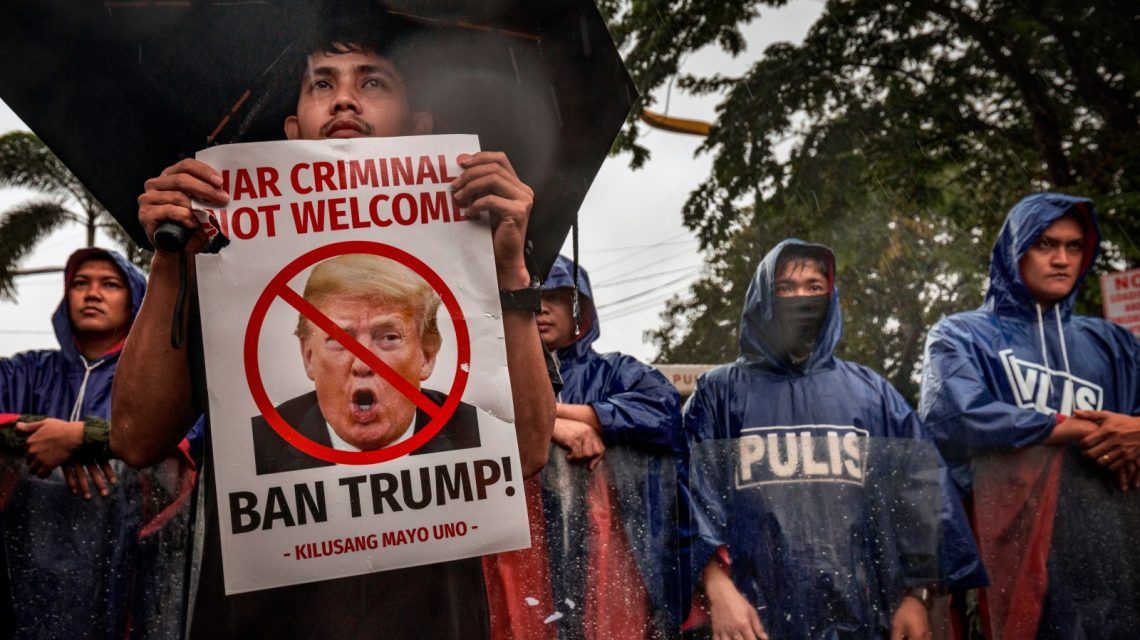
Protests Planned as Trump Visits Manila Amid AI Supply-Chain Talks
Protests are being organized in response to President Donald Trump’s visit to Manila next week for the Association of Southeast Asian Nations (ASEAN) Summit. This occurs amidst White House efforts to secure an international agreement on artificial intelligence supply chains. Trump is visiting the Philippines from November 16-18 for the summit and plans to meet with Philippine President Ferdinand Marcos Jr.
Understanding the Pax Silica Initiative
The Pax Silica initiative was launched last December. It is designated by the State Department as a major effort focused on super intelligence and supply chain security. The aim is to foster economic security among allies and trusted partners. The term is derived from the Latin “pax,” meaning peace, and “silica,” referring to silicon, a key component in computer chips.
This initiative seeks to build trust among allies, accelerate AI development, secure the supply chain for industries like semiconductor and chip manufacturing, and promote industry investment to scale the global AI economy. According to a State Department memo, the technological revolution in AI is rapidly reorganizing the global economy and supply chains.
The State Department stated, “Economic value and growth will flow across all levels of the global AI supply chain, creating unprecedented opportunities and demands for energy, critical minerals, manufacturing, and technology.”
With this agreement, the U.S. and more than 20 allies aim to secure innovation, ensure fair competition, and protect sensitive technologies and infrastructure from undue influence.
Impact on Indigenous Philippine Communities
The proposal has faced opposition from local Philippine communities concerned about environmental and human rights implications. These communities have organized protests in various cities throughout July to September.
Student groups and members of the political group GABRIELA have demonstrated against U.S. investment in AI data centers. Protest signs included messages like “Shut the Pax Down” and “Philippines Not For Sale.” GABRIELA criticized the U.S., claiming it plans to turn the Philippines into a militarized industrial hub with AI facilities and mineral extraction sites. They allege these would be built on ancestral lands, displacing indigenous and farming communities, while American corporations profit.
University students organized by the New Patriotic Alliance (BAYAN) are planning further protests. They emphasize the need for education and industry in the Philippines to focus on national interests rather than foreign-controlled strategic initiatives.
While increased foreign investments could strengthen the Philippines’ industrial capabilities and mineral resources, environmental concerns remain a significant issue. The Center for Environmental Concerns – Philippines (CED) has voiced strong opposition, seeking to protect local natural resources from foreign exploitation.
CED stated last month, “Our lands, forests, water, and minerals must sustain our communities and serve the Filipino people. They must not be sacrificed for foreign corporate or military dominance.”
Philippines’ Stand on the Agreement
Philippines Department of Trade and Industry (DTI) Undersecretary Ceferino S. Rodolfo mentioned at the ASEAN Investment Forum that the Pax Silica deal would not be signed during the summit. He emphasized the importance of not diverting attention from other regional diplomatic and geopolitical initiatives during the ASEAN summit. He further stated the agreement might be finalized by year-end.
U.S. Ambassador to the Philippines Lee Lipton confirmed that the signing was not planned for the ASEAN summit. The ambassador noted the need for thorough discussions with the Philippine government to address all stakeholder concerns.
Timeline and Participating Countries
Initially, countries including Japan, South Korea, Singapore, and the Netherlands signed the Pax Silica initiative. By 2026, a diverse group of countries joined, with 54 countries endorsing the AI Opportunity Statement. This statement commits to a collaborative approach to managing AI growth and regulation.
The U.S. is advancing partnerships to establish new tech infrastructure like the forthcoming tin refining plant in Virginia, planned to open in 2027 in collaboration with the Democratic Republic of the Congo.
 Greenland Military Expansion Poses Threat to Hunting Livelihoods
 US Treasury Secretary Relocates Due to Threats
 Iran Strikes Omani Island Base Amid Tensions
 Trump’s Controversial Relationship with Nvidia CEO Amid China Tensions
 Scrutiny on Nvidia’s CEO Raises Questions of Political Motives
 Iran-backed Operatives Charged with Planned Attack on British RAF Base