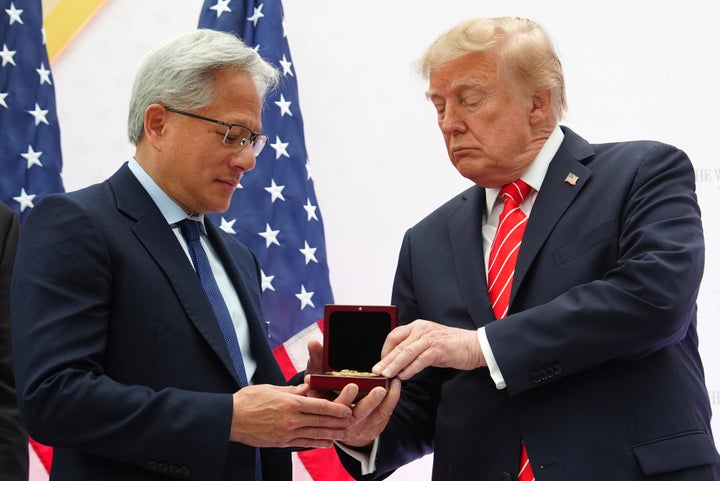
President Donald Trump allowed Jensen Huang, the CEO of a major computer chip company, to engage in discussions with China. U.S. intelligence had expressed concerns about Huang’s proximity to a Chinese spy, yet Trump permitted the sale of advanced chips to China. This decision raised questions about America’s efforts in the race for artificial intelligence dominance.
Nvidia donated $25 million to Trump’s ballroom project, further complicating the issue. Trump continues to support Huang, despite an ongoing internal investigation at Nvidia over Huang’s admitted affair with an executive at a Malaysian data center company. Trump’s comments on the matter have downplayed any security risks.
“I think he’s an honorable guy,” Trump stated, dismissing concerns over Huang’s dealings. Trump suggested everyone has affairs that may affect national security, adding he saw no issue with Huang joining an upcoming meeting with Chinese leader Xi Jinping. “I’d certainly take him,” Trump affirmed.
Trump acknowledged being informed of Huang’s ties with a woman under suspicion as a Chinese government operative. “I think he probably has an excuse for it,” Trump rationalized. He defended Huang at a press conference, referencing Huang’s claim of ignorance about the woman’s espionage role.
A memo concerning the situation allegedly circulated earlier, but Trump stated it did not significantly impact his decisions. “Certainly, it didn’t make much of an impact on me,” he said. The scandal implicates broader concerns, touching on Nvidia’s stock performance’s role in the U.S. economy, donor influence in the Trump administration, and national security challenges.
Central to Trump’s policy has been an emphasis on competing with China, which is complicated by his leniency in regulating AI or data centers. He reiterated this stance during a “60 Minutes” interview, saying, “We’re in a race with China.”
John Bolton, a previous national security adviser, expressed surprise at the unfolding scenario given its significant security implications. Robert Kagan, a former State Department official, criticized the administration for prioritizing personal financial benefit over consistent foreign policy.
Ex-Chicago Mayor Rahm Emanuel highlighted Trump’s purchase of Nvidia stock, questioning administrative awareness of the issue’s details. “Who in the Trump Administration knew? When did they know it? And knowing it, why did they keep letting Huang make his case?” Emanuel queried publicly. The White House and National Security Council have not responded to related inquiries.
Trump’s actions reflect a contradiction, extolling AI primacy while facilitating technological exports to China. On April 25, Trump declared intent to lead over China in AI. “We’re dominating AI. We’re leading everybody, including China,” he stated in Dublin on Sept. 12, bringing Huang to Beijing shortly after.
Nevertheless, Trump approved Huang’s request to export Nvidia’s H200 chip to Chinese firms. On Monday, as concerns mounted, Senators Elizabeth Warren and Jim Banks called for a suspension of Nvidia’s export licenses to China, urging a national security review.
The revelation of Huang’s interaction with a potential Chinese agent intensified scrutiny over Nvidia, pressing for transparent answers on any related activities.
 Gov.-elect Xavier Becerra Announces Transition Team
 Audit of ICE’s Body-Camera Program Underway
 Governor Newsom to Attend UN Climate Conference in Turkey
 Sen. John Cornyn’s Final Days in the Senate
 Scrutiny on Nvidia’s CEO Raises Questions of Political Motives
 Federal Government Freezes Minnesota Medicaid Funds Amid Fraud Concerns