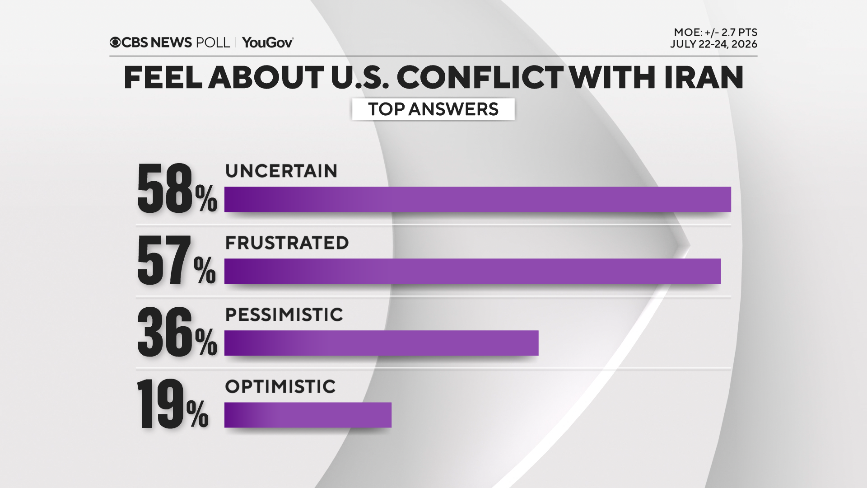
According to a CBS News/YouGov survey conducted in late July 2026, many Americans express feelings of uncertainty and frustration about the ongoing conflict with Iran. The public identifies key goals for the U.S., including reopening the Strait of Hormuz, halting Iran’s nuclear program, and mitigating regional threats. Yet, there’s skepticism about the ease of achieving these objectives.
Public Perception of the Conflict
As fighting escalates, the majority of Americans expect the conflict to prolong for months or even years. This reflects a belief that the situation is more challenging than the Trump administration initially thought. Despite the importance of diplomatic goals, a larger number of respondents now prefer ending the war rather than pushing for additional concessions. This sentiment, however, has waned compared to previous support when a ceasefire appeared imminent.
The survey also highlights a partisan split. While Republicans mostly supported the President’s earlier decision to seek a ceasefire, many now advocate continuing the conflict following the breakdown of the deal. Meanwhile, younger Americans are likelier to favor concluding the war compared to those over 65.
Challenges in Understanding and Approval
Many Americans report a lack of clarity on day-to-day developments in the Strait of Hormuz. While perceptions of progress have dimmed, opinions on who holds the upper hand remain varied, with some believing the U.S. has gained an advantage recently.
President Trump’s handling of the conflict is perceived negatively by most, believing he portrays the situation more positively than reality reflects. Despite these criticisms, overall approval ratings of actions in Iran remain stable yet unfavorable.
Domestic Concerns and Economic Influence
Domestically, economic issues persist without significant change. Income stagnation relative to inflation concerns many, with the President criticized for insufficient focus on reducing prices and unpopular tariffs, as well as efforts to modify buildings in Washington, D.C. Issues like high gas prices, though slightly improved, remain significant hardships for half of the population, correlating to disapproval of military actions linked to the conflict.
Perspectives on the U.S. economy remain largely negative but unchanged over recent weeks. Those affected by rising costs overwhelmingly oppose new tariffs. The President’s approval regarding Iran remains low, although his general approval rating has slightly improved since June.
Political Dynamics
When considering approaches to Iran, the public does not perceive Democrats as having a strategic advantage over Republicans. This perception of insufficient solutions across the political spectrum contributes to broader uncertainty about resolving the ongoing conflict.
Note: The margin of error for this survey is ±2.7 points, based on a sample of 2,193 U.S. adults, representative of the U.S. population across various demographics. It was conducted between July 22-24, 2026.
 Alan Ritchson Faces Backlash Over Political Remarks
  Himalayan Pilgrimage: A Couple’s Narrow Escape and Lingering Questions
  Former CEO Sentenced for Bank Fraud and Sanctions Evasion
  Russia’s Potential Incursion Into Estonia: NATO’s Resilience Under Scrutiny
  Senators Urge Action to Free Imprisoned Journalist in Iran
  Trump’s Address at UNGA and Key Political Developments