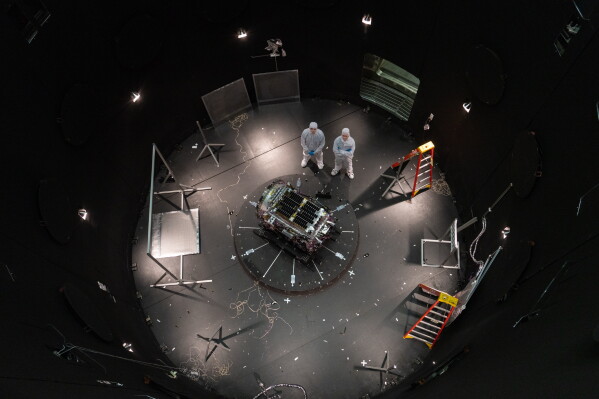
A three-armed spacecraft successfully launched into orbit on Friday from the Marshall Islands in the Pacific. It’s on a mission to save a NASA telescope that’s at risk of crashing back to Earth. This rescue mission involves Northrop Grumman launching Katalyst Space Technologies’ Link spacecraft. The Pegasus rocket took off from the belly of a modified aircraft, aiming to reach and secure NASA’s Swift Observatory within about a month.
The Swift Observatory, initially launched in 2004, is descending more quickly than before due to recent solar storms. NASA has invested $30 million in Katalyst’s mission to capture and elevate the telescope’s orbit, allowing it to continue its exploration of significant cosmic events like gamma-ray bursts and star explosions. If the operation is successful, Swift might resume its cosmic observations by September. Currently, all observations have been halted to maintain the telescope’s orbit as long as feasible.
The Hubble Space Telescope might face a similar recovery effort in the coming years, as it too is losing altitude because of increased atmospheric drag from solar activity. Right now, the 1.6-ton Swift Observatory orbits approximately 224 miles above Earth. The goal is for Katalyst to elevate its orbit by 150 miles, returning it to its original position. This will involve Link’s thrusters gradually boosting Swift’s altitude to avoid any rough movement.
Katalyst Space Technologies rapidly organized the mission in just nine months, prompted by NASA’s urgency; the telescope will be irretrievable by fall if not adjusted. Without timely intervention, it’s forecasted to fall and disintegrate by October. There were last-minute launch delays due to bad weather and technical challenges.
“This mission carries a high risk but offers high rewards,” said Katalyst Space CEO Ghonhee Lee before the launch. “The critical threat was failing to launch and allowing Swift to burn in the atmosphere. We’ve diligently worked to prevent that situation.”
The Associated Press Health and Science Department receives support from the Howard Hughes Medical Institute’s Department of Science Education and the Robert Wood Johnson Foundation. The AP remains solely responsible for all content.
 Hurricane Formation and Strengthening
  Ancient Mastodon Tooth Unearthed in California Creek
  The Tiny World of the Pumpkin Toadlet
  Chimps and Self-Medication: Insights from Gombe Stream
  Rovelli Challenges Physics with Relational View
  Legal Waiver for Sharing UAP Information Announced