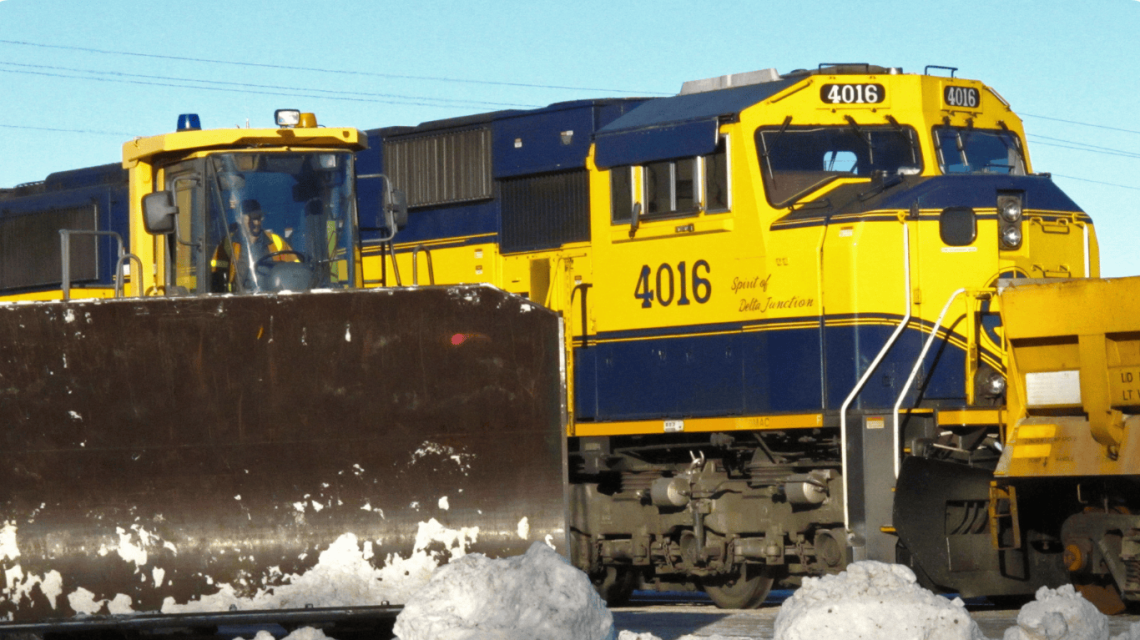
For almost 35 years, the railroad to Port MacKenzie has remained mostly undeveloped. First proposed in 1992, the Cook Inlet port was yet to be constructed. Over the years, construction made sporadic progress. A right-of-way was cleared, and much of the groundwork was established, but rails themselves were never installed, according to the Alaska Beacon.
Recently, a $311 million project for the 32-mile line was approved by the railroad board, with a substantial grant announced in October covering a majority of the expenses. The railroad’s chief executive, Bill O’Leary, informed the Beacon that construction could commence next summer.
Infrastructure and Industry Goals
The line aims to serve as a freight corridor for minerals, materials for natural gas pipelines, and national security. However, documents from its two endpoints reveal more complex goals. At the port, a developer plans an “Advanced Manufacturing & Compute Campus.” Near Houston, where the spur meets the main line, the state’s development authority has secured approval for land designated as “a behind-the-meter data park.” Neither data center has been built, nor is there a committed tenant for either. Yet, records indicate simultaneous railroad revitalization and decisions about welcoming power-intensive industries in Alaska.
National Context and Alaska’s Energy Decisions
Across the U.S., developing data centers for artificial intelligence involves power source considerations. In Alaska, one proposed solution is coal. In March, the Interior Department announced Terra Energy Center’s $1 billion agreement with Hyundai Heavy Industries Power Systems for boilers for a 1.25-gigawatt coal power plant in Alaska. This marks the first such order in the U.S. since 2006. Korean private equity firm KOREIT committed $500 million.
This initiative comes amid a political shift. Incoming Governor Jonathan Kreiss-Tomkins, a Democrat, has expressed intent to temporarily ban new data centers.
Local Developments and Port MacKenzie
In March, the Matanuska-Susitna Borough Assembly passed a resolution supporting a collective effort with Terra Energy Center Corp. to attract “large power consumers.” The resolution highlights “Attraction of data center and advanced computing facilities” as a priority. It promises a steady power supply from TECC’s planned generation facility and emphasizes land near Port MacKenzie’s advantageous tidewater access. Unlike the Interior Department’s announcement, neither the resolution nor the memo mentions coal.
The memo reveals Terra has a land-use permit for about 1,058 acres in the port district. This permit allows Terra to assess the feasibility of an “Advanced Manufacturing and Computing Campus.” If the developer fails to lay a foundation by December 31, 2028, the borough may reclaim the land.
Despite Mayor Edna DeVries’ veto of the resolution over concerns about potential land risks, the Assembly overrode her decision. The resolution does not obligate the borough to sell or lease land. Supporters are planning around the tracks, and coal-powered computing projects are among upcoming developments.
Other Projects and Critical Minerals
In October 2025, the Department of War awarded $43.4 million to Nova Minerals’ subsidiary, Alaska Range Resources, under the Defense Production Act. This funding supports military-grade antimony trisulfide production. Nova plans to pair a mine with a refinery at Port MacKenzie. Both facilities are planned but not yet operational.
Critical minerals, including antimony, contributed to securing federal funding for the railroad. The grant announcement did not reference coal power or computing.
Houston Developments and Land Use
The Alaska Industrial Development and Export Authority (AIDEA) applied to the state Department of Natural Resources for about 20,000 acres near Houston. Plans include “secure, scalable data centers,” “a behind-the-meter data park,” and “a data/energy campus.” The application mentions utility corridors for electricity, natural gas, and fiber, without mentioning the Port MacKenzie line.
A smaller transfer of 6,800 acres was approved, despite substantial public concern and comments over the development prospects of scalable data center facilities. Borough officials suggested West Susitna and Point Mackenzie as more suitable locations for these developments, which would relocate them closer to the port.
Grant Details and Legislative Support
The U.S. Department of Transportation’s $249 million grant announcement focused on moving Alaska’s substantial mineral and energy resources. Transportation Secretary Sean Duffy highlighted the state as “America’s natural resource powerhouse.” Alaska Senator Lisa Murkowski stated that the link would enable cargo movement from resource projects in the region.
Coal’s relevance persists in past records; the Surface Transportation Board approved the line in 2011. In the environmental impact statement, the railroad argued the spur would make resource development more feasible. The plan included coal, limestone, timber, and metallic minerals, estimating “two freight trains per day.” Fifteen years later, coal resurfaces as an energy source for computing instead of as cargo.
Funding and Future Steps
AIDEA committed $33 million of the necessary matching funds, with the rest covered by the railroad and borough. A state briefing indicated $184 million in state rail infrastructure investment. The project received legislative support with a 58-1 vote in House Joint Resolution 14, which noted almost two-thirds of the project as complete.
AIDEA’s board will revisit funding on November 24. Kreiss-Tomkins, starting his term in December, wants spending paused until then. O’Leary does not foresee the governor obstructing the rail project.
Republican Senator Dan Sullivan, who celebrated the grant, lost re-election. Construction commencement awaits federal approval, expected within a month to six weeks. Nova targets antimony production in 2027, while Terra’s term sheet has a 2028 deadline for foundational work.
The initial freight on the new line, whether minerals, pipeline steel, or server equipment, remains undecided by the available documentation.
 Body of Missing Marine Found in San Bernardino County
 Weather Threatens Thanksgiving Travel Plans
 Purdue University Professor and Daughters Killed in Apparent Murder-Suicide
 Rodeo at Angola: Redemption and Resilience
 Mexico’s New Documentation Requirements for Cruise Passengers
 Tragic Arizona Crash Claims Two Lives