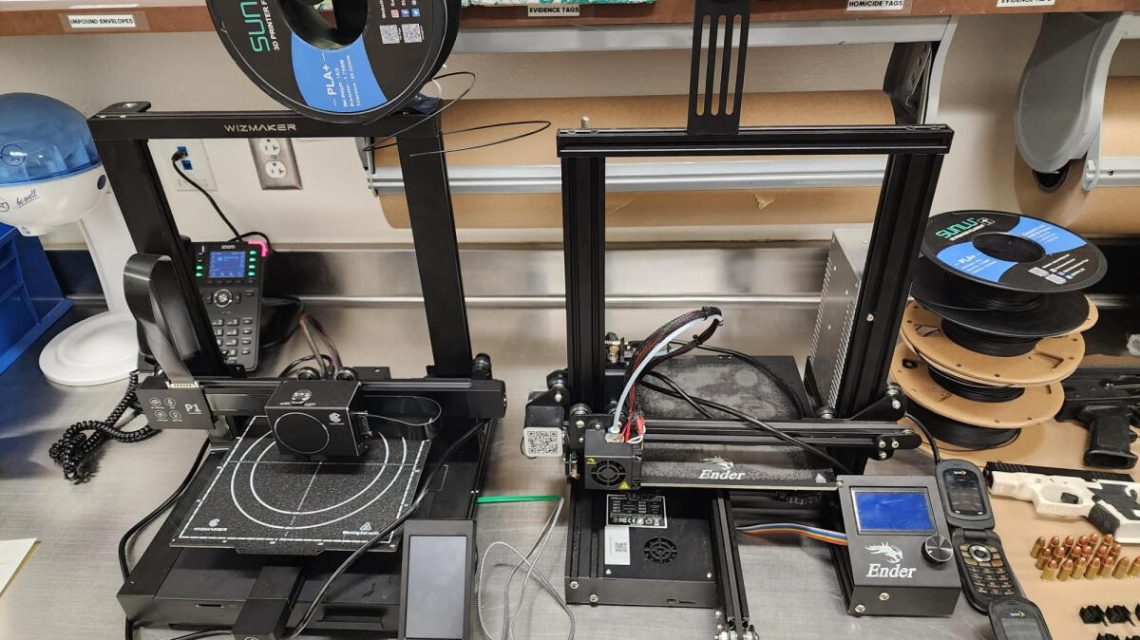
San Diego County recently intensified its battle against ghost guns in California by filing a lawsuit against a 3-D printing filament manufacturer. The lawsuit targets Polymaker, accusing the company of selling filament for the expressed purpose of making illegal firearms, violating state laws. This legal action is in collaboration with the Giffords Law Center.
The county alleges that Polymaker made a deliberate business decision to market and sell 3-D printer filament in California, enabling the production of untraceable firearms. These firearms, known as ghost guns, can be created using consumer-grade equipment, allowing individuals to manufacture weapons in less than nine hours.
The lawsuit highlights that unlike ghost guns made from commercially sold parts, 3D printed ghost guns can be assembled using plastic filament, which is fed into 3-D printers.
A recent incident involving a 16-year-old in San Diego County exemplifies the potential dangers. The police recovered spools of filament and printed firearms from his home, which he intended to sell. This case underscores the threat Polymaker’s products pose, according to the suit. Polymaker has not commented on these allegations.
This lawsuit is part of a wider effort by California to curb the production of ghost guns by halting the sale of essential components. Earlier this year, San Francisco joined with the California attorney general to sue Gatalog, an online library offering digital firearm manufacturing codes for various 3-D printed guns.
The availability of affordable 3D printers, starting at about $200, and PLA+ polymer filament, which cost around $20-30, make producing a 3D-printed handgun much cheaper compared to a manufactured firearm. For example, a 3-D-printed handgun can cost about half the price of a Glock.
The lawsuit claims that the proliferation of untraceable weapons has pushed authorities to extend regulatory powers to capture prints and components used by hobbyists to produce firearms with minimal investment.
Both Gatalog and Polymaker, the lawsuit alleges, promote their products through a network of influencers specializing in ghost gun content. Polymaker targets California residents, featuring state-specific privacy and Proposition 65 warnings on its website.
Legal actions against these entities have sparked challenges from those accused. For instance, the creators of Gatalog contested their lawsuit, claiming it infringed on their rights. However, a Florida court sided with California’s capacity to regulate these products.
The campaign against ghost guns is part of a broad initiative by local and state officials in California, employing the Unfair Competition Law. San Diego’s latest suit is one of several undertaken by a new department aimed at actively litigating against businesses on behalf of its residents.
There remains uncertainty about enforcing new gun control measures. Recent decisions by the 9th Circuit Court of Appeals, which has shown skepticism towards gun control measures, question how effectively these laws can be implemented. The court has ruled on cases involving ghost guns, with some opinions acknowledging the complexity of distinguishing between raw materials and component parts.
The issue goes beyond state concerns as the Supreme Court has also deliberated on related cases, balancing regulatory control with constitutional rights. Justice Gorsuch emphasized that unfinished parts aren’t necessarily equivalent to assembled products, drawing analogies to common objects to illustrate the point.
 Police Investigate Potential Serial Killer on Popular Trail
  Shooting of Dominican Man by Federal Officer Sparks Controversy
  Demonstrators Rally on National Mall to Support Cornell University Rape Case
  Controversy Erupts Over Save Girls Sports Advocate’s Shirt at California School Forum
  Hurricane Isaias Approaches Florida Panhandle
  Texas Senate Race Heats Up as Ken Paxton Faces Pressure to Debate