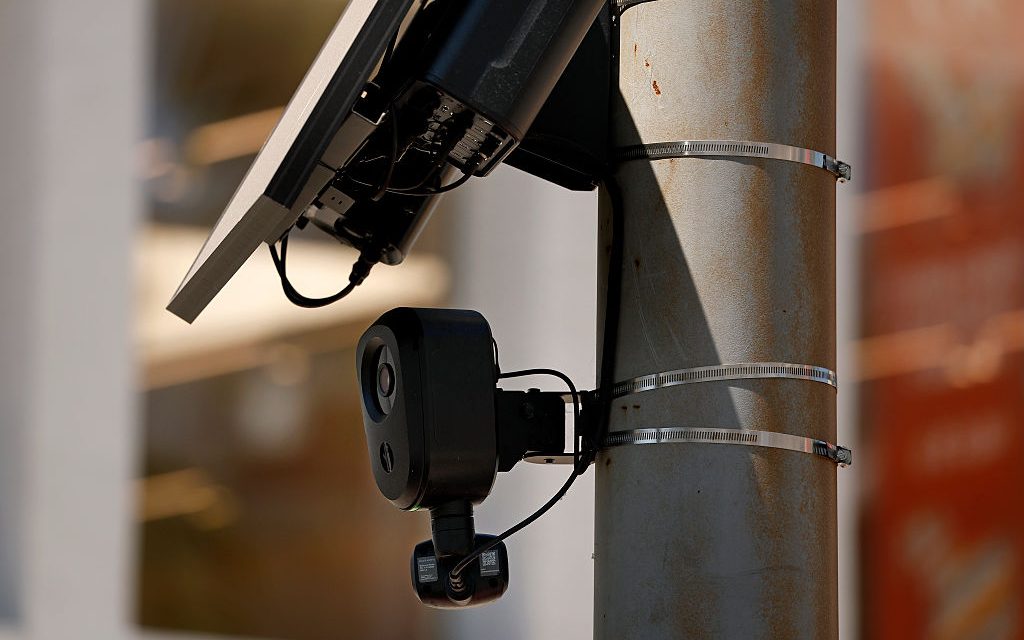
Flock Safety is a surveillance equipment provider collaborating with over 5,000 law enforcement agencies in 6,000 communities. The company supplies solar-powered license plate readers that record and compile data. Agencies partnering with Flock can search these records for license plate numbers, car makes and models, or unique identifiers like bumper stickers.
Supporters claim these cameras aid in crime resolution, while critics worry they could misuse data to monitor individuals not involved in criminal activities. A Flock Safety camera is shown mounted to a light pole on August 3, 2026, in Beverly Hills, California. ‘The system collects data from every car’s license plate that passes through, creating a vehicle fingerprint using AI,’ explained Knox County Mayor Glenn Jacobs in an interview. ‘It includes distinctive features like make, model, color, and other markers. This data is retained for up to 30 days in a searchable database, flipping the traditional purpose of license plate readers.’
Garrett Langley founded Flock Safety in response to rising crime rates he witnessed in Atlanta. During an April TED talk, Langley stated, ‘Crime felt too easy to get away with. The fact that someone could steal a car or commit murder and have a 50% chance of evading capture didn’t make sense.’
Checking Flock Camera Locations
Flock reports that almost 100,000 cameras are operational across more than 6,000 communities in 49 states. However, the company does not publicly provide detailed camera location lists. DeFlock seeks to raise awareness about automatic license plate readers and their potential impact on privacy and civil liberties. Through a crowd-sourced map, DeFlock shows alleged camera locations across the U.S.
‘Camera locations are provided by volunteers and the OpenStreetMap community, not by private companies or government agencies,’ states DeFlock.
Nexstar couldn’t verify these claims independently, but users can explore their neighborhood using the map above. It includes cameras from other tech companies besides Flock. As these cameras become more widespread, criticism has grown. Several city councils have chosen to reject or remove Flock cameras, pushing for enhanced privacy measures.
San Jose, California, exemplifies proactive community measures, restricting data storage to 30 days and banning cameras near sensitive locations such as abortion clinics, healthcare facilities, or places of worship.
This material is owned by Nexstar Media Inc. It cannot be published, broadcast, rewritten, or redistributed without permission.
 Tips for Maintaining VPN Connection While Traveling
  Debate Over OpenAI’s Solution to Navier-Stokes Equations
  Google Fined for Privacy Breaches
  Emergence of AI-Powered Malware and Its Implications
  Virginia’s Data Center Plan Sparks Tensions Over Energy and Environmental Goals
  President Trump Proposes ‘Super Intelligence’ as New AI Term