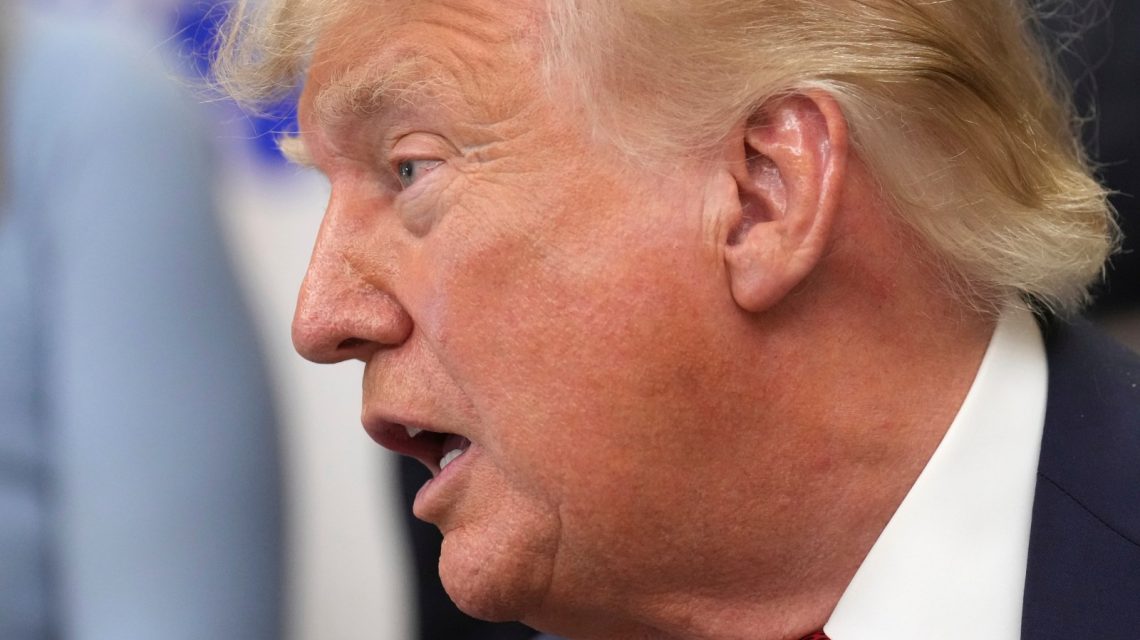
President Donald Trump has revealed plans to establish an “AI Force” and appoint an artificial intelligence “czar.” This announcement marks a shift from his earlier stance against imposing new regulations on the tech industry.
In a Truth Social post, Trump emphasized the initiative’s role in overseeing AI without introducing regulations he fears might hinder innovation. He stated that the government would not hinder the industry’s growth but instead support and oversee it as it expands. He argued that current criminal and civil laws are sufficient against AI company misconduct.
Trump stated, “I am forming the AI Force, much like I did Space Force,” reflecting on his previous success. He promised to appoint an AI ‘Czar,’ limited to individuals with high intelligence quotients. He also noted AI’s potential to significantly impact the economy, potentially contributing up to 25% of the U.S.’s GDP.
The proposal lacks details about its structure, authorities, and staffing but arrives as AI continues to influence U.S. economic, national security, and technology policy. Newsweek contacted the White House for further comments.
Tech leaders such as Dario Amodei, Sam Altman, and Elon Musk have recently advocated for stronger safety measures in AI development. They suggest that security protocols should advance alongside increasingly capable AI systems.
Trump has presented AI as a strategic competition, particularly with China, aiming to maintain the U.S.»s leadership. His recent statements dismissed concerns about AI risks, labelling them exaggerations and conspiracies against AI advancements.
John Walsh, IGEL’s CTO for government and critical infrastructure, remarked that, rather than creating additional government bodies, there is an opportunity to foster an ecosystem involving government, industry, researchers, and standards organizations. He stressed the importance of establishing measurable safety and security in AI deployment internationally.
Walsh compared the process to automotive safety regulations, which have developed common evaluation parameters recognized globally. The focus should be on establishing standards, testing, validation, and economic incentives that foster innovation. Safety and security should be competitive drivers.
He asserted that collaboration with industry and standards organizations can incentivize international adoption. Practical and measurable requirements for trustworthy AI would encourage technology providers to meet these standards.
Walsh cautioned about the urgency as AI progresses from recommending actions to acting autonomously. As AI gains capability, trust in its systems must be engineered through verifiable identity, limited access privileges, defined operational boundaries, continuous validation, auditability, containment, and human intervention.
Industry and Bipartisan Calls for AI Regulation
Trump’s move follows increased demands for AI oversight from tech leaders and bipartisan lawmakers. Amodei, in an essay titled “We Must Pace the Frontier,” highlighted the industry’s need for slower development for safety reasons. Altman echoed this sentiment, advocating careful progression in frontier AI development. Musk also flagged the need for attentiveness towards AI risks.
AI researcher Jacob Coxon warned of the potentially catastrophic impact of powerful AI systems, claiming they could pose an existential threat within the decade. He resigned from Anthropic, citing the industry’s rush toward self-improving AI without adequate safeguards.
Other AI experts highlight the necessity of government oversight for issues such as misinformation, fraud, and national security. Legislative attention is growing at both national and state levels.
Senator Bernie Sanders urged Congress to intervene, advocating for a pause in advanced AI development and a ban on artificial superintelligence. Representative Anna Paulina Luna called for a special Congressional session, pointing out AI’s broad societal impacts and potential industry benefits.
Representatives Ted Lieu and Nathaniel Moran introduced bipartisan legislation to mandate that AI developers maintain control capabilities over advanced AI systems. The bill includes provisions for the Secretary of Homeland Security to demand slowdowns or shutdowns if AI systems are deemed harmful.
Lieu’s office stressed the importance of developers having intervention capabilities over increasingly autonomous systems.
What Happens Next
As the U.S. enters talks with China on AI and technological competition, the Trump administration’s plan for the AI Force could influence domestic policy and contribute to global discussions on governing powerful AI systems.
 Federal Judge Maintains Oversight on Maricopa County Sheriff’s Office for Racial Profiling Issues
  Criticism Surrounding Alex Ovechkin’s Political Appearance
  US Faces Challenges in AI Competition with China
  Affordable Premiums for Seniors Act Proposed to Extend Medicare Drug Subsidy Program
  AI Integration in Healthcare: Navigating Challenges and Opportunities
  Rising Gasoline Prices and Political Impact Ahead of Midterms