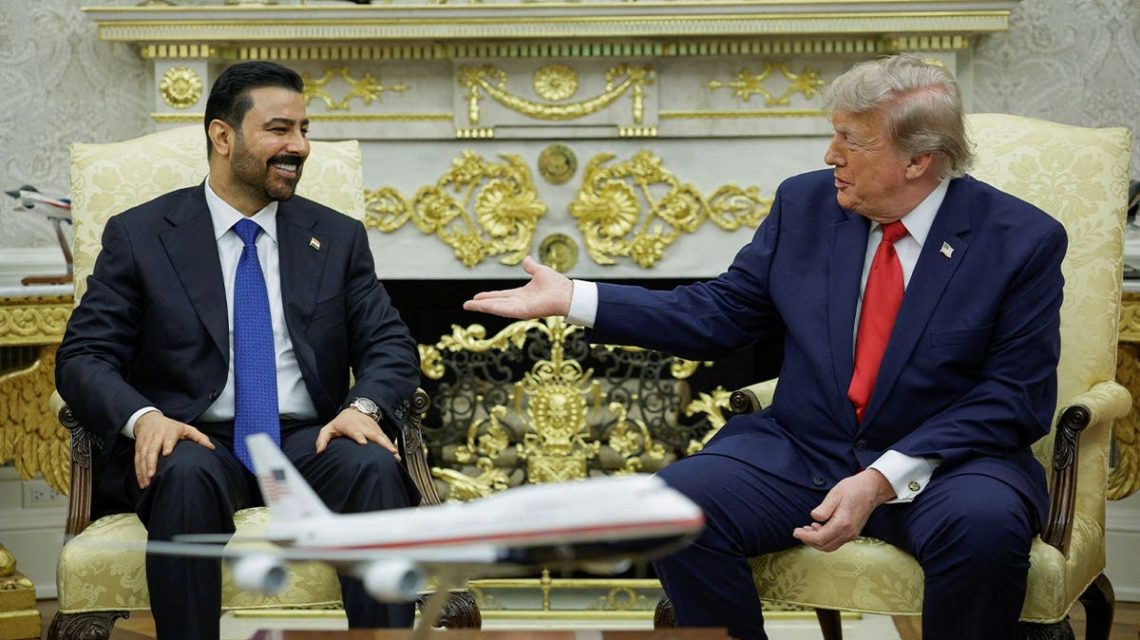
President Donald Trump announced that Iraq no longer requires the presence of U.S. troops, indicating that the country is ready for autonomy. In response, Iraqi Prime Minister Ali al-Zaidi stated that any armed groups outside government control will have no grounds to exist once the coalition’s mission concludes.
The Trump administration has been exerting pressure on Prime Minister al-Zaidi to disband pro-Iran militias, despite facing obstacles in this effort. In late August, a senior Iraqi official declared that the government will not view September 30 as the deadline for disarming the Popular Mobilization Units (PMU), also known as the Popular Mobilization Forces.
The Iraqi government aims to rein in state-affiliated militias by integrating them into official structures. Some factions within the PMU, such as Muqtada al-Sadr’s Saraya al-Salam, support this integration approach. However, more extreme groups, including Kataeb Hezbollah and Harakat Hezbollah al-Nujaba, have refused to disarm or integrate.
Qasim al-Araji, a security advisor to the prime minister, clarified that September 30 marks the departure date of the international coalition, not the deadline for disarmament. This coalition, led by the U.S., played a crucial role in defeating the Islamic State in Iraq and Syria during Trump’s tenure. The reason for the Iraqi government’s revision of the PMU disarmament timeline remains unclear.
The Iraqi government previously issued a statement affirming that all political factions are committed to centralizing weapon control within the state. Prime Minister al-Zaidi emphasized the absence of intentions for military confrontations and highlighted the negative impact of unauthorized weapons on investment opportunities.
Al-Zaidi communicated at the Baghdad Dialogue Conference that consensus exists among political forces on maintaining arms under state authority. He stressed the importance of preventing hostile entities from exploiting any vulnerabilities.
In May, the U.S. Treasury Department sanctioned Iraq’s Deputy Oil Minister, Ali Maarij Al-Bahadly, accusing him of channeling oil benefits to Iran-aligned militias. Treasury Secretary Scott Bessent condemned Iran for leveraging Iraqi resources to fund activities against the U.S. and its allies.
In August, reports indicated Al-Bahadly faced legal consequences for corruption. Additionally, controversy arose over reports of Iraqi oil being transported through the Strait of Hormuz, partly funding Iran’s militia operations. An Iraqi spokesperson refuted such claims.
A U.S. State Department representative expressed support for Iraq’s new direction under Prime Minister al-Zaidi, underscoring the partnership between the U.S. and Iraq.
Entifadh Qanbar, a former spokesperson during the George W. Bush administration, expressed skepticism about al-Zaidi’s ability to address militia challenges, despite rumored commitments following his White House visit.
Recent militia actions indicate ongoing refusal to disarm. IRGC Quds Force commander Esmail Qaani’s instructions to delay disarmament efforts have been noted as a strategic move within Iran’s broader deterrence plan.
Elizabeth Tsurkov, affiliated with the New Lines Institute, acknowledged the Iraqi government’s attempts to regain control, but acknowledged the militias’ ability to resist due to their infiltration into state structures.
The arrest of Abbas al-Yaqubi, head of intelligence for PMF operations, and his subsequent transfer back to the PMU, highlighted the difficulties the Iraqi government faces in challenging militant groups.
Benjamin Weinthal covers Israel, Iran, Syria, Turkey, and Europe. For more updates, connect with him on Twitter @BenWeinthal.
 President Trump’s Ideal Venue Near the White House
  U.S. Lawmakers Propose AI Development Ban Amid China Competition Concerns
  Hasan Piker’s Influence and Controversy Within the Democratic Party
  Explosion at Mexican Festival Causes Fatalities and Injuries
  AM Radio’s Lasting Impact and Future Assurance
  Democratic Candidate Supports Impeachment of War Secretary