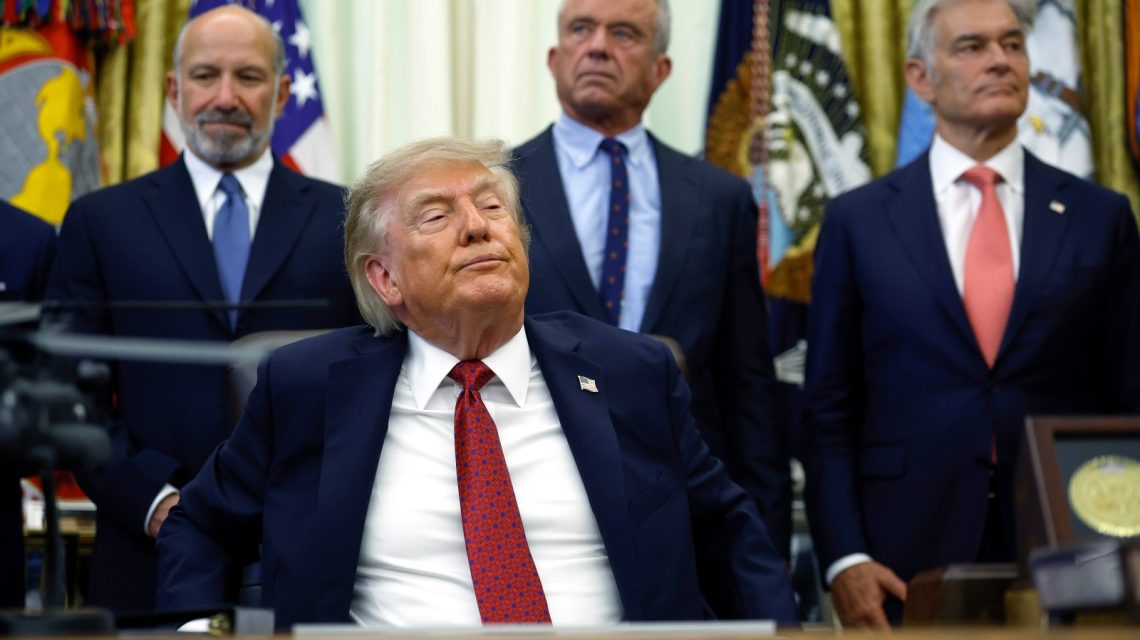
Trump’s Commitment to $5,000 Checks
President Donald Trump has reinforced his pledge to issue $5,000 checks to Americans if Republicans maintain control of Congress. However, a novel approach to funding these checks involves wealthy foreigners contributing $5 million each to the federal government.
Proposed Funding Through Trump Platinum Card
Commerce Secretary Howard Lutnick revealed that this payment would not rely on taxpayer money, emphasizing the upcoming Trump Platinum Card program. Lutnick noted that over 100,000 individuals are already on the waiting list for this program.
Lutnick said, “We have a waitlist of more than 100,000 people who want to come. That’s $500 billion.”
Trump repeated his promise in a Truth Social post, initially presented at the Republican midterm convention in Dallas. Critics, primarily Democrats, have labeled the promise as a vote-buying tactic.
White House spokesperson Davis Ingle defended Trump’s record in a statement to Newsweek, citing achievements like lowering prescription prices and securing the border.
Projected Expenses and Eligibility
Should this proposal go ahead, it represents a significant financial undertaking. The Associated Press estimated the total cost at around $1.23 trillion, considering the number of eligible adult U.S. citizens. Vice President JD Vance has proposed excluding wealthy Americans, though no income cutoff has been announced.
This raises the critical question: where would the funds, over $1 trillion, originate from?
Details of the Trump Platinum Card
The Trump Card website describes the Platinum Card as “coming soon.” Currently, foreign nationals can join a waiting list, but the program itself hasn’t launched. Applicants will have to pay a $15,000 processing fee and a $5 million contribution to the U.S. government for the privilege of spending up to 270 days per year in the country without being taxed on their non-U.S. income.
If 100,000 individuals pay the full amount, the program could generate $500 billion. Nonetheless, this would only cover around 41% of the proposed $1.23 trillion total. Achieving complete funding through Platinum Cards would require approximately 246,000 contributors.
Previous Programs and Funding Alternatives
The Gold Card program, launched in December 2025, offered a similar immigration path for a $1 million contribution plus a $15,000 fee. Lutnick claimed $1.3 billion “worth” of Gold Cards sold quickly, but only one person had been fully approved by April, despite predictions of raising $1 trillion.
Other funding suggestions include utilizing tariff revenue. The Congressional Budget Office estimated tariff collections at $167 billion for the current fiscal year, significantly less than what would be needed. Trump’s investment in Intel has also been suggested as a source, following the government’s acquisition of shares worth billions.
Marc Goldwein of the Committee for a Responsible Federal Budget pointed out the existing federal deficit of roughly $2 trillion annually. Nevethless, any dividend spending would need congressional authorization.
Previously, Trump proposed other dividends, such as the “DOGE dividend” and a $2,000 tariff dividend. Neither materialized.
Democratic Opposition
Democrats have criticized Trump’s proposal. Senate Minority Leader Chuck Schumer accused Trump of vote bribery, while other Democrats labeled the proposal as an empty promise and potentially illegal.
 New York City Council Considers Bill to Reform Press Pass Practices
  Rising Anti-Muslim Rhetoric in U.S. Politics
  Complexities in Middle Eastern Conflict: Yemen’s Houthis Challenge U.S. and Saudi Strategies
  Minnesota Senate Race: Flanagan vs. Tafoya
  Senate Debates Bills on Cryptocurrency Regulation and College Athletics Governance
  BRICS Summit in New Delhi: Key Discussions and Challenges