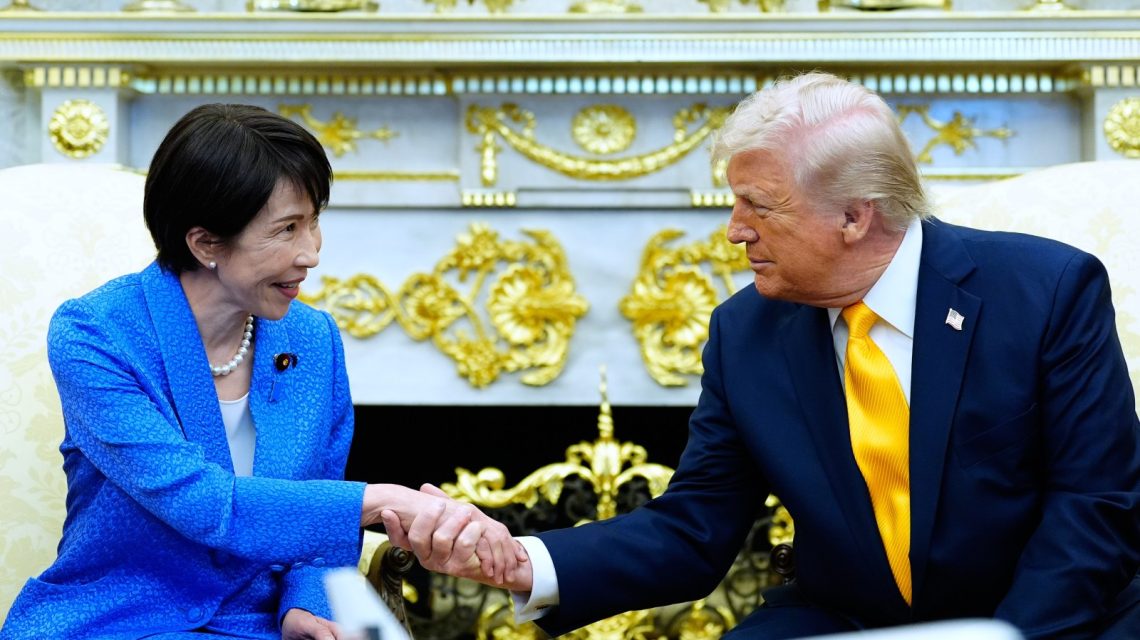
The United States has joined Japan in a joint effort to boost the yen, marking the first such collaboration in almost three decades. This move has successfully strengthened the currency in the short term. Despite this, analysts warn of ongoing challenges for the yen’s long-term stability.
The Market Impact
Following the announcement by U.S. President Donald Trump and Japanese Finance Minister Satsuki Katayama, the dollar weakened notably against the yen. Before markets closed on Monday, the dollar was trading at approximately 156 yen, a significant drop from the nearly four-decade high of over 163 yen in July. This intervention marks the first since the 1998 Asian Financial Crisis.
U.S. Treasury Secretary Scott Bessent stated both countries would maintain open communication and assured that Washington would participate in future interventions if necessary. Newsweek sought comments from the Bank of Japan for further insights.
Reasons for Yen Intervention
The yen’s depreciation has primarily resulted from the disparity in interest rates between the U.S. and Japan, making the dollar more appealing than the yen. This devaluation increases import costs, heightening inflation and the cost of living for Japanese families. Although the weak yen has made Japan a popular travel destination, it burdens consumers through increased import prices.
Compounding these issues is the U.S.-Iran conflict, affecting Japan’s crude oil imports through the Strait of Hormuz. With fuel prices capped at around 170 yen per liter, authorities are considering possible increases in response to the energy crisis, as reported by Kyodo News.
Benefits for Japan
President Trump highlighted the strong U.S.-Japan relationship during a recent briefing. He humorously acknowledged Japan’s requests for assistance, noting that the intervention reflects a “signal of friendship” benefiting both nations and the global economy.
Ken Moriyasu of the Hudson Institute pointed out that Trump sees Japan as a strategic ally against China and a partner in reducing the U.S. trade deficit. Following the global tariffs imposed by Trump, Japan was the first major economy to agree to a strategic trade and investment framework, involving considerable U.S. investments.
Political Context in Japan
The intervention comes at a politically sensitive time for Japanese leader Takaichi, whose approval ratings dropped below 60% for the first time since assuming office, according to a Yomiuri Shimbun poll. Her efforts to strengthen Japan’s Self-Defense Forces and previous comments about Taiwan have also drawn criticism from China.
Ken Moriyasu suggested Beijing might hope Trump directs Takaichi towards accommodations with China, but Trump’s stance indicates his focus remains on countering China’s influence.
Implications for the U.S.
Washington’s decision was also motivated by its interests, particularly concerning the U.S. Treasury market. Japan holds the most substantial foreign stakes in U.S. Treasuries, and any major selling could increase borrowing costs for the U.S. government.
Nic Puckrin, a former analyst, explained that while the intervention helps temporarily, the interest rate gap remains a significant issue. Japan would need to raise interest rates substantially to compete with those in the U.S., a scenario seen as unlikely in the short term.
Future Outlook for the Yen
Tokyo’s substantial investments earlier this year only provided fleeting support for the yen. However, joint action with the U.S. might yield more resilient results. It reduces the likelihood of rapid yen depreciation, granting the Bank of Japan time to assess impacts from the Middle East conflict and rate hikes. Nonetheless, Shigeto Nagai from Oxford Economics forecasts the yen, while stabilizing later, to face headwinds until possibly 2027, with gradual recovery as interest rates adjust globally.
For further information, Newsweek editors Frances Mao and Sam Wilson are available for comment.
 Venezuelan Leadership at the United Nations
  Ontario Synagogue Shooting During Yom Kippur Leaves One Officer and Shooter Injured
  Pope Leo XIV’s Upcoming Visit to Latin America: An Overview
  Ukraine Deploys Ground Robots in ‘Operation Vivaldi’
  Understanding AI’s Impact Compared to Historical Threats
  State Department Alerts on Middle East Travel Amid Rising Tensions