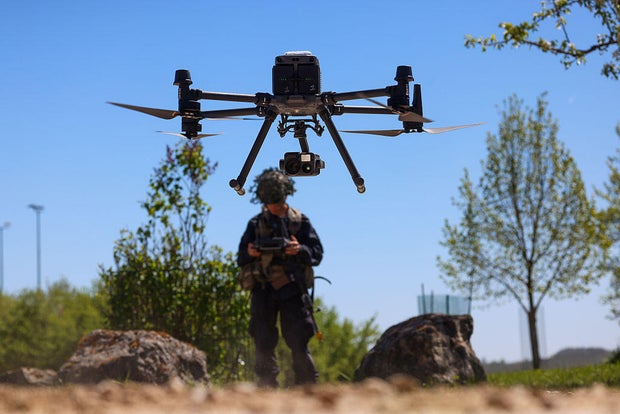
The U.S. Army plans to dismantle a drone battalion designed to study practical lessons from drone warfare, including insights from the ongoing conflict in Ukraine. An Army representative confirmed the decision to CBS News.
Several current and former officials cited tension between supporters of the battalion and Gen. Christopher LaNeve, the acting Army chief of staff, as a key factor. The battalion received backing from Gen. Randy George, former Army Chief of Staff, and Gen. Christopher Donahue, past commander of U.S. Army Europe and Africa. Both generals were dismissed or pushed to retire, leading to LaNeve’s appointment as acting chief.
The battalion, labeled the Unmanned Assault Battalion, focused on drone warfare deployment. With Ukraine’s war spotlighting drones’ pivotal role, the battalion aimed to equip Army strategies with new insights.
During a joint operation by the U.S. and Israel targeting Iran, Iran launched attack drones at U.S. military sites across the Middle East, reinforcing the drone’s significance.
The Unmanned Assault Battalion is part of the 173rd Airborne Brigade. After a scheduled exercise extending through September, the battalion will revert to core tasks as an airborne infantry unit. This involves parachute training and aircraft egression.
The Wall Street Journal initially reported the initiative’s closure. Previously, George and Army Secretary Dan Driscoll launched the Army Transformation Initiative, concentrating on unmanned systems. Driscoll expressed regret at not leveraging Ukraine’s experiences more effectively.
An Army spokesperson mentioned Driscoll chose not to comment on the unit’s dissolution.
Internal discord among Army leadership fueled the decision, say officials. Long-standing friction existed between LaNeve and proponents of the battalion, stemming from prior disputes involving LaNeve and Donahue, linked to LaNeve’s tenure at Fort Bragg ending ahead of schedule.
The Army confirmed plans to disband the drone unit, with LaNeve outlining future directions in “The Army Azimuth.” He emphasizes soldier fundamentals while integrating technologies to counter unmanned systems.
Every Soldier deserves to know where this Army is headed and what’s expected of them. My focus is simple and hasn’t changed: this Army must fight and win today.
David Petraeus, a retired Army general and former CIA director, advocates for incorporating drones into military operations. He argues for replacing traditional armored battalions with drone-focused groups.
Capt. Ronan Sefton, previously stationed in Germany, emphasized the need for more drones in military training. Learning from Ukraine, Sefton advises that drones should be integral to military exercises to enhance realism.
Sefton conveyed the significance of drones to senior U.S. commanders, advocating for immediate implementation to transform warfare. He joined the Ukraine Lessons Learned Task Force, aiming to apply Ukrainian battlefield experiences to the U.S. military strategies.
Sefton stresses that while advanced technology is crucial, traditional firepower remains vital. The Army must quickly adapt to rival nations’ drone innovations.
 Tensions Rise at NATO Summit as Trump’s Turkey Ties Face Scrutiny
  Prince Harry and Meghan’s Return to Britain: A Step Towards Reconciliation?
  U.S. Enacts New Sanctions on Ecuadorian Entities for Alleged Cocaine Trafficking
  Harry and Meghan’s Return to Britain: A New Chapter
  Choosing the Right Vacuum: Expert Insights and Recommendations
  Prince Harry and Meghan Markle’s Return to the UK: A Decision to Repair Royal Ties