International health officials announced the U.S. has lost its measles-free status, highlighting the spread of the highly contagious virus among unvaccinated populations. This marks the highest rate of spread in over 30 years. Mexico and Bolivia have also lost their measles-elimination status due to similar resurgences.
The Pan American Health Organization’s declaration is mostly symbolic but signifies a significant shift in controlling a disease once thought to be managed through scientific advances. The resurgence suggests a potential return of past diseases posing serious challenges today.
Since 2024, measles has been spreading across the Americas, starting in Mennonite communities and branching out to areas with low vaccination rates. Last year, Canada also lost its measles-free status, last held in 1998.
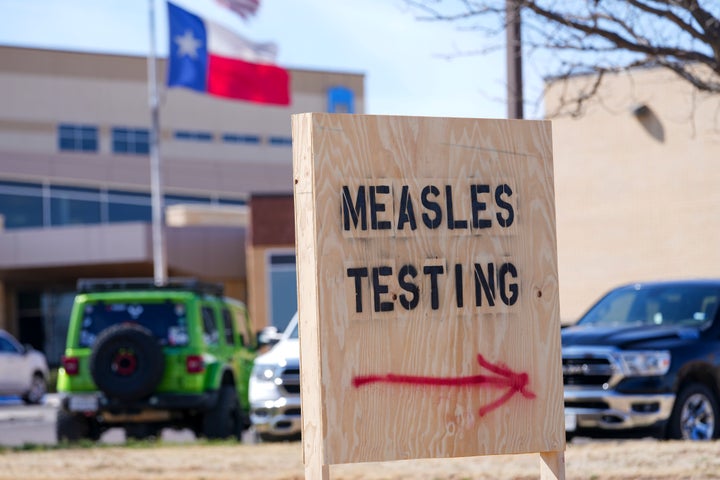
A sign is seen outside of a measles testing site in Seminole, Texas.
Based on international health standards, measles is considered eliminated if the virus does not spread locally. The status depends on whether a single measles chain persists uninterrupted for at least 12 months. This announcement reflects a decline in public health preparedness.
Vaccination rates have fallen for various diseases, both in the U.S. and worldwide. Measles, being highly infectious, is one of the first vaccine-preventable diseases to resurface when vaccination rates decline. Experts note this might indicate potential future outbreaks of other diseases.
Measles vaccination has successfully halted the virus in the U.S. for three decades. A 95% community vaccination rate is necessary to halt outbreaks. Yet, due to declining vaccination by parents and confusion sown by leaders, the virus finds opportunities to spread across the U.S.
According to Sen. Ron Wyden of Oregon, the situation results from misinformation campaigns endangering children’s health. The past two years saw over 7,000 cases and 11 deaths in the U.S. Nearly all those affected were unvaccinated or their vaccination status was unknown. More than 10% required hospitalization.
Measles usually begins with a high fever, followed by a distinctive rash starting on the face and neck. While recovery is common, it’s a leading cause of death among young children. Complications include blindness and brain swelling, especially in young children and adults over 30.
This year, the U.S. reported ten measles-related deaths, with at least five children among the deceased. These numbers surpass any year in the last three decades, making 2023 the worst for measles since 1991. Significant outbreaks have occurred in Texas, Utah, South Carolina, and Pennsylvania.
Following the 2000 elimination of measles, the U.S. typically recorded fewer than 200 cases annually, primarily linked to international travel. However, since 2025, outbreaks have surged, initially starting in the southwest.
In Texas, over 760 cases led to two child deaths. In New Mexico, 100 cases resulted in one adult death. During the summer of 2025, outbreaks spread in rural towns in Arizona and Utah. South Carolina experienced a major outbreak during winter and spring, with nearly 1,000 cases, marking a rapid rise in measles infections.
This year’s more than 5,400 confirmed cases, driven by a significant outbreak in Pennsylvania, have already doubled the 2025 figures. Experts believe the actual case numbers are higher than reported.
Critics argue the U.S. response is inadequate. U.S. Health Secretary Robert F. Kennedy Jr., a prominent anti-vaccine figure before his appointment by President Donald Trump during his second term, claims vaccination rates were already declining. Kennedy emphasizes that measles is not solely a U.S. issue, noting better handling of the virus compared to other countries.
While other countries face similar challenges with measles and lost elimination status, some experts contend that this result wasn’t inevitable for the U.S. The government has initiated some responses. The CDC recently allocated $100 million to support state and local responses to measles outbreaks. Kennedy and CDC Director Dr. Erica Schwartz acknowledge the importance of vaccination in preventing measles spread.
However, state and local health officials argue the funding falls short. Chrissie Juliano, executive director of the Big Cities Health Coalition, asserts that more resources are needed to address the crisis adequately.
Some experts criticize the lack of robust federal advocacy for vaccinations. Public health professor Noel Brewer remarks that the limited federal response contributes to declining vaccination programs.
Despite vaccination campaigns’ historical success, with the Americas achieving measles elimination in 2016 and preventing 6.2 million deaths between 2000 and 2023, North America now faces the challenge of regaining its measles-free status.
Some countries like Brazil and the United Kingdom have managed to regain their elimination status post-loss. Efforts continue across countries to reclaim this status in the modern landscape.
The Associated Press Health and Science Department receives support from the Howard Hughes Medical Institute’s Department of Science Education and the Robert Wood Johnson Foundation. The AP is responsible for the content presented.
 Managing Holidays While on GLP-1 Medications
 Highlights from Recent News Stories
 DEA Dismantles First U.S. Large-Scale Nitazene Lab
 Trump Open to Bipartisan Health Care Plan with Democrats
 Ty Pennington’s View on Home Renovation and Health
 Detroit Boy in Critical Condition After Unsecured Firearm Incident