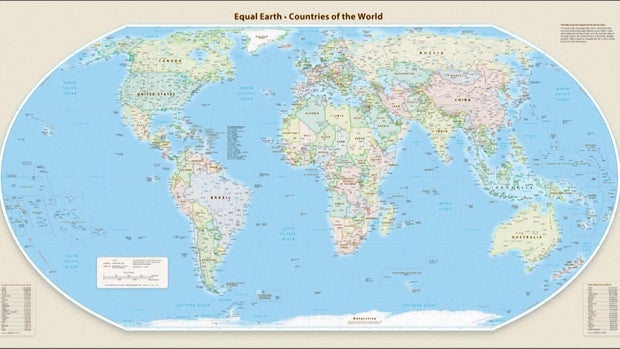
On September 6, 2026, the United Nations General Assembly agreed to endorse a new world map that depicts Africa’s actual larger size. This decision marks the result of a campaign initiated by African nations and advocacy groups seeking more accurate global representation in maps.
The resolution, sponsored by Togo and supported by African Union members, received 164 votes in favor. The United States opposed it, while Serbia, Estonia, Georgia, Lithuania, Moldova, and Ukraine abstained from voting.
The initiative encourages global governments and institutions to transition from the Mercator map, frequently used since the 16th century, to the Equal Earth projection. The latter offers a more accurate depiction of the world’s sizes and shapes.
The Mercator projection inaccurately portrays Greenland and Africa as nearly identical in size. In contrast, the Equal Earth projection accurately demonstrates Africa as 14 times larger than Greenland.
Although the resolution does not mandate an immediate switch to the Equal Earth projection, it encourages adopting it. Togo’s Foreign Minister, Robert Dussey, emphasized maps’ role in shaping worldviews and educational materials. He noted that a map’s representation can greatly influence perceptions.
Africa No Filter, a prominent advocate for the new map, praised the resolution. They aim for the Equal Earth map’s inclusion in educational and informational resources worldwide.
French Foreign Minister Jean-Noël Barrot supported the resolution, noting it corrects a long-standing misrepresentation of global proportions.
The Mercator map, developed by Gerardus Mercator, originally aimed to assist European navigators. However, it exaggerated landmass sizes near the poles and minimized those near the equator.
The Equal Earth projection, developed in 2018, follows the Earth’s natural curvature. It more authentically represents the relative sizes of continents and countries.
Geographers, like Professor Mark Monmonier from Syracuse University, assert that the Mercator map’s utility lies solely in navigation. Beyond maritime use, it offers limited value.
 U.S. Forces Intercept Drug-Smuggling Vessels Near Ecuador
  Dolphin Incident in Ceuta Sparks Outrage Among Locals
  DHS Plans to Expand Birthright Citizenship Exceptions
  Efforts Intensify to Ban Child Marriage in the U.S. and Globally
  Russian Propagandist Calls for Aggression Against NATO
  Lost Papal Letter Offers Fresh Insight into the Norman Conquest