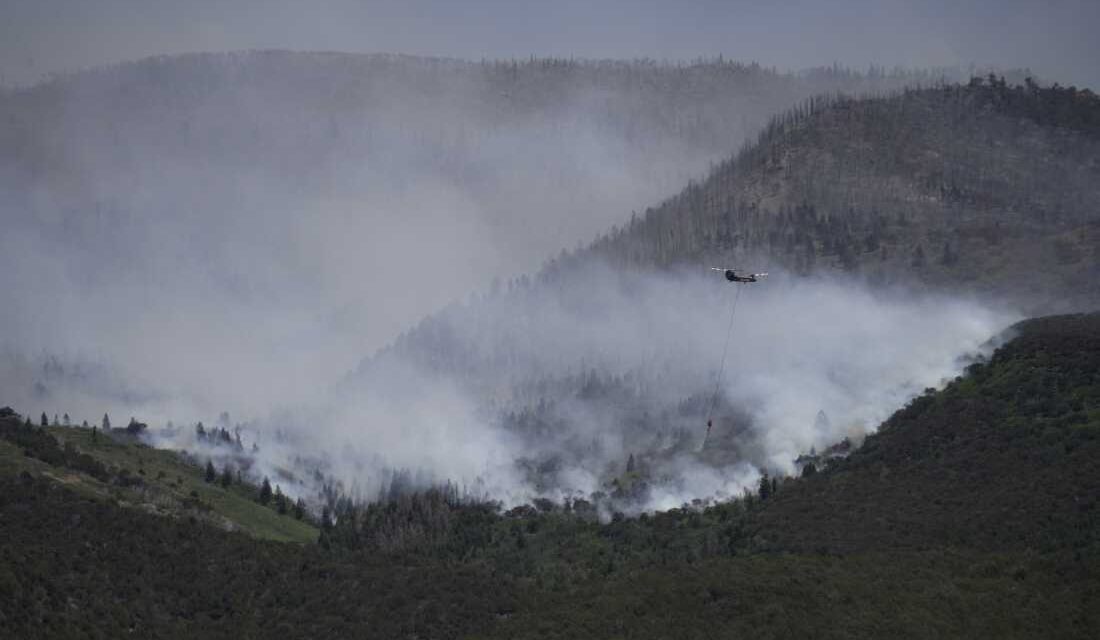
A helicopter was observed dropping water on the Cottonwood Fire in Beaver, Utah, on Saturday, June 27, 2026. Tragically, three firefighters lost their lives and two others sustained injuries while confronting fires at the Colorado-Utah border. This announcement came from the U.S. Wildland Fire Service.
The firefighters were part of a joint response effort tackling the Knowles and Gore fires. A statement from the U.S. Wildland Fire Service expressed solidarity with the USDA Forest Service, saying, “The U.S. Wildland Fire Service stands united with the USDA Forest Service in grief and in our unwavering support for the loved ones left behind. Their bravery, dedication, and sacrifice will never be forgotten.”
The Department of the Interior reported that these five firefighters encountered a “burnover incident,” a situation where escaping becomes impossible, forcing them to find shelter as fires pass overhead. The two surviving firefighters are currently receiving treatment for burn injuries.
Thanks to persistent low humidity, high temperatures, and strong winds, fires in Utah, Colorado, and Arizona have surged in intensity. These conditions have escalated the fire behavior to unprecedented levels, leading governors of Utah and Colorado to declare emergencies.
Cottonwood Fire Remains Uncontained
The Cottonwood Fire, located in southern Utah’s Beaver County, is the largest blaze active in the U.S., covering over 144 square miles. It’s entirely uncontained, having caused significant damage to the Eagle Point ski resort and destroyed summer cabins. Although damage assessments started on Saturday, no comprehensive estimates of destroyed structures are yet available.
Residents in towns like Marysvale, Junction, and Circleville were warned of potential evacuation as conditions worsened. The Snyder Fire also burns across more than 28,000 acres. Initially starting as the Snyder Mesa Fire in east Utah’s Grand County, it later merged with smaller Jones and Knowles Fires in Colorado.
Alyssa Mason, spokesperson for the Cottonwood Fire, noted the crew faced single-digit humidity and wind gusts around 45 miles per hour. Fuel moisture readings ranged between 2 and 8 percent, which hampered firefighting aircraft operations. The steep terrain has complicated efforts further, making equipment movement challenging.
Utah Gov. Spencer Cox remarked on social media about the grim conditions, acknowledging the improbable rescues carried out by crews amidst the difficult circumstances. “Please pray for them and for the rains we desperately need,” he urged.
The National Weather Service in Salt Lake City issued a “particularly dangerous situation” red flag warning, emphasizing the threat from wind, heat, and low humidity. This indicates critical fire-accelerating conditions persisting into Sunday.
Region Primed for Wildfires
Experts attribute the extreme fire behavior to deteriorating conditions over months. Utah reported its lowest snowpack and warmest winter on record in the previous season. Snowpack peaked three weeks earlier than usual, causing drying of soils and vegetation throughout spring.
The region—including Nevada and Colorado—faces widespread drought after an unusually dry winter. Jamie Barnes, Utah’s state forester, stated that fires have stretched Utah’s firefighting resources and moved closer to populated areas compared to previous years.
Governors implemented emergency measures, with Utah Governor Cox restricting fireworks before the Fourth of July and Colorado Governor Jared Polis authorizing National Guard aid for state firefighting efforts. Nearly 3 million acres have burned nationwide since the year’s start, surpassing the 10-year average. National Weather Service forecasts issued red flag warnings across the West, encompassing California, Arizona, and New Mexico.
Nate Rott from NPR contributed to this report.
 Infrastructure Challenges and the Uncertain State of America’s Bridges
  Maintaining America’s Infrastructure: A Crucial Task
  Wheaton Community Mourns Loss of Student-Athlete
  White House Responds to Natalie Maines’ Criticism of Trump
  Record Early Voting in Georgia Midterms Amid Political Campaigns
  Tragic Roller Coaster Accident at Six Flags Raises Safety Concerns