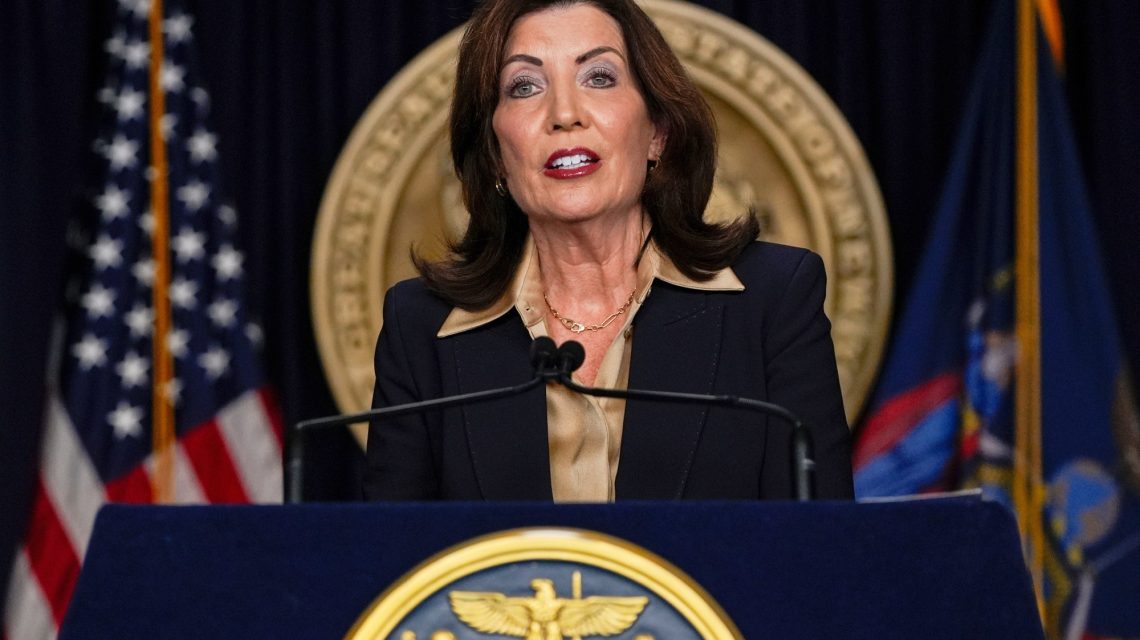
Advertisements in New York featuring artificial intelligence-generated people must now clearly label the use of “synthetic performers” to comply with a new state law. Governor Kathy Hochul signed the legislation in December, and it officially took effect on Tuesday.
The governor’s office describes the law as a pioneering measure aimed at enhancing transparency amid the rising presence of AI-generated performers in media, including social platforms and digital ads. The legislation outlines synthetic performers as digitally-created media that resemble real individuals. It applies to advertisements across all mediums.
“In New York, we are setting the rules of the road instead of letting AI run the show,” Governor Hochul, a Democrat, stated. The law mandates a “simple, honest disclosure” to protect consumers, respect the creative workforce, and maintain New York’s leadership in responsible innovation.
Advertisements failing to disclose the use of synthetic performers face penalties, with a $1,000 fine for the first violation and $5,000 for subsequent offenses. The law provides specific exemptions for ads related to movies, TV shows, streaming content, video games, and other projects, where synthetic performers are featured throughout. Audio ads or those using AI solely for language translation are also excluded.
During the legislative process, the American Association of Advertising Agencies, along with other advertising groups, strongly opposed the law. The 4As warned of potential compliance challenges disrupting advertisers, burdening brands and agencies working in New York, and inhibiting creative and technological advancement.
The New York State Broadcasters Association acknowledged relief due to certain exemptions introduced through amendments but remained concerned about the broad definition of synthetic performers. David Donovan, the association’s president, indicated local broadcast stations are prepared to adhere to the new law.
Support came from SAG-AFTRA, the actors’ union, which views the law as adding protective measures against synthetic performers, consistent with their recently ratified contract with studios and streaming services.
New York’s law is among several proposed or enacted statewide measures aimed at securing job opportunities for humans and addressing potential privacy or safety risks related to AI. Existing state laws have focused on prohibiting deepfakes, limiting personal data collection, and increasing corporate transparency.
Following Governor Hochul’s signing of the synthetic performer law in December, President Donald Trump issued an executive order urging states not to impose AI regulations. The order stems from concerns that fragmented state regulations could hinder AI companies’ growth and enable China to rival the U.S. in AI development. Critics of the executive order contend it allows tech companies to operate with minimal oversight.
 AFL Investigates Fairfax County Schools’ 9/11 Teaching Guidance
  Poll Reveals Voter Preferences Between Socialist Democrats and MAGA Republicans
  Challenges of Electing a Female President: Insights from ‘The View’
  Upcoming Concerns and Influence in Health Politics
  Rep. Donalds Distances Himself from Trump as Florida Governor Race Tightens
  Controversy Surrounds President Trump’s Proposed D.C. Arch