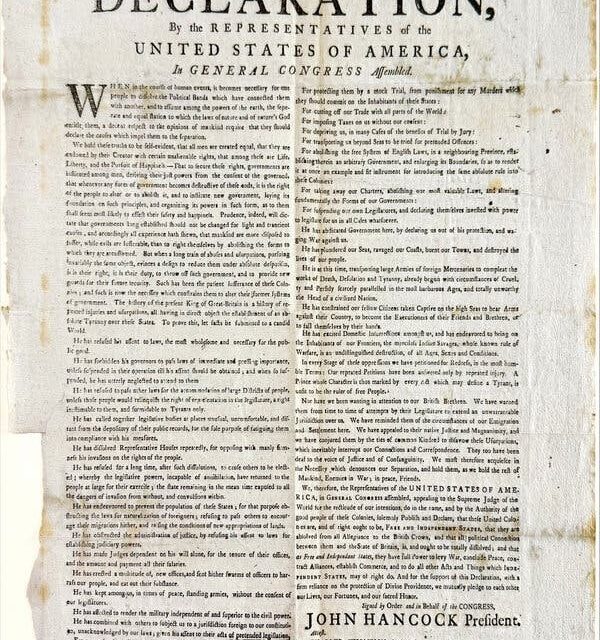
In May, a volunteer named Michael Scurr made a remarkable discovery while assisting at the National Archives in London. Amidst the 18th-century letters of a British naval captain, Scurr found a folded piece of paper with the title: Declaration of Independence.
The document turned out to be an unknown copy, printed in mid-July 1776 in Exeter, New Hampshire. Known as the Exeter broadsides, these copies were printed on large sheets. Historically, only about 10 such copies were believed to exist.
The initial versions of the Declaration of Independence were created by John Dunlap, a printer in Philadelphia. His task was to inform the American colonies of their representatives’ decision to break free from British rule. As news of the declaration spread, additional copies, including those printed in Exeter, emerged.
Surviving copies of these historic documents are incredibly rare. Of the original 200 Dunlap broadsides, only 26 remain, and even fewer Exeter broadsides have been found. Recently, one Exeter copy fetched over $5.6 million at an auction.
The National Archives already houses several Declaration of Independence copies. One is part of an exhibition celebrating American independence.
 Exploring Complex Marriages in “Marble”
  The Role Sports Played in My Life and the Importance of Truth in Women’s Athletics
  Dudley Laufman: Reviving New England Folk Dance
  Significant Events in Chicago Area on August 3
  Caitlin Clark’s Response to Transgender Athlete Debate
  Exploring the Mysteries of Lourdes and Its Miracles