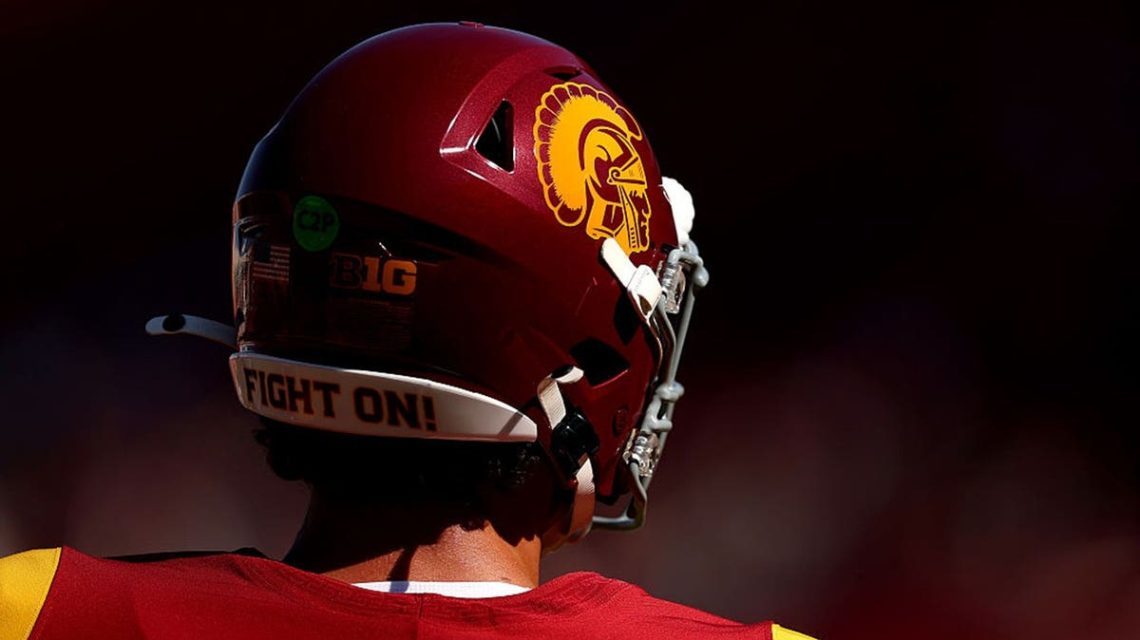
The University of Southern California (USC) athletic department might need a refresher in Greek literature. Twice in recent years, USC has attempted to build football excitement around Greek stories without considering a key detail: the stories end badly for the Trojans.
A USC football helmet is visible before a game between the USC Trojans and the Missouri State Bears at United Airlines Field in Los Angeles, Calif., on August 30, 2025. (Photo by Luke Hales/Reuters)
Recently, with Christopher Nolan’s “The Odyssey” gaining attention, USC football used this opportunity to promote their season. They released a poster featuring the Trojan helmet and the phrase, “Our Odyssey begins August 29.” It’s captivating and timely, but overlooks a small issue.
The Odyssey is about the Greek hero Odysseus’s decade-long journey home after the Trojan War. He’s returning after helping destroy Troy. The Trojans aren’t the heroes in this story. They’ve lost their city and warriors, while the Greeks head home victorious.
This could be misaligned branding for USC. A copy of The Odyssey translated by Emily Wilson is displayed in Manhattan, N.Y., on July 12, 2026. Friends connected through being roommates and their Survivor Watch group decided to form a book club to read The Odyssey. (Photo by Jackie Molloy/The Washington Post via Getty Images)
Admittedly, not everyone studies ancient texts for fun. However, representing a school with a Trojan mascot should imply some basic knowledge of Troy’s fate. Someone in social media should have searched “Who wins the Trojan War?” before sharing the content.
USC made a similar error before their 2024 season. A well-crafted video showed USC players emerging from a Trojan Horse to battle. Again, an appealing visual, but historically inaccurate. The Greeks hid in the Trojan Horse, while Trojans unwittingly brought it inside their city, leading to their fall.
Following backlash for that mistake, USC returns to this narrative with yet another story of their defeat. Adding to the irony, USC starts their 2026 season on August 29 against San Jose State, known as the Spartans.
So, USC connected their season narrative to Troy’s downfall, and previously linked it to the Trojan Horse, culminating in a matchup with a Greek army-inspired opponent.
Anyway, farewell Trojans, and consider avoiding suspicious wooden structures in the future. Amber Harding writes for OutKick.
 Debate Over O.J. Simpson’s Omission from Buffalo Bills’ Wall of Fame
  Red Sox Remove Interim Tag, Appoint Chad Tracy as Manager
  Lane Kiffin Criticized After Ole Miss Loss While Florida Football Faces Social Media Fiasco
  Taylor Swift’s Countdown Sparks Speculation Among Fans
  Deion Sanders Enforces Discipline After Colorado’s Defeat to Northwestern
  Steve Lotysz: From Medinah’s Gates to Presidents Cup Artistry