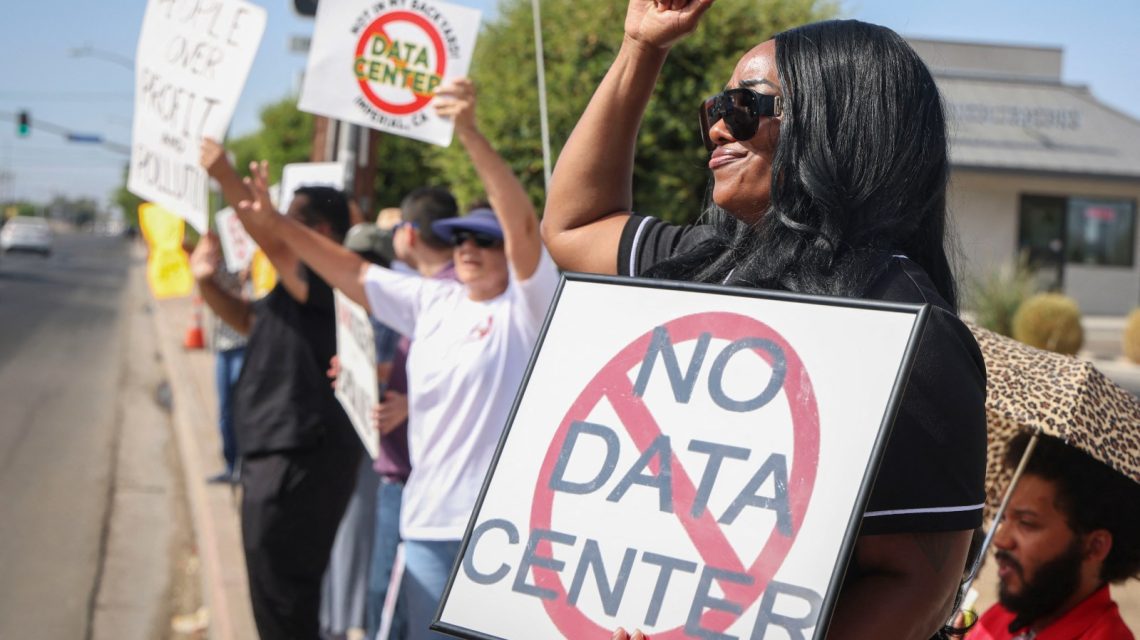
Growing Public Opposition
A recent poll by Emerson College reveals that 63% of U.S. voters are against AI data centers being built in or near their communities. This reflects a 21 percentage point increase from December 2025. Such opposition underscores growing concerns over potential issues like higher electricity bills and reduced water supplies associated with these centers.
Voter Concerns and Educational Influence
Conducted between July 19 and 20 among 1,100 likely 2026 voters, the poll demonstrates widespread concern about artificial intelligence, with 63% expressing unease, compared to 14% who are excited and 22% neutral. The skepticism increases with educational attainment. According to Emerson, 79% of those with postgraduate degrees oppose AI data centers, marking a 27-point rise since December, while 72% of those with college degrees also showed a 25-point increase in opposition. Meanwhile, 37% of Americans with a high school degree oppose these installations, a 9-point increase since December.
Overall, only a quarter of U.S. voters support AI data centers in their vicinity, while 10% are neutral.
Community Impact and Perception
A May survey by Redfin reveals further opposition, with 53% of U.S. residents against local data center construction versus 34% in favor. The survey also identifies generational differences. 65% of baby boomers and 60% of Gen Xers oppose such construction in their neighborhoods. In contrast, 42% of Gen Zers and 43% of millennials express opposition.
The aversion to data centers surpasses that toward other nearby constructions, like new apartment complexes, which 39% of respondents oppose. Concerns include noise, increased traffic, heavy water and electricity use, and the impact on neighborhood aesthetics.
“A buyer recently asked me, unprompted, to make sure there wasn’t a data center planned near a home she was considering,” Matt Ferris, a Redfin Premier agent in Northern Virginia, said. “I have another client who moved into a community in Prince William County, where there are several data centers. A year after moving, they felt they would have chosen a different location had they known.”
According to the Data Center Opposition Report, grassroots opposition to hyperscale AI data centers has surged, with at least 430 local groups in 40 states organizing online. Since December, membership in these groups has grown sevenfold.
State Responses to AI Data Centers
In response to concerns over resource utilization and community impact, states are reconsidering their stance on AI data centers. New York imposed a one-year statewide freeze on new hyperscale centers, announced by Governor Kathy Hochul, to develop environmental standards. This measure addresses rising utility bills and resource consumption concerns.
Other states are contemplating similar moratoriums. Maine’s legislature passed an 18-month moratorium on centers over 20 megawatts; however, Democratic Governor Janet Mills vetoed the bill. Virginia’s attempt to temporarily ban AI data centers tied to power demand concerns was unsuccessful, as was Oregon’s effort to restrict centers accessing major tax breaks pending environmental and economic studies.
In Illinois, the proposed POWER Act mandates large data centers to finance energy infrastructure, disclose water use, undergo environmental reviews, and meet community-benefit requirements. Other states, including Delaware, Georgia, Michigan, Minnesota, Oklahoma, Pennsylvania, South Carolina, Vermont, and Wisconsin, are considering similar restrictions.
Benefits of Hosting AI Data Centers
Despite increasing opposition, data demonstrates some benefits for hosting communities. Redfin analysis of county financial records shows significant growth in education spending in Virginia’s Loudoun and Prince William Counties, home to numerous data centers. Loudoun County, housing 176 centers, attributes the largest source of personal property tax revenue to these facilities. In Prince William County, with 77 centers, personal property tax revenues have surged, contributing to the education budget.
Over 15 years, Loudoun County’s personal property tax per resident rose by nearly 639%, while Prince William County saw a 349% increase. Both counties used this revenue to boost education spending significantly.
The Federal Reserve Bank of St. Louis notes that AI center construction has fostered local economic activity in hosting communities.