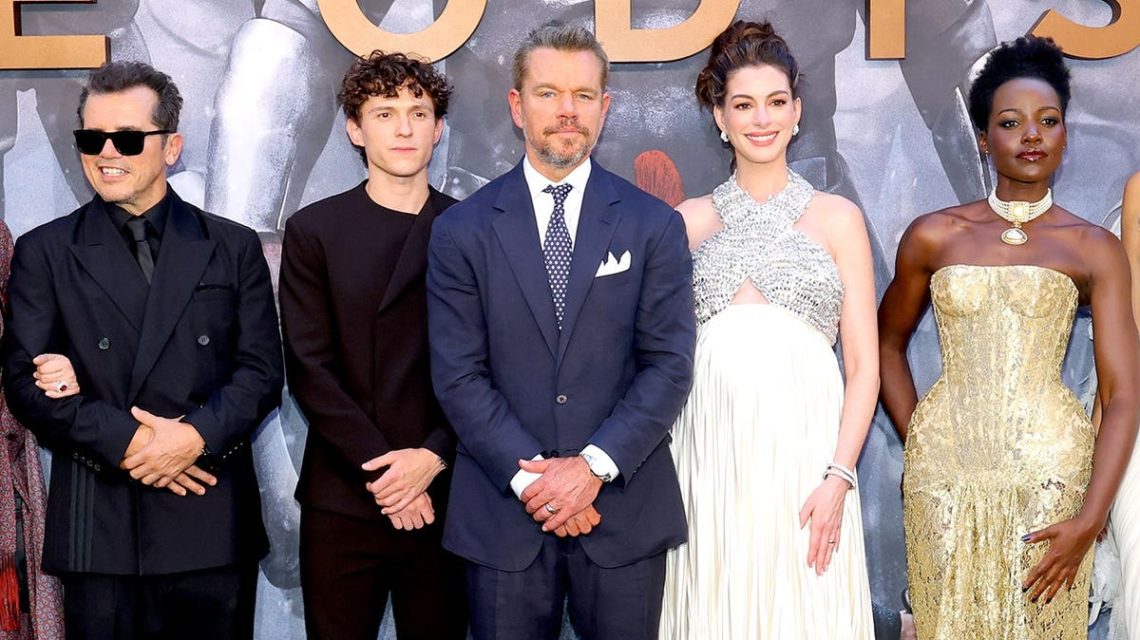
Christopher Nolan’s film adaptation of “The Odyssey” vividly presents the mythological creatures from Homer’s epic, engaging viewers with each mythical encounter Odysseus faces. The film’s detailed CGI and powerhouse performances from an ensemble cast make it a must-see in theaters.
Joel P. Christensen, a Homer scholar from CUNY Graduate Center, believes audiences can easily follow the story without prior knowledge of the book, thanks to the context provided in the film. Unlike typical blockbusters with a central villain, “The Odyssey” introduces different challenges and mythical beings at every turn.
Polyphemus
The infamous Cyclops, Polyphemus, imprisons Odysseus and his crew, consuming several crew members. Britannica notes his name translates to “rich in songs and legends.” Odysseus blinds Polyphemus to escape, leading the sea god Poseidon to curse his journey. Bill Irwin portrays Polyphemus, capturing the mix of danger and memorable presence.
Laestrygonians
These giant cannibals annihilate most of Odysseus’ fleet after they are drawn into their harbor. The encounter in Book 10 showcases the destruction that leaves Odysseus with only a single ship, as depicted in Nolan’s film through intense visual sequences.
Circe
The sorceress Circe, portrayed by Samantha Morton, initially transforms Odysseus’ men into pigs but later aids him by outlining the perils ahead. Her storied interactions with Odysseus, especially turning men into pigs, are some of the film’s most memorable and unsettling moments.
Sirens
Sirens, part bird and part woman, pose a lethal threat to sailors with their mesmerizing songs. Circe advises Odysseus to block his crew’s ears and have himself tied to the mast to safely pass them. This iconic scene reinforces the cunning tactics Odysseus employs throughout his journey.
Scylla and Charybdis
These monstrous sea creatures present a lethal challenge. Odysseus navigates between them under Circe’s guidance, sacrificing six crew members to Scylla to avoid Charybdis’ whirlpool. This decision underscores the perilous nature of the voyage.
Calypso
On Ogygia, the nymph Calypso detains Odysseus, driven by love. Charlize Theron’s portrayal highlights Calypso’s reluctance and eventual compliance when Zeus orders Odysseus’ release. Her contribution is pivotal in aiding his return home after years of captivity.
A Scholar’s Perspective
Nolan’s adaptation condenses Homer’s expansive narrative, focusing on selective mythological characters. Joel P. Christensen critiques some portrayals, particularly Polyphemus and Circe, suggesting the film simplifies complex narratives to fit cinematic storytelling.
The film’s modifications, including gender role implications and reduced divine interactions, reflect its distinct divergence from epic poetry. Despite these changes, the spirit of Homer’s “The Odyssey” persists, albeit through a lens shaped by Nolan’s artistic vision.
 Stallone Surprised by Appointment as Hollywood Ambassador by Trump
  Sylvester Stallone: A Multifaceted Hollywood Icon
  Fat Bear Week 2026: A Look at the Contest and Its Competitors
  Riot Fest’s Muddy Weekend and Commitment to Park Restoration
  Presley Gerber: A Look Back at His Life and Legacy
  Rhiannon Giddens on Music, Heritage, and Hope