A group of business and transportation leaders is proposing a private train service named the O’Hare Flyer that aims to transport passengers from downtown Chicago to O’Hare International Airport in about 15 minutes. This project faces several challenges in planning, financing, and regulation before it can begin.
Development of the O’Hare Flyer
The proposed train, leveraging existing freight railroad tracks, is designed to transport travelers between downtown Chicago and O’Hare Airport. Although ticket prices remain undisclosed, they are expected to be significantly lower than taxi fares but higher than the Chicago Transit Authority (CTA) Blue Line, which takes around 45 minutes and costs between $2.50 and $5. The O’Hare Flyer would operate every 15 minutes from 4 a.m. to 10 p.m.
Dave Lundy, the CEO of strategic communications firm Aileron Communications, heads the initiative. Other key figures include rail industry expert Mark Walbrun and Kristi Lafleur, formerly with the Illinois Tollway. They anticipate the project might launch within five years, with an estimated cost of $2.25 billion, entirely funded by private investors. No government subsidies are expected.
Project Inspiration and Previous Attempts
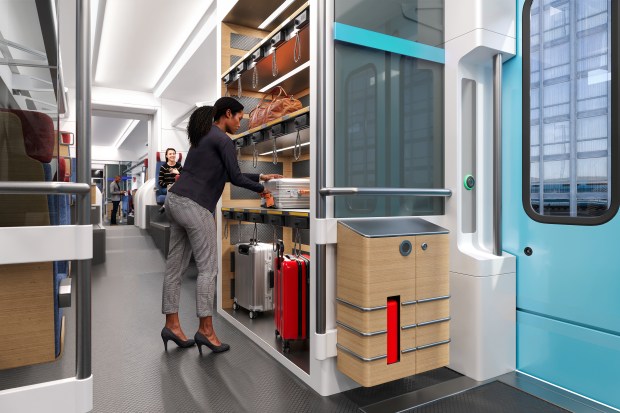
The O’Hare Flyer aims to provide a faster and more comfortable transit option than the existing Blue Line service. World-class cities like London and Hong Kong have similar express train services that connect central city areas to major airports. An artist’s rendition reveals the O’Hare Flyer as a battery-powered train capable of completing the journey swiftly. Former proposals, like the one involving Elon Musk’s The Boring Company in 2018, failed to materialize, highlighting the challenges of such projects.
Potential Support and Challenges
Mayor Brandon Johnson has expressed support for the O’Hare Flyer, noting that private investment confidence in Chicago is growing. The administration considers sustainable and affordable transportation solutions as core goals. Despite this backing, the initiative must overcome significant hurdles. Agreements are needed from rail companies for track use. The Flyer group has already executed a letter of intent with CSX railroad, though final agreements are pending. They will also require permissions from Union Pacific and Canadian National railroads.
Furthermore, federal regulatory approvals are necessary, potentially involving bodies like the Federal Railroad Administration and the Federal Aviation Administration. City Council approval is likely required as well. The group has already initiated preliminary discussions with federal agencies.
Funding Strategies
The financial details of the project are not fully transparent. However, Lundy indicated a successful first funding round, with plans for an additional $18 million round. There is a plan to allocate city revenue sharing from the train service, though specifics remain undefined.
Route and Impact on Local Transit
The proposed route starts in the Chicago Loop, utilizing city property under Canal Street near the former main post office and connecting to Union Pacific tracks at 16th Street. The train would then pass through the city’s West Side and northwest suburbs, ending at O’Hare’s Terminal 2.
While some worries exist about fare revenue competition with the CTA, the Flyer team clarifies that the service targets air travelers’ needs, such as luggage storage and baggage check options for the final destination. Lundy contrasted the projected service experience with that of the Blue Line, emphasizing the specialized nature of the O’Hare Flyer.
 The High-Cost Evolution of Foldable Smartphones
  AI’s Impact on Employment in China’s Rapidly Evolving Job Market
  AI and Cybersecurity Risks in Water Utilities
  Autonomous AI Agents Breach Systems in Unprecedented Cyberattack
  Impact of AI Infrastructure on U.S. Housing Market
  Ukraine Gains Access to European Military Technology