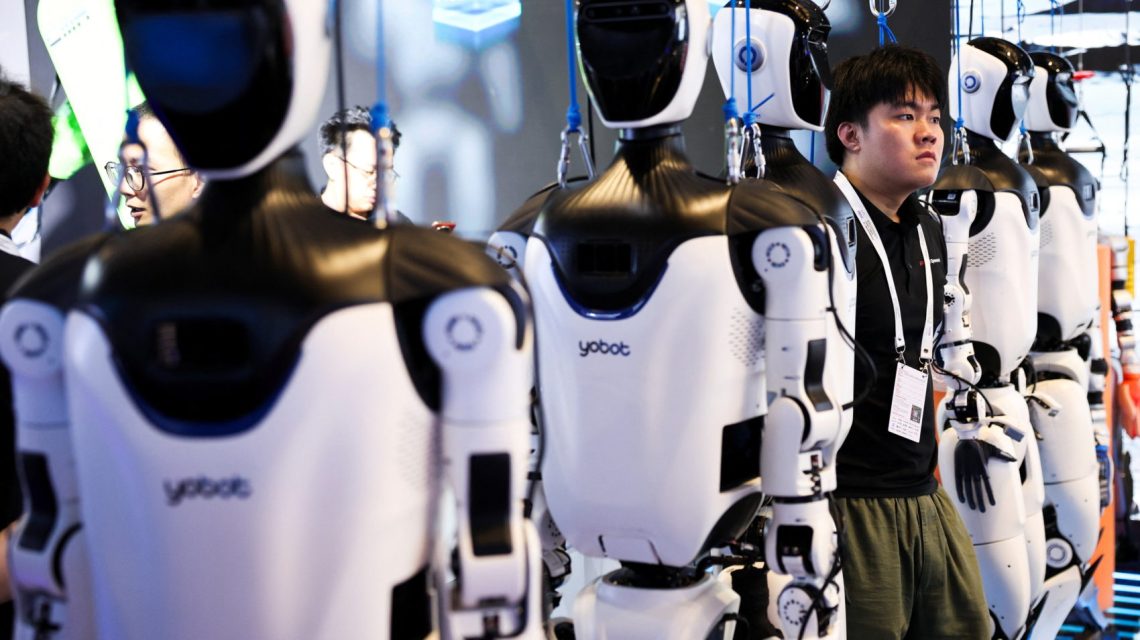
In Beijing, computer programmer Fei Zhaojun faced an unsettling question from his employer: could artificial intelligence soon replace human jobs in coding? Only two weeks later, Fei was laid off, along with around 160 colleagues. This reflects a growing trend as artificial intelligence transforms China’s vast job market, driven by supportive government policies.
Some economists fear that AI’s rapid adoption could weaken China, the world’s second-largest economy. AI impacts various fields, from programming to scriptwriting and manual tasks. These changes either force job losses or build anxiety about job security. China’s government actively promotes AI use in daily life, urging people like Fei to adapt quickly to these innovations.
“There is notably less anti-AI sentiment in China compared to other places. Many people appear either neutral or mildly interested in AI,” shared Shujing He, a senior analyst at Plenum, a Beijing-based advisory and research firm.
Individuals losing traditional jobs often experiment with AI-driven businesses or independent ventures. The openness to AI adoption is palpable across the workforce.
Fei, who initially doubted AI’s ability to perform programming tasks efficiently, has adjusted his outlook. “Mid-level coding jobs are generally replaceable,” said Fei, 40. Despite challenges, he embraces AI, similar to others. Now, he creates short vlog-style videos during a career hiatus. These videos, centered on ordinary lives, aren’t lucrative but provide new direction.
Part-time translator Du Qinchun trains an AI model for translations, finding temporary work through the process. “However, industry pay has more than halved,” Du stated, residing in Chengdu. AI translation tools have diminished the popularity of traditional foreign language programs in colleges.
AI adoption by Chinese industrial enterprises has surged from 9.6% in 2024 to 47.5% last year. According to IDC, a market intelligence firm, China’s open-source model ecosystem boosts AI innovation, bridging gaps between model capabilities and real-world business value.
Small-scale humanoid robots now sort parcels in postal centers and perform various human-centric tasks like directing traffic and making coffee. Food delivery robots pose a potential threat to millions of Chinese delivery workers.
Generative AI increasingly handles creation, production, and distribution in China’s short drama industry. Live-action short and vertical video series for mobile devices saw a 75% decline in the first quarter of this year. This transformation underscores AI’s ability to execute tasks previously needing specialized training. Workers in affected sectors face greater displacement risks.
A report from the International Labor Organization highlights women often face higher job loss risks from AI usage, due to roles more easily automated, such as electronics assembly work. Women also remain underrepresented in science and tech fields.
China’s “AI Plus” initiative seeks widespread AI integration across industries, part of a five-year plan ending in 2030. This aims to enhance China’s tech competitiveness with the U.S. “China’s government strategically promotes AI diffusion across the economy, potentially quicker than other countries,” noted Zilan Qian from Oxford China Policy Lab.
Economic growth is slowing in China. Concerns about job security dampen consumer spending. The housing market downturn has strained household wealth, compounding issues. Despite high productivity, China’s tech industries may not create numerous new jobs.
According to Eswar Prasad, a Cornell University economics professor, AI might boost overall productivity but disrupt employment, worsening growth issues and affecting social stability. Like U.S. tech companies, Chinese tech giants have restructured and reduced tens of thousands of jobs influenced by AI.
China’s urban unemployment rate hovers around 5%, but younger individuals face unemployment rates three times higher. Long-term, experts suggest automation could alleviate a shrinking workforce as China’s population rapidly ages. By 2050, China may have less than two working-age adults per retiree, shifting from the current 2.5 U.S. ratio, according to Xuenan Cao from San Francisco Bay University.
Embracing AI to explore new living avenues, former scriptwriter Wang Zhicheng utilized AI for brainstorming and fact-checking in his previous job. After his company laid off about half its scriptwriting staff, Wang transitioned to making illustrated children’s books. While AI saved time, its scripts needed thorough refinement. “AI is akin to a tool like Microsoft Word,” Wang explained. “Humans remain decision-makers on what AI generates.”
High school chemistry teacher Yang Zheng doesn’t see AI as a threat, though students may use it for homework help. “Teachers can’t always be present,” Yang, 29, commented. “AI benefits students with real-time question resolution, despite occasional errors.”
Fu Ting contributed from Washington. AP video producer Wu Jia in Beijing contributed to this report. A free press is vital for a healthy democracy. Support reliable journalism and civil discussion.
 Tesla Roadster: Revolutionary Prototype with Flying Capabilities
  Meta’s Settlement and AI’s Impact on Youth
  Potential Scenarios of an AI-Controlled World
  Geography and Politics Shape Future of AI Data Centers in Red States
  Efficient Ways to Organize Photos on Smartphones
  Party’s 2028 Agenda: Addressing AI and Economic Concerns