An Egyptian-Spanish team of archaeologists has discovered a 4,300-year-old tomb near Cairo. This site belongs to an ancient judge and his father, according to local authorities.
The tomb is located in Saqqara, a vast necropolis to the south of the Egyptian capital. It dates back to the rule of Pharaoh Djedkare Isesi, a key figure of Egypt’s Fifth Dynasty who implemented significant administrative reforms in the 24th century B.C.
The Egyptian tourism and antiquities ministry revealed that the tomb was constructed for a high-ranking official named Yunmen. Yunmen’s role involved hearing appeals from the kingdom’s citizens and assessing their complaints for the state.
Amr al-Tayeb, the director at the Saqqara archaeological site, explained to AFP that Yunmen’s responsibilities align with the ancient Egyptian notion of Maat, focusing on truth, justice, and social order.
The ancient Egyptian concept of Maat embodies the principles Yunmen upheld as an official.
The discovery was made during this summer’s excavation season in the Mariette Cemetery area of northern Saqqara. This effort is part of an ongoing collaboration between the Autonomous University of Barcelona and Egypt’s Supreme Council of Antiquities.
The tomb unveiled is a mastaba, a flat-roofed structure typically erected for elite members. It contains two chapels for funerary purposes: one for Yunmen and another for his father, Ity. Ity held the position of a senior scribe, managing agricultural lands and offerings.
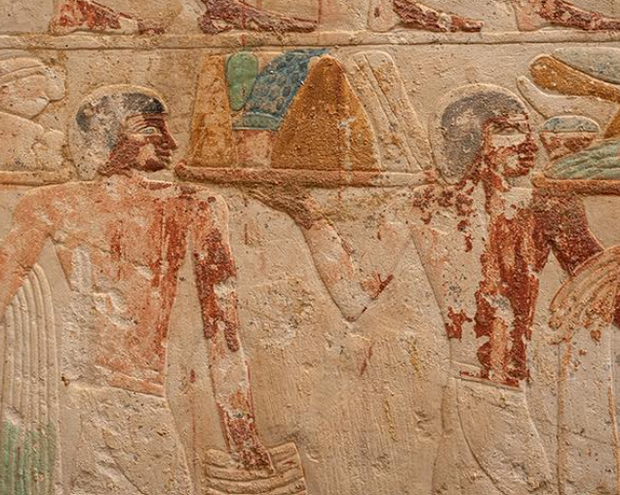
Yunmen’s chapel is decorated with intricate reliefs showing farm workers, servants with offerings, and scenes from funerary rituals. Despite being buried for over 40 centuries, many of the paintings have preserved their original colors. The ministry highlighted these well-preserved scenes on social media, sharing images of the site.
Further excavation revealed an ornate facade covered in funerary inscriptions, as well as formal portrayals of the tomb’s owner. Ity’s chapel contains remnants of painted offering scenes and a false door, believed to allow the deceased to receive sustenance from the living.
This find coincides with Egypt’s efforts to highlight new archaeological discoveries. Tourism, essential for the country’s foreign revenue, stands to benefit.
In November, Egypt organized an event with numerous foreign leaders to celebrate the Grand Egyptian Museum’s official opening. This $1 billion project faced numerous delays due to financial issues, political tumult, the COVID-19 pandemic, and regional conflicts before its eventual inauguration.
 Early Evidence of Betel Nut Use in Ancient Indonesia
  The Impact of El Niño on U.S. White Christmas Odds
  OpenAI Claims Breakthrough in Mathematics with AI Model
  Retraction of Pyramid Study Over Methodological Flaws
  Exploring Animal Senses Through Ed Yong’s ‘An Immense World’
  Investigation Reveals Heat’s Deadlier Impact