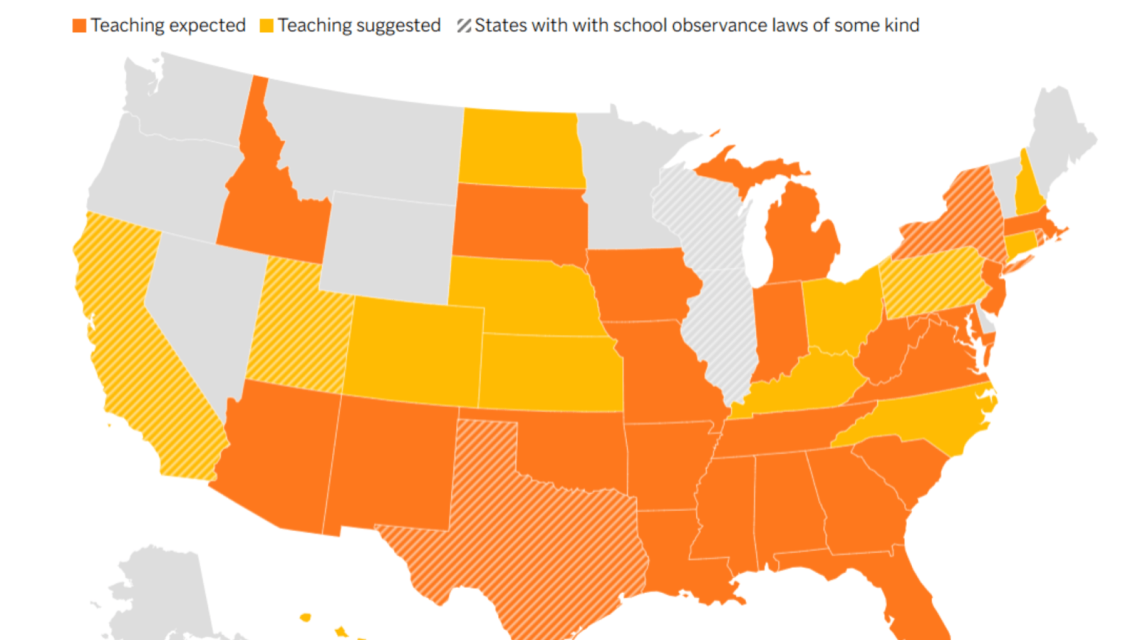
As the United States approaches the 25th anniversary of the September 11 terrorist attacks, an increasing number of states have implemented policies requiring or recommending schools to educate students about this pivotal event in modern American history. Research by The Associated Press reveals that at least 40 states either require or suggest some form of 9/11 instruction in public schools. Of these, 25 states have laws or standards that specifically mandate teaching about the attacks, while another 13 include optional 9/11 references in educational guidelines. Several states also mandate or recommend observances such as moments of silence, making at least 40 states with a 9/11-related policy.
Approximately one-third of Americans were born after the attacks carried out by al-Qaida terrorists, which resulted in nearly 3,000 deaths in New York, at the Pentagon, and near Shanksville, Pennsylvania. This temporal distance means current students have no personal memory of the events from September 11, 2001. Jeremy Stoddard, an education professor at the University of Wisconsin, notes that teachers now view the attacks as a historical context, focusing on how post-9/11 policies impact students today. Newsweek has contacted Megan Jones, education chief at the September 11 Memorial & Museum, for commentary and awaits her response.
“States vary vastly in their approach to teaching 9/11,” stated the research.
Some states require that students receive detailed instruction on the attacks and their aftermath. Others incorporate the topic within broader curricula about U.S. history, civics, or discussions about terrorism and foreign policy. Certain states only encourage observance of the anniversary through activities like moments of reflection.
In a more comprehensive approach, some states require students to delve into the long-term implications of the attacks. For instance, Alabama’s standards mandate that students study U.S. military actions following the attacks and evaluate the effectiveness of America’s response, including the Department of Homeland Security’s creation and the Patriot Act’s enactment. Arizona initially enacted a statewide requirement for “age-appropriate education” each 9/11 anniversary, currently required only for students in grades seven through 12.
Why It Matters
Education experts underscore the importance of teaching 9/11, particularly since fewer students today have a personal connection to the attacks. Stoddard highlighted the challenge for educators due to this generational shift. Many students and an increasing number of teachers lack direct memories of the attack. “They just do not have the same emotional connection,” he said. Teachers often share personal stories from September 11, but students cannot share that experience.
“Even worse than starting wrong or using inappropriate language is omitting the story entirely,” said Gordon Felt, whose brother died on United Airlines Flight 93.
This summer, teachers gathered at the Flight 93 National Memorial to discuss educating a generation unfamiliar with the attacks. Discussions addressed which details are suitable for younger children, how to honor victims, and what broader historical lessons to impart.
Classroom approaches have shifted over time. Around the attacks’ 20th anniversary, educators focused on the anniversary through news footage and personal memories, emphasizing first responders’ heroism and national unity. Recently, educators have broadened their approach, examining how post-9/11 decisions continue to shape American life, such as the ongoing impacts of the Patriot Act. Stoddard indicated that states are now more willing to embed the attacks in curriculum standards as history has lengthened the temporal distance.
A decade after the attacks, about 60% of states did not mention 9/11 in their education standards. Curriculum requirements have since expanded. Stoddard observed that where states include 9/11, instruction is considerably more detailed than before. U.S. Department of Education officials also were contacted for commentary, with responses pending.
Key Takeaway: Diverse Approaches to 9/11 Education
There is no straightforward divide between states regarding 9/11 instruction. The most stringent requirements generally fall into three categories:
- Dedicated instruction: States like Arizona and Florida have explicit mandates for teaching about the attacks.
- Curriculum standards: States such as Alabama, Arkansas, Georgia, and others integrate 9/11 into required or expected social studies.
- Commemoration: States including California, New York, and Wisconsin have laws concerning moments of silence or similar observances.
Another group of states, including Alaska, Colorado, and Illinois, offers guidance or suggested content without specific mandates. Several states, such as Minnesota and Washington, have no statewide 9/11 policy identified in the AP review. Different reviews on state standards have reached different conclusions due to varied methodologies.
A 2026 University of Wisconsin analysis by Stoddard found fewer states with explicit 9/11 teaching requirements, focusing only on official standards and legislation. Newsweek has previously provided guidance on educating students about 9/11.
 Ohio Teacher’s Tragic Death in a Crash Involving Deported Driver
  Rising Costs Challenge Los Angeles Residents Amid Inflation
  Reflections and Resilience: A Year After Charlie Kirk’s Assassination at Utah Valley University
  Long-Delayed Pentagon Memorial Project Lacks Museum or Visitor Center
  25th Anniversary of September 11: Commemorative Events and Protocols
  Passenger Ferry Fire in Philippines Leaves Dozens Missing