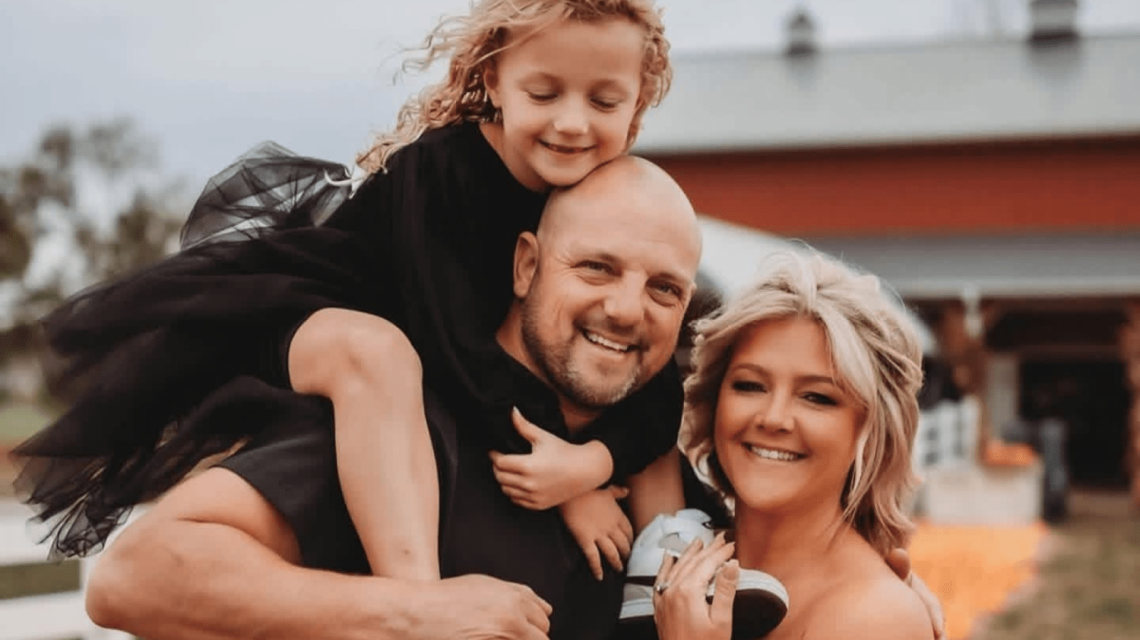
A year ago, an Indiana mother received an unexpected call from her husband at the emergency room. She had been watering flowers when the phone rang. Her husband, Rob, said from the other end, “I think you need to come up here.” This moment marked the beginning of a life-changing period for Brittany M. Bohacik, 39, and her family.
During the Fourth of July weekend in 2025, Rob, then 43, started experiencing what he thought was a common stomachache. Both he and Brittany assumed he might have eaten something unpleasant, contracted a virus, or was simply tired. “There was nothing that made us think our lives would change,” Brittany shared with Newsweek. Despite his discomfort, Rob continued with his daily responsibilities as a husband and father to their eight-year-old daughter, Ava.
As his symptoms worsened, Rob drove himself to the hospital. Brittany recalled the ordinary nature of this act, stating, “That detail stays with me because of how ordinary it was.” There was no dramatic moment signaling the dramatic change that lay ahead. Eighteen days after his symptoms began, Rob received a diagnosis of stage IV pancreatic adenocarcinoma, with cancer already having spread to his liver.
The diagnosis left Brittany and Rob in shock. Days earlier, they had been living their normal lives, focused on work, family, and weekend plans. Suddenly, they found themselves confronting discussions about chemotherapy, metastasis, and survival statistics. Brittany expressed, “People imagine there must have been some warning sign we ignored. There wasn’t.” Their everyday lives transformed overnight as cancer became a central focus.
For the next eight months, Brittany dedicated herself to saving her husband’s life. She researched continuously, contacted medical professionals, and explored clinical trials. She learned about genetic mutations, treatment protocols, and chemotherapy options. Her role expanded beyond being a wife and mother to becoming an advocate and researcher.
Genetic testing revealed that Rob’s tumor carried a BRCA2 mutation, but lacked a KRAS mutation, known as KRAS wild-type. The National Cancer Institute notes that most pancreatic cancers have KRAS mutations, so this finding made further molecular testing necessary to identify other genetic alterations. They traveled to Germany for dendritic-cell immunotherapy, despite the lack of guarantees. Brittany admitted, “I wasn’t asking anyone to promise me 20 more years. I was looking for time.” She yearned for more ordinary moments – watching TV together, sharing small disagreements.
As Rob’s illness progressed, Brittany assumed multiple roles. She became an advocate, scheduler, driver, and caregiver. Many nights, she found herself researching treatments at 2 a.m., juggling her roles while holding onto the present. Looking back, she wishes someone had advised her to “put the computer down sometimes, sit next to him, take pictures, and record his voice.” Those small moments, she realized, might become cherished memories.
Rob passed away at home in March 2026, at the age of 44. Brittany found herself grappling with a loss of purpose after his passing. “For months, my entire purpose had been keeping him alive,” she said. After his death, she faced questions about rebuilding life without him. Sharing Rob’s story on social media has connected Brittany with others who reach out for guidance and support.
Brittany continues to share their journey, hoping Rob’s story will inspire others. “Rob wasn’t simply a pancreatic cancer patient,” she emphasized. “He was my husband, Ava’s dad, and the person I thought I would grow old with.” She is determined to ensure that cancer doesn’t define his life and that his story endures beyond his death.
 The Unlikely Intrigue of a 1990 NBA Trading Card
  Celebrating Day of the Dead: Students Craft Calaveras in Pilsen
  Family Conflict over Sentimental Necklace
  Cindy Crawford’s Son Presley Gerber Dies at 27
  Navy Veteran Generald Wilson Reflects on Emotional National Anthem Performance
  Fat Bear Week: A Unique Annual Tradition at Katmai National Park