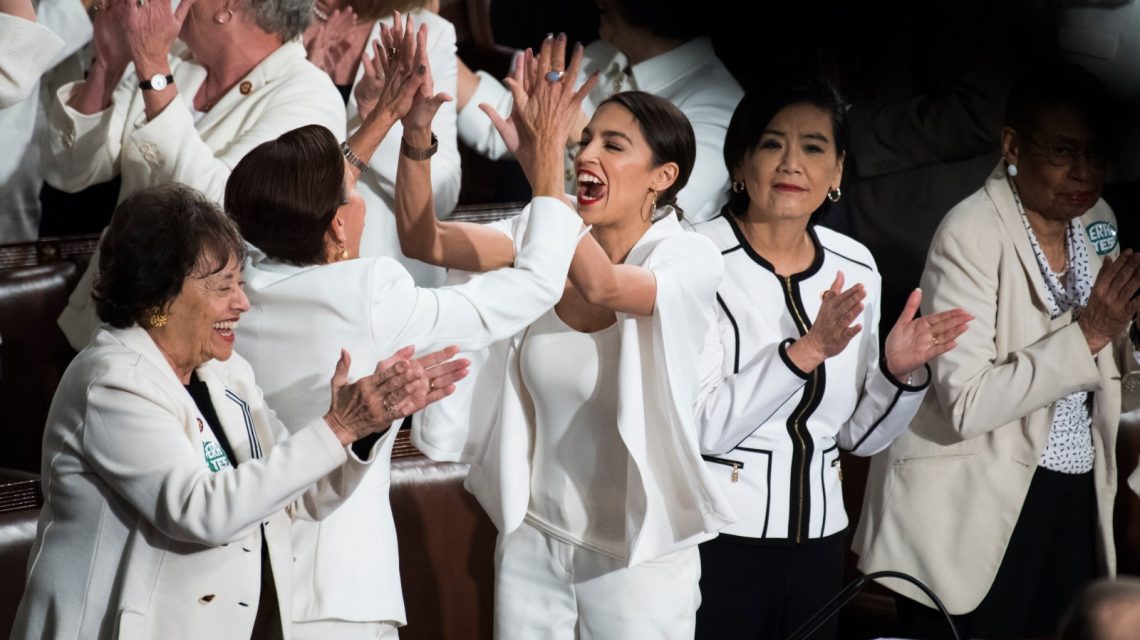
If Walmart sold a Democratic Resistance Starter Kit, it might feature a kaffiyeh, a green abortion-rights bandanna, a pink blazer, and a black T-shirt emblazoned with ‘NO KINGS.’ Batteries not included. Placard sold separately. For the more traditional Democrat, there could be the Heritage Collection: a pristine white pantsuit as a nod to the suffragists.
This is a joke, but barely so. Over the last decade, Democrats have cultivated a highly specific political wardrobe. Activists have ensembles for reproductive rights, Palestinian solidarity, resisting Donald Trump, invoking suffragists, and sometimes managing multiple causes simultaneously.
At the 2024 State of the Union, Representatives Summer Lee, Cori Bush, and Rashida Tlaib wore kaffiyehs to show support for Palestinians. Meanwhile, Democratic women adorned suffragist white to make a statement about reproductive rights. Democratic congresswomen have worn the color during Trump’s first term, including a coordinated sea of white at his 2019 State of the Union. They repeated this approach in 2024 and again in 2026 to protest the SAVE America Act.
In 2022, Democratic members such as Alexandria Ocasio-Cortez, Ilhan Omar, Ayanna Pressley, and Tlaib marched to the Supreme Court wearing green bandannas with the slogan ‘Won’t Back Down’ to challenge the overturning of Roe v. Wade. During Trump’s 2025 address to Congress, Democratic women wore pink. Representative Teresa Leger Fernández explained pink symbolizes power and protest. Nancy Pelosi joined this unified demonstration, while Representative Maxwell Frost donned a black shirt stating ‘NO KINGS LIVE HERE.’ Representative Delia Ramirez wore ‘NO KING. NO COUP.’
June 2020 provided a memorable image many Democrats might wish to forget. Nancy Pelosi, Chuck Schumer, and others kneeled in the Capitol wearing kente cloth stoles after George Floyd’s murder. The kente cloth ties back to Ghanaian culture and royalty, reflecting solidarity intentions. However, the photograph conveyed a more complex message.
Beyond Washington, the uniform concept extends to liberal neighborhoods where the politics are often visible before they are audible. The simple kaffiyeh or protest T-shirt, combined with a bandanna or tote, showcases political stances. This attire offers an ongoing demonstration without a formal protest, highlighting the visual objections: something is wrong, someone is responsible.
Political clothing did not originate with liberals. The MAGA hat can say much about a person’s stance even from afar. This piece of political clothing succeeds by establishing tribal connections—acknowledging identity while proposing ‘Make America Great Again.’ This slogan embodies an affirmative message.
The Democratic apparel, conversely, tends to express opposition:
- Opposition to Trump: Pink.
- Opposition to abortion restrictions: Green.
- Opposition to women’s rights threats: White.
- Opposition to monarchy: NO KINGS.
- Opposition to Israel’s Gaza conduct: Kaffiyeh.
Individually, these items resonate well. But collectively, the Democratic ensemble suggests persistent protest. Such messaging may not resonate with the average American. If clothing conveys belongingness, the Democratic uniform increasingly resembles opposition attire—not as a partisan stance but an identity. This creates a peculiar image for a party aiming to govern.
Protest movements exert pressure externally, but governing parties should display possession of power and a clear agenda. Democrats have honed the aesthetics of demanding power without showing leadership. While addressing worthy causes, the clothing often emphasizes grievances instead of conveying comprehensive political solutions.
Ultimately, Democrats might not necessitate a new dress code. What they need is apparel that symbolizes victory and vision.
 Trump Criticizes Surrogacy Bill at Syracuse Rally
  Exploring the Life and Career of Tyler Zacharia
  Potential 2028 Presidential Candidates Begin Campaigning
  California Voter ID Proposal Sparks Debate
  Nevada Governor Race Heats Up as Election Day Approaches
  Rethinking Child Welfare Policy: A Call for Reform