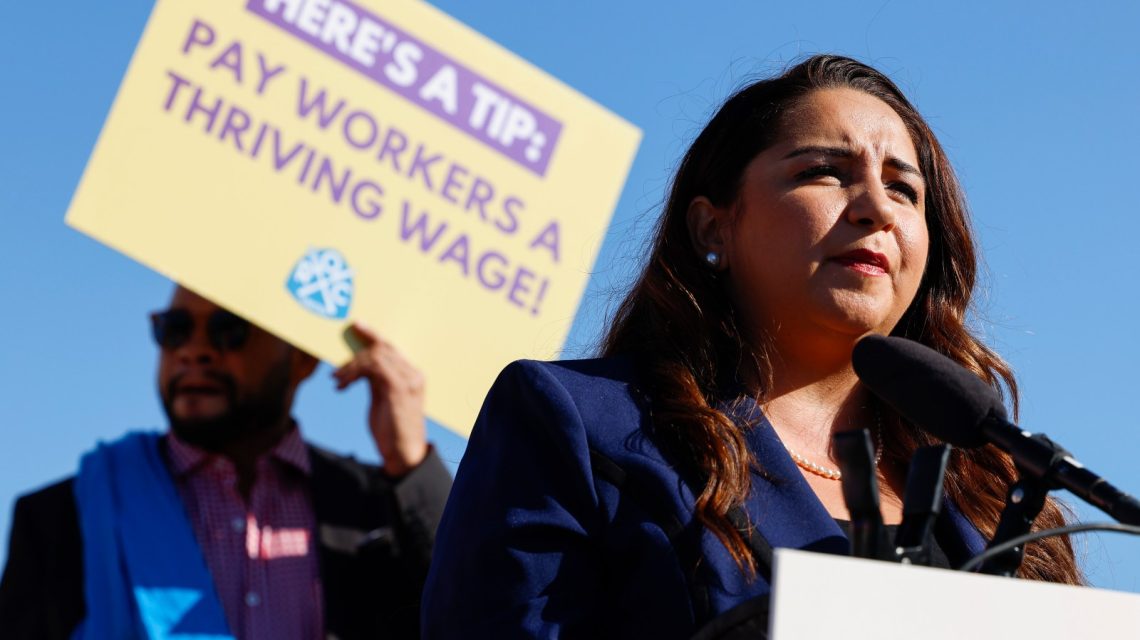
A bill to raise the federal minimum wage to $25 an hour has been in Congress for nearly six months. Lawmakers are facing a narrowing window to advance the proposal before the current legislative session ends. Introduced on April 28 by Illinois Democratic Representative Delia Ramirez, the Living Wage for All Act, or H.R. 8555, seeks to gradually increase the federal minimum wage over the upcoming years. Different deadlines are specified for large and smaller employers.
Introduction and Proponents
Senator Chris Murphy, a Connecticut Democrat, announced in June his intention to introduce a Senate version of the bill. Democratic lawmakers behind this bill describe it as significant legislation addressing America’s current living costs. Since 2009, the federal minimum wage has remained at $7.25 an hour. The bill has been referred to the House Committee on Education and the Workforce but has not yet secured a committee hearing.
Newsweek reached out to Ramirez’s office via email and contacted the House Committee on Education and the Workforce through its website for comments.
Details of the $25 Minimum Wage Bill
The proposed legislation aims to gradually increase the minimum wage to $25 an hour by 2031 for large employers and 2038 for other employers. Large employers, those with at least $1 billion in annual revenue or employing 500 or more workers nationwide, would progressively raise the minimum wage, achieving specific annual targets. Other employers would adopt a slower schedule, adhering to different annual targets.
Once the federal minimum wage aligns with two-thirds of the national median hourly wage, it will automatically adjust annually to maintain the same ratio. The bill also seeks to eliminate lower minimum wages for tipped workers, younger workers, and certain workers with disabilities, eventually aligning them with the standard minimum wage.
Support and Criticism
The House legislation has 32 cosponsors, all Democrats, including Representatives Rashida Tlaib of Michigan, Ro Khanna of California, and Pramila Jayapal of Washington. Representative Ramirez emphasized the need to address both the wage and affordability crises, stating that companies report record earnings while many struggle financially. Labor unions and advocacy groups support the bill, arguing that increasing the minimum wage would help workers better manage living costs.
April Verrett, president of the Service Employees International Union, praised the bill, highlighting its significant step towards recognizing worker demands for fair payment and respect.
However, some experts express concern regarding the economic implications of increased labor costs. A study by the Employment Policies Institute cited by The Daily Signal projected that a $25 federal minimum wage could lead to about five million fewer jobs, with significant impact on the hospitality industry and the 16-24 age group.
Rebekah Paxton, the institute’s research director, warned about potential unaffordability for millions due to such mandates.
Legislative History and Future
Since 2009, the federal minimum wage has remained unchanged, although many states and local jurisdictions have introduced higher rates. As of July 2026, 30 states and the District of Columbia had minimum wages above the federal level. The legislative future of the Living Wage for All Act remains uncertain, as it has not yet been reviewed by a committee. If not approved before the 119th Congress concludes in January 2027, it will need reintroduction in the subsequent Congress.
Contact Newsweek editors for this story: Matthew Cannon and Sam Wilson.
 House Speaker Expresses Concerns Over Live-Stream Execution
  Elon Musk Increases Political Contributions Ahead of Midterms
  ATF Eases Regulatory Burden on Certain Firearm Add-ons
  Survivor of Fort Hood Massacre Questions Livestreaming Execution
  Ohio Senate Race: Candidate Criticizes Misleading Mail Campaign
  President Trump’s Proposed $5,000 Checks