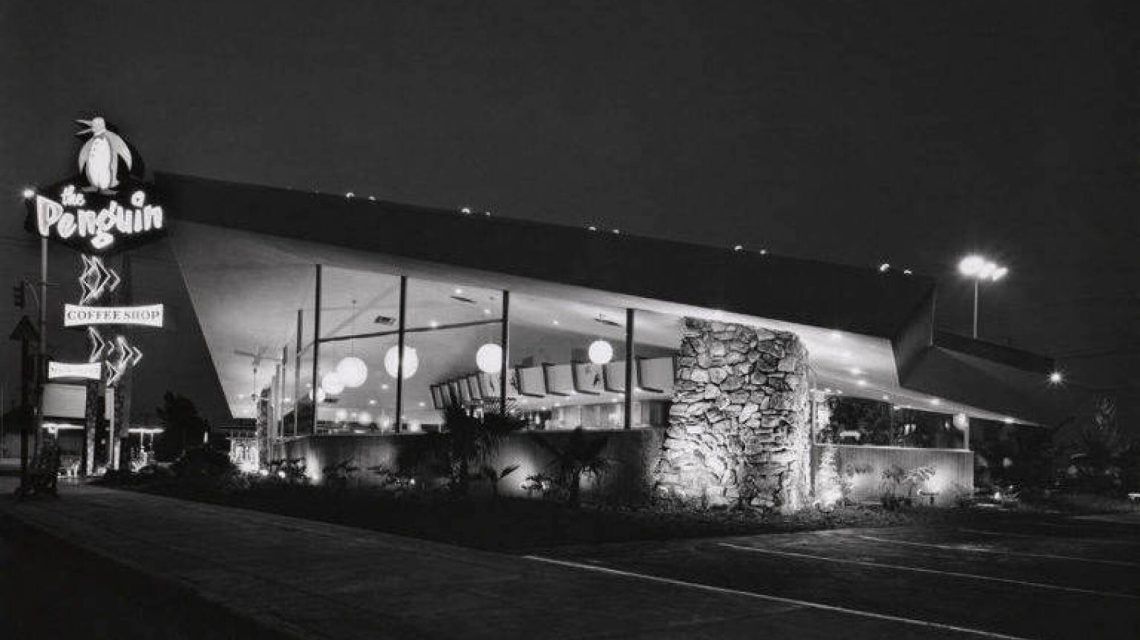
A mid-century building at Lincoln and Olympics boulevards in Santa Monica, known as the terminus of Route 66, faces an uncertain future. Originally home to the Penguin Coffee Shop, it now houses Mel’s Drive-In. The owners have filed initial paperwork to replace the structure with an eight-story apartment building, sparking a preservationist push for its historic designation.
The Santa Monica Landmarks Commission will address this issue on December 14 when the site’s landmark status will be discussed. The Santa Monica Conservancy and the Los Angeles Conservancy advocate for the building’s protection, claiming it represents a significant example of its architectural style in Santa Monica.
Designed by architects Armet & Davis, the building hosted the Penguin Coffee Shop from 1959 to 1991. Nina Fresco, vice president of Santa Monica Conservancy, emphasizes preserving its Googie architecture, stating, “there’s no reason why housing and historic preservation can’t be partners.”
ValueRock Realty, based in Irvine, acquired the property for $6.2 million in 2020. They offered it for sale at $26 million in 2025. Learning of the sale, the Santa Monica and L.A. conservancies put forward a landmark nomination. They raised the nomination fee of $6,800 and gained the support of the L.A. Conservancy.
In September, ValueRock filed an application to replace the building with a development featuring 138 apartments, 123 parking spaces, and retail space. Despite their earlier acknowledgment of the site’s historic value, they indicated no known historic resources exist there.
Fresco noted that city law requires a 75-day wait period after a demolition permit application if a property is over 40 years old. The December hearing offers a temporary reprieve. If landmark status is awarded, the owner can still appeal to the City Council.
Mel’s Drive-In continues to operate, attracting both locals and Route 66 tourists. Manager Marilina Borchio reassures customers worried about demolition, stating, “We’re going to be here until 2029.”
The building’s Googie style features a distinctive slanted roof and large windows. Though it never attracted critical culinary acclaim, it was popular for its quick service and bold design. The Penguin Coffee Shop closed in 1991, later becoming a dentist’s office, and eventually Mel’s in 2016.
Renovation efforts preserved architectural elements like stone and terrazzo flooring, aiming to conform to historic standards. However, Mel’s remains largely unrecognized in major architectural guides.
The National Trust for Historic Preservation awarded a grant for Route 66 centennial signage. Rhys Martin from the Trust emphasized that losing the building would mean erasing an important cultural history.
Fresco hopes for a compromise that integrates historic structures with new housing, similar to other Santa Monica projects. She believes that landmark status would require “doing exactly what they want to do now,” but in a different way.
Route 66, named U.S. Highway 66 in 1926 and extended to Santa Monica in 1935, officially ends at Lincoln and Olympic. Despite its decommissioning in the 1980s, Route 66’s cultural significance continues to attract interest, especially during centennial celebrations.
Architectural historian Alan Hess highlighted Los Angeles’s unique cultural development, suggesting that these buildings deserve serious consideration in that context.
 California Residents Face Challenges from Wildfires and Rising Sea Levels
  Chicago Faces Border Crisis with Growing Migrant Arrivals
  A Woman’s Journey to Breast Cancer Diagnosis and Advocacy
  The Financial and Marketing Challenges in Aspiring to Become a Top Racing Driver
  Michael Jordan’s Iconic Jersey Sets Record Sale
  City Official Killed in Electric Scooter Collision